

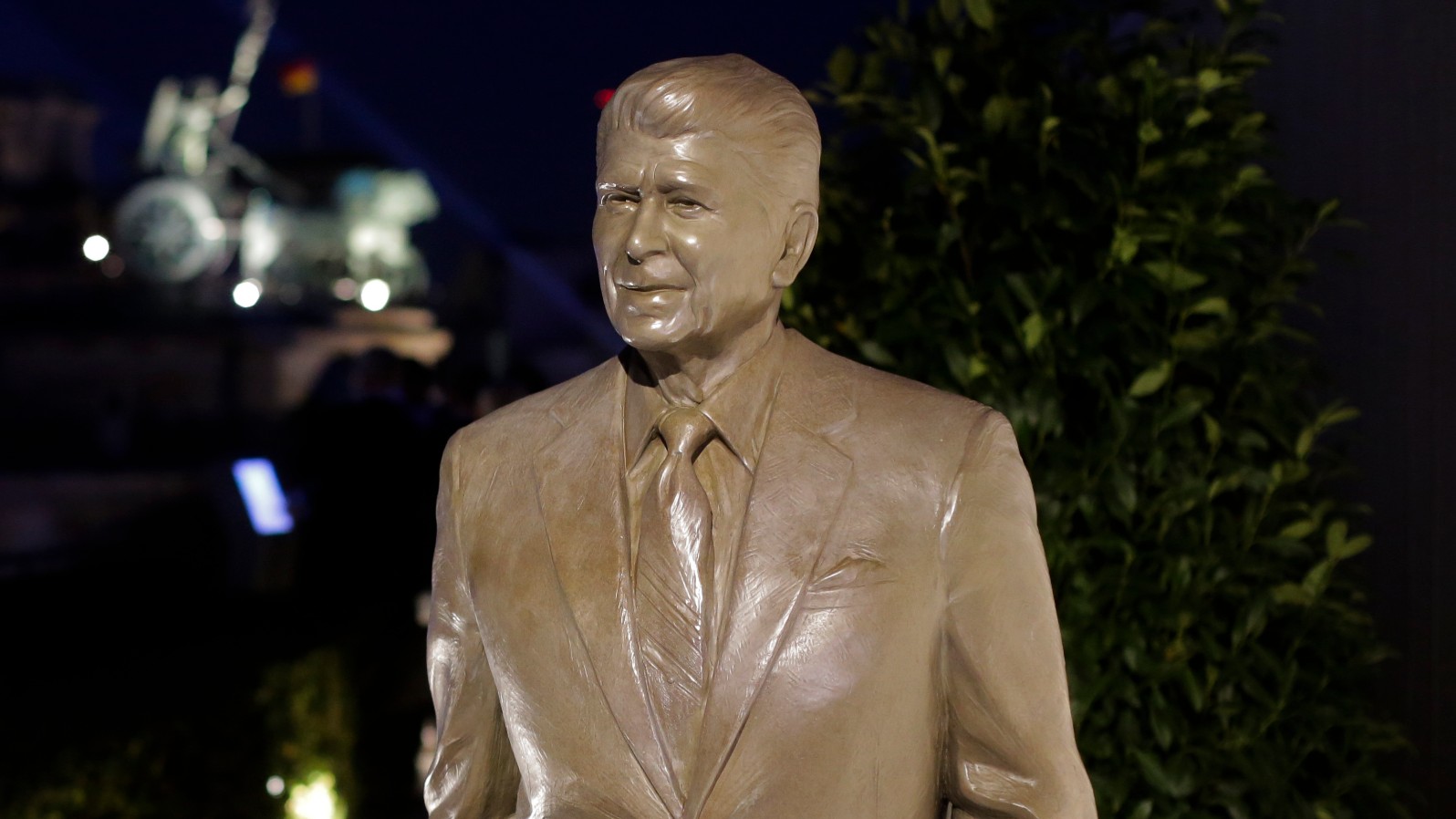
With the impeachment proceedings of President Trump maturing and impeachment on the horizon, Ronald Reagan and his legacy are more important to the American Right now than they have been in a generation.
As a Reagan scholar who has spent weeks at the Reagan Library and Museum, and written a book on the Reagan legacy, I was pleased that the complex survived the recent fires. As the flames engulfed the California landscape, threatening to destroy the physical manifestation of the Reagan legacy, it seemed a sad yet fitting image for the state of the modern American conservative movement and Republican Party. Trump threatens to dismantle the policy platform that Republicans have embraced since 1980.
Recommended Stories


However imperfectly, past Republican administrations have embraced free trade, humane immigration reform, support for international organizations (such as the United Nations and NATO), and an American foreign policy of engagement across the globe. Trump is challenging each of these positions, and in the process, he is remaking the Republican Party in his image.
Thanks to the hard work of firefighters and 500 goats, the Reagan Library was saved. It is unclear whether Reagan conservatism can likewise be rescued. Republicans need to return to the Reagan years, not to forge new myths about the fortieth president, but to relearn the lessons of the 1980s and to revisit some of his greatest achievements.
First, like Trump, Reagan believed in deregulation and tax cuts as a means to revitalize the economy. Combined with Federal Reserve Chairman Paul Volcker’s monetary policies, they led to economic recovery and contributed to sustained economic growth over the next two decades. Unlike Trump, however, Reagan recognized that the budget deficits generated during his administration represented a major threat to America’s fiscal well-being — even if he was unable to address them during his time in office.
Where have all the fiscal hawks gone? After all, there is little to no talk about the $23 trillion debt among the presidential hopefuls, including the Republicans challenging Trump.
President Reagan achieved many policy victories while he was in office. All of them required bipartisan support, and Reagan worked tirelessly to build coalitions for his policy prescriptions. As Reagan is quoted as saying in October 1987, “The person who agrees with you 80 percent of the time is a friend and an ally, not a 20 percent traitor.” To this end, Reagan worked with Democratic House Speaker Tip O’Neill and the Democrats to extend the solvency of Social Security, to close loopholes in the tax code, and to achieve immigration reform in 1986.
Along with enforcement mechanisms, Reagan’s immigration act granted amnesty to almost three million undocumented immigrants. While Reagan wanted to stop illegal immigration, he believed that immigrants were essential to America’s identity and spoke of them in glowing terms. During his final speech as president, Reagan argued that new waves of immigrants were “vital to our future as a nation” and insisted that “if we ever close the door to new Americans, our leadership in the world would soon be lost.” While new immigrants “give more than they receive” and were often “entrepreneurs,” Reagan insisted that their greatest contribution was that “they renew our pride and gratitude in the United States of America.”
Indeed, many of Reagan’s greatest achievements were the product of working across both the political and ideological aisle. Reagan’s signature tax cuts in 1981 were possible because of the support of the boll weevil Democrats, and the 1986 tax reform package was also bipartisan. Most importantly, however, it was Reagan’s willingness to negotiate with General Secretary Mikhail Gorbachev — the leader of the dreaded “Evil Empire” — that eased superpower tensions and cleared the path for a peaceful end to the Cold War.
Reagan’s greatest foreign policy achievement was the signing of the INF Treaty in December 1987. The signing of the treaty marked the first time the two superpowers had agreed to dismantle some (around 5%) of their nuclear arsenals. In signing the treaty, however, Reagan had to go against many in his conservative base. William F. Buckley released an edition of National Review titled “Reagan’s Suicide Pact,” in which the journal denounced the INF Treaty.
Likewise, Howard Phillips, the chairman of the Conservative Caucus, took out a full-page advertisement in the Washington Times. The ad ran under the title “Appeasement is as Unwise in 1988 as in 1938.” Below the headline, there was a picture of Ronald Reagan directly under Neville Chamberlain. Across from their images, Gorbachev appeared directly under the image of Adolf Hitler. Phillips and the Conservative Caucus implored readers in all caps to “HELP US DEFEAT THE REAGAN GORBACHEV INF TREATY.”
Modern-day Republicans and conservatives can learn a great deal from visiting the Reagan Library and Museum. Reagan’s true legacy is that of a pragmatic conservative who was willing to compromise and work with his political and ideological opponents to govern effectively.
The GOP needs Reagan now more than ever. Despite liberal critiques, Reagan represents a more inclusive and optimistic form of conservatism — a conservatism built not on hyper-nationalism or protectionism, but a conservatism grounded in free enterprise and meritocracy. It isn’t too late for the Republican Party once again to be the party of Reagan.
Dr. Marcus Witcher is a Scholar-in-Residence in the History Department and the Arkansas Center for Research in Economics (ACRE) at the University of Central Arkansas. He specializes in political, economic, and intellectual history from 1920 to present. Dr. Witcher’s book Getting Right with Reagan: The Struggle for True Conservatism, 1980-2016, will be released Nov. 29, 2019.
