

As part of a series on Metrorail performance in the Washington, D.C. area, I hoped to conclude with a response from the Washington Metropolitan Area Transit Authority. The only problem: WMATA declined my interview request.
“I can provide you with some information to answer your questions, but with respect to an interview we would decline,” WMATA’s Media Relations Manager Sherri Ly told me in an email.
The questions I would have asked were about improving Metrorail performance in the short and long term. What is Metro doing in the present to cut down on delays, unreliable service and interruptions in rush hour service? Over the next five to 10 years, what is Metro doing to reduce overcrowding and the number of trains that go out of service? Will improvements require fare hikes? I wanted to find out what Metro was doing to fix the problems that plague riders day to day, or at least doing to make sure problems don’t get worse.
The public documents Ly provided show how Metro is making an effort to improve. Still, it’s difficult to trust that Metro’s long-term improvement plans will be successful. Nearly every weekend, Metro cuts service to do maintenance, but weekday performance continues to deteriorate.
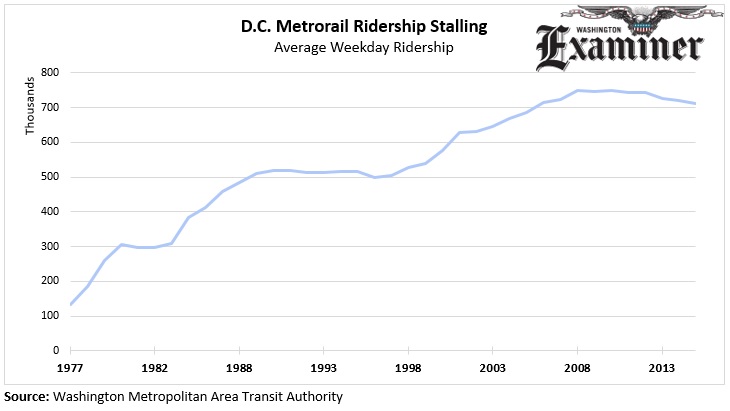
In an October report, Metro acknowledged that unreliable service is a factor in declining ridership numbers. The rise of biking, car-sharing and telecommuting were also cited as factors.
Average weekday ridership has declined the last three years. Even with the addition of the Silver line this year, average weekday ridership dropped by 9,000 riders to its lowest point since 2005.
To improve delayed rail service, Metro hopes to manage train spacing and better maintain its rail infrastructure. Maintenance of rail, however, means more mid-day track work, single tracking and speed reductions. The plan to improve train spacing largely revolves around internal communications during incidents, not during general service.
Nothing in the quarterly report mentioned improving communications with customers. Lack of communication is one of riders’ most frequent complaints.The report measured WMATA performance across 11 metrics. One of those was rail customer satisfaction, but the report made no recommendations on improving communication. When a train is holding at a station and the operator says, “We’ll be holding here momentarily,” riders want to know how long they’ll be holding. How many moments? Should I give up and find a cab or just wait on board?
For fixing trains, Metro plans to raise its number of spare rail cars as brand new trains continue to enter service. During the summer months, however, Metro wants to reduce eight-car trains to six on Mondays and Fridays so cars can undergo maintenance. The lack of eight-car trains is a common complaint among Metro riders frustrated with overcrowded trains. Metro hopes to achieve 100 percent eight-car trains during rush hours by 2021.
Although riders complain, about 95 percent of Metro escalators and elevators were available in the second quarter of 2015, meeting Metro’s goals. Metro plans to replace over one-fifth of the system’s escalators and rehabilitate another fifth.
In the long-term, WMATA has established seven projects it hopes to accomplish by 2025, five of which affect rail customers. This includes construction of a new Blue line connection, with either a second Rosslyn station or new rail track to connect to the rails at the Court House station. Metro is also trying to expand the mezzanines at its core stations and is looking into pedestrian passageways between two pairs of its busy stations.
Metro also acknowledges the need for communications improvements, with new public information signs on platforms, new public address systems and software upgrades. Sadly, there is no mention of better communication between train operators and riders during delays, when it is so desperately needed.
Overall, Metro knows it has problems, and is making efforts to solve them. Still, it’s clear that significant improvement is not coming in the near future, and that efforts to improve service will likely cause more frustrations in the meantime.
With all the ongoing work and continued deterioration of service, riders should be forgiven for not getting their hopes up that Metro will improve anytime soon.
This is the final part of a series on WMATA. Click here for part one, part two and part three.
Jason Russell is a commentary writer for the Washington Examiner.
