
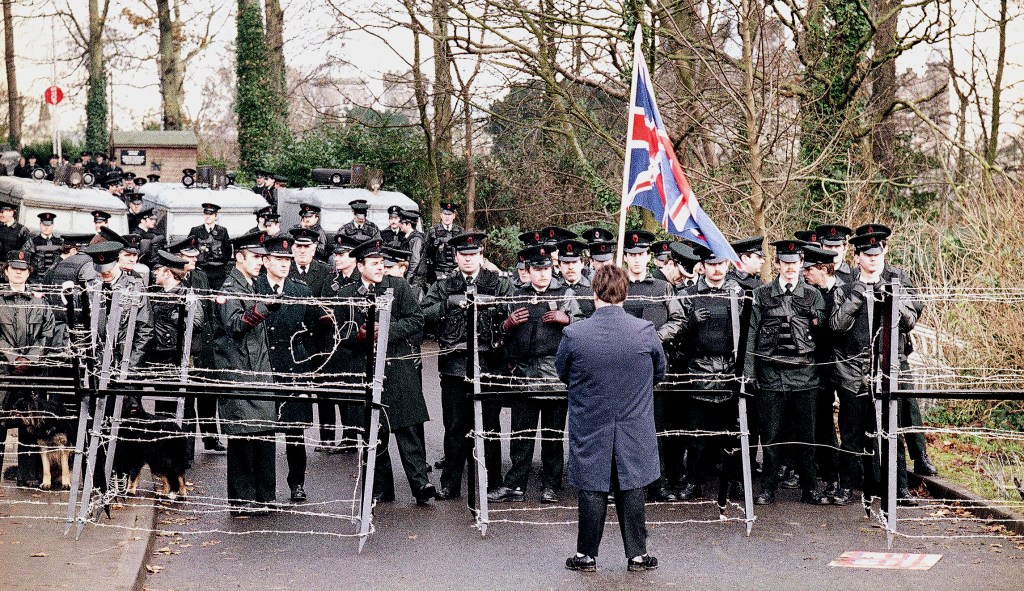
Colin Breen’s A Force Like No Other is a story of courage and decency amid very difficult circumstances.
It’s a collection of experiences from Breen and others who served alongside him in the Royal Ulster Constabulary, Northern Ireland’s police service between 1922-2001. The author’s documenting of RUC officer experiences is primarily focused on “the Troubles” period of sectarian violence in the 1970s and 1980s.
Recommended Stories
While the RUC’s struggle against the Irish Republican Army, the Ulster Defence Association, and other terrorist organizations is a major part of this historical recording, at its core, A Force Like No Other is a story of cops trying to do their best in clearing crimes and getting home alive to do so another day. That last responsibility, getting back home, was no easy task. To serve as a police officer in Northern Ireland in that period was to risk ambushes, snipers, and bombers determined to spill blue blood. Facing this violence, the officers relied on their comradeship and abundant alcohol.
There’s a lot of value to these stories. We learn that even the most dedicated terrorist groups had limits. Capturing a murder suspect, one officer notes that the arrestee’s organization, the UDA, “was glad to see” him caught. The UDA “couldn’t control him and he was killing people on a whim, a psychopath.” The officer continues, “That brings police attention and affects their criminal activity and support from locals.”
We hear how the often poorly equipped officers mitigated their risk of being blown up by bombs hidden in alleyways. The officers would attract dogs with scraps of food and then throw balls in the hope the dog would trigger whatever explosive had been left in wait. These accounts form a brilliant testament to the banality of violence. In one such tale, a police officer finally realizes why his beer was smelling so bad. It wasn’t the beer; it was the fact he had recently returned from a murder scene and had brain matter stuck to his sleeve. The officers loved it: “It’s just the black humor. I suppose it’s a safety net for the people who have to attend these things. They find things funny that other people would be horrified at.”
There’s the unnamed man who traveled from the U.S. to Northern Ireland to exact vengeance on a gang who had killed his brother. He killed those he wanted and then returned to America without a trace. There are also the terrorists who are tracked down after a RUC detective copies a French TV news report that had recorded their culpability. There are criminals caught and criminals who escape.
This is also a history of intelligence tradecraft: of recruiting and running agents inside terrorist and paramilitary groups, and of recognizing that few agents are working for the police for moral reasons. To most, money matters more.
The outcome, however, is moral: “One of the reasons why we managed to negate the loyalist organizations so totally,” one officer explains, “was because the penetration was pretty comprehensive.”
Nevertheless, there’s pride but also a righteous anger in Breen’s book. These officers served their community, while others tore it apart at the altar of criminality and sectarianism. And while the author underplays the collusion between elements of the RUC and loyalist terrorist groups, he convinces us that most officers were professionals doing their job well. For Catholics like Breen, it was an especially dangerous task: “The IRA were quicker to murder Catholic officers to scare others off joining, but that gets happily ignored.”
There are moments of light in this otherwise dark documentation of the overwhelmed good versus outrageous evil. We hear about a young girl from an abusive home who was befriended by a police officer. With his support and time, she managed to escape her hellish early life and now lives happily with her own kids and grandchildren.
How many other saved souls did the RUC deliver? It’s impossible to say. But after reading A Force Like No Other, I suspect it’s a good high number.
