

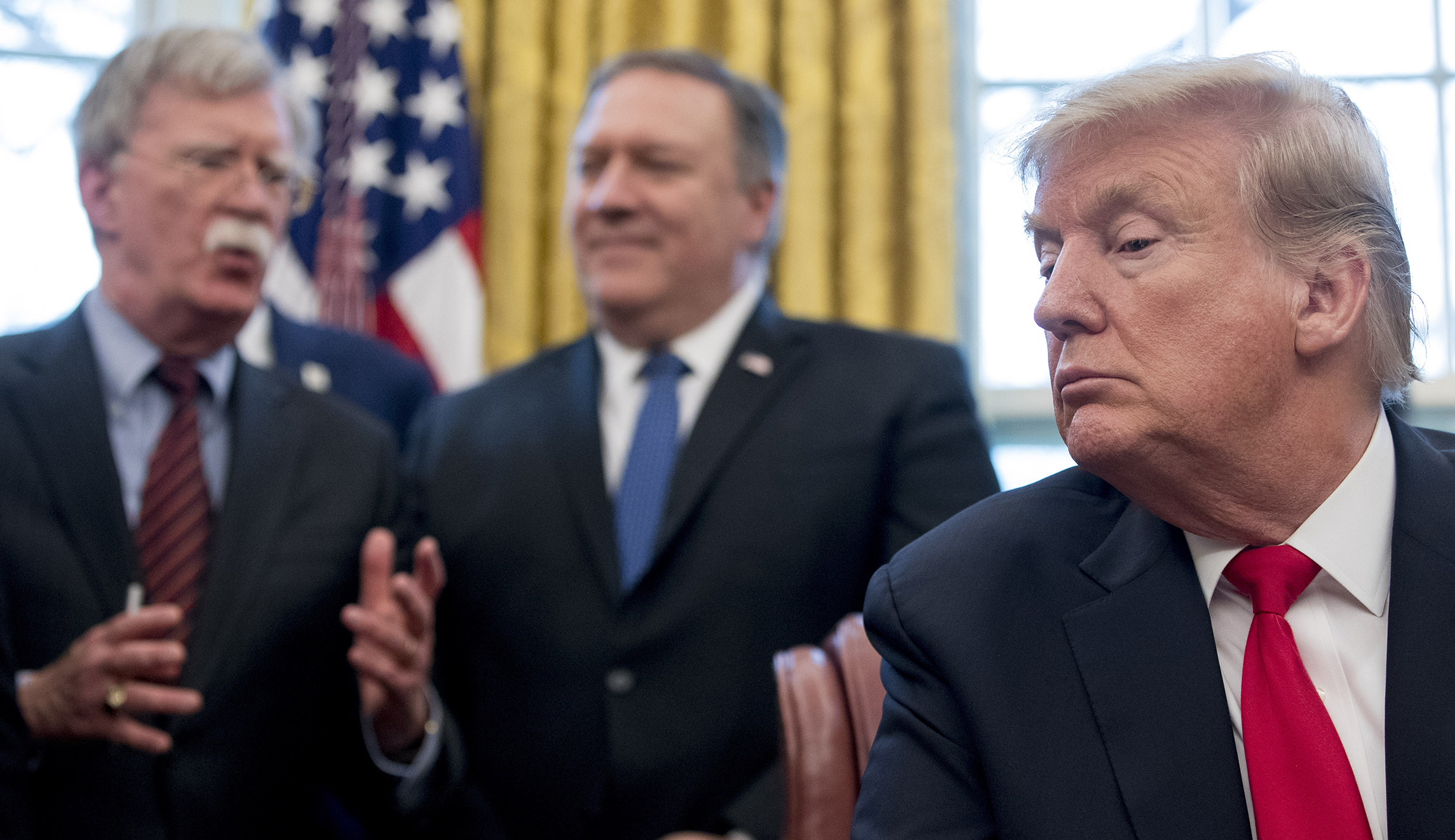
President Trump can seem like a walking contradiction when it comes to war and peace. He loves talking tough, but he’s proven trigger shy. He has surrounded himself with bellicose hawks like John Bolton and Mike Pompeo, but for decades he has sounded philosophically averse to war.
It’s good that Trump can see both sides on the weightiest and deadliest question a president faces. It’s good that he deliberates on the questions of war and peace.
Recommended Stories



It’s not good that he does that deliberation out loud in public. It’s not good that he takes both sides on a single question in a matter of minutes.
We want to keep our adversaries guessing, but we shouldn’t do it by making threats we don’t keep or making decisions from which we back down. Instead, Trump should keep our adversaries like Iran guessing by keeping his own mouth closed.
Teddy Roosevelt’s approach to foreign policy was that the president ought to “speak softly and carry a big stick.” Trump should, when in public, stop speaking about his war plans. His incontinence on Iran has only undermined America’s credibility and arguably emboldened other bad actors such as Russia, China, and North Korea.
Trump probably made the correct decision to not attack Iran on Thursday night. He also went about it in the worst possible way.
After an oil tanker was attacked, and U.S. intelligence pinned the blame on Iran, Trump opted against retaliation. Then Iran shot down a U.S. drone, over international waters according to the official U.S. account. Trump’s first reaction was to give the Iranian government a way out by positing it was a rogue general who shot down our drone.
Iran demolished that explanation, instead justifying the attack by asserting our drone was in Iranian airspace.
Along the way, Trump oscillated between threatening comments at Iran and conciliatory ones. Then he decided to attack Iran, and at the last minute backed down. Finally, he has made this all public, explaining his decisions—his indecision, really — on Twitter and on cable television.
We’re not saying that there were easy decisions here. An attack by Iran deserves a response. The response should be swift, but not impulsive. It should be proportionate, and Trump is right to suggest that taking down an unmanned drone doesn’t call for a mass-casualty counterattack. Our response should weaken Iran, but shouldn’t escalate. After all, a full-blown war with Iran would be a grave error.
Could our generals come up with a target that would weaken Iran’s anti-aircraft capabilities without killing hundreds of troops? Perhaps ratcheting up sanctions would be better than a military strike.
These debates need to happen. But they need not to happen in the open. Diplomacy requires both resolve and discretion. Public waffling allows for neither.
As the commander-in-chief, Trump carries a large enough stick. He should complement that by speaking a lot less, if at all.
