

PITTSBURGH — Gecko Robotics, a western Pennsylvania-based startup located in a miraculously repurposed former shopping mall, announced on Tuesday morning that it has secured a five-year contract with a $71 million ceiling to deploy artificial intelligence and robotics to assess and maintain the health of the assets of the Navy.
Standing in the middle of what was once a bustling Sears Department Store, Jake Loosararian is all smiles about earning this contract and finally being able to do things in the city he loves. Loosararian and Gecko Robotics will help reindustrialize the country’s aging defense system and showcase the intellectual and manufacturing capabilities still thriving in a region renowned for its contributions, not only in building the country, but also its military assets.
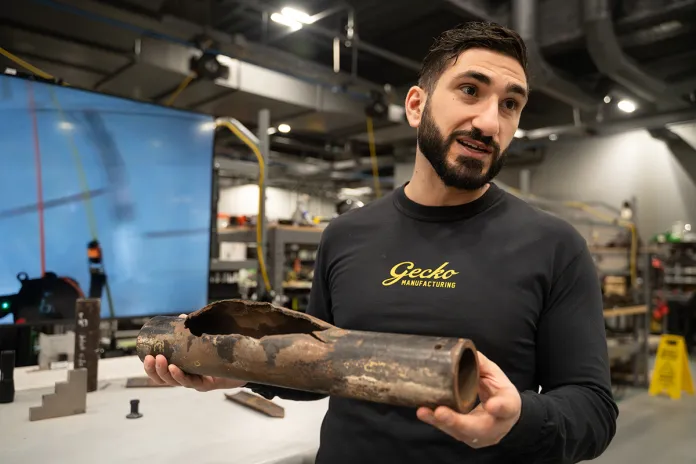
Loosararian said Gecko’s robots have multiple capabilities, including swimming, flying, and scaling critical infrastructure for use in the energy and military sectors. The latter includes robots that use sensors and a camera, which can move the timeline from years and months to a handful of days.
By streamlining production, Gecko will support the Navy’s goal of 80% fleet readiness by next year. The contract is part of the military’s growing reliance on technology startups to modernize complicated and aging systems.
Loosararian explained that moving toward startups such as his is part of a broader shift toward technology, which has typically been limited to software. But what is happening in this massive headquarters, which employs 300, is about far more than software. The robotic capabilities are impressive.
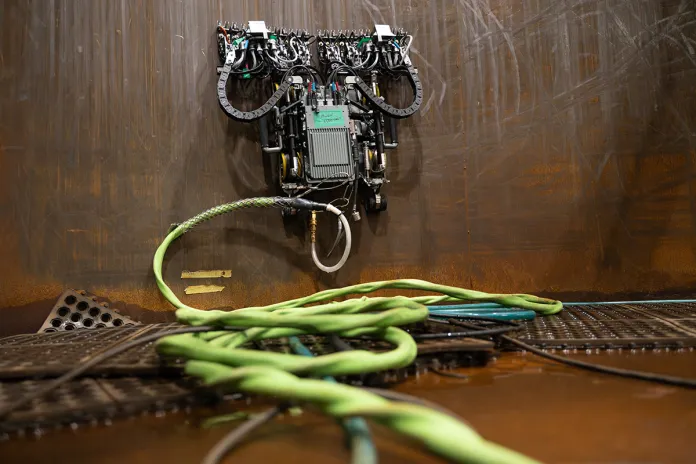
Gecko is definitely not your father’s defense contractor. The company fits the priorities that President Donald Trump outlined when taking office, including restoring U.S. shipbuilding capabilities, as the Navy has fallen behind China‘s.
A walk through Gecko shows technicians, scientists, retired soldiers, and laborers all working on different programs and technologies that provide better safety and efficiency in the mining, manufacturing, and energy businesses. They work on restructuring equipment that has reached its maturity point and finding ways to minimize the time it takes to repair industrial facilities or, in this case, ships.
At one point, there was a robot carefully going over the decking of an aircraft carrier to detect erosion, flaws, or cracks — a safety check that is vital in saving lives and ensuring mission readiness in one of the military’s most hazardous workplaces.
Behind Loosararian is a massive American flag that is draped across the steel girders that run horizontally across the workspace. He said earning the contract provides him with a sense of pride — not vain pride, but the pride of hard work.
“I think the thing to take away from this announcement is that there’s a new prime that’s emerging and it’s in western Pennsylvania and its name is Gecko,” Loosararian said.
OUR CIVILIAN-MILITARY BOND IS CRACKED
“It is a prime focus on technology that helps the warfighter right now,” he said. “It’s focused on actually delivering results towards the 80% readiness that has been the mandate for the Navy to get ships, vessels, and our critical assets that deter conflict and protect our freedoms.”
Gecko, Loosararian said, enables warfighters by bringing the best tools to the fight, ensuring they’re not stuck in dry dock during maintenance cycles that drag on and are over budget and overpriced. Rather, it eliminates the incentives that encourage those kinds of behaviors.
“It’s technology that’s in the hands of the port engineers that they’re clamoring for,” he said. “It’s a bold way to leverage and use AI and robotics in a way that’s advantaged that our adversaries don’t have.”
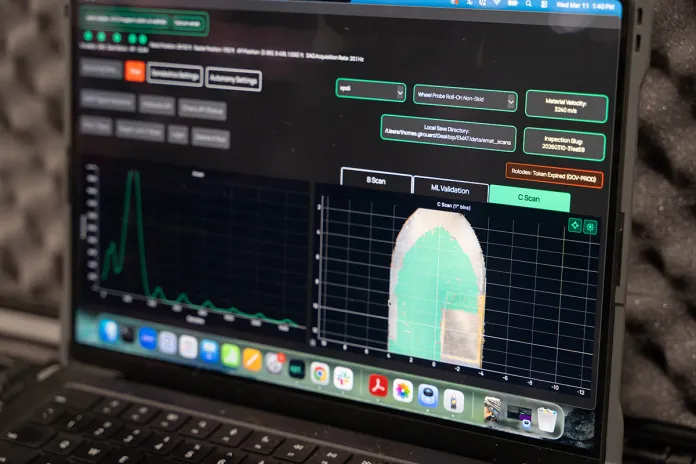
And it comes from a place that is the birthplace of infrastructure on the manufacturing side. A case in point: Some of the steel Gecko uses comes from U.S. Steel, and its technology can be integrated with existing 100-year-old forges.
Loosararian said it is a point of accomplishment to ensure that Gecko reduces the amount of time that destroyers and submarines spend sitting in a dry dock and costing taxpayers millions of dollars.
“Our objective is to arm the warfighter with the best technology and tools to be able to get their jobs done and get them back in the fight, not sitting around,” he said. As for location, when people ask him why western Pennsylvania, his answer is short and simple: “Why not?”
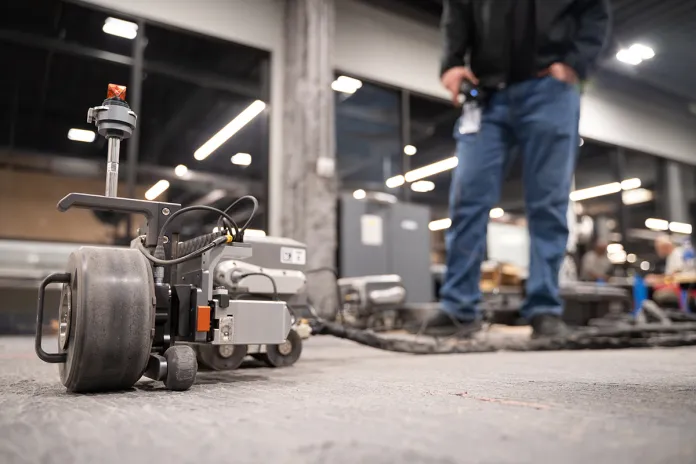
“We want to be carrying the flag and the torch that says Appalachia, and Pittsburgh is the place where the world was built and where industries were forged and that the Industrial Revolution was birthed,” he said. “And we believe that we are the shining example of the new leaders of that industrial evolution.”
Looking out the window of his office are two prime examples of how this place played a role in American history by birthing industry. And it’s not just the skyline of Pittsburgh where he can see the towers of U.S. Steel, PNC Financial, PPG Industries, and Highmark, all examples of both the industrial past and the future in finance and healthcare.
There is also right in front of him the remnant of the Pennsylvania Canal, an aqueduct spanning more than 1,000 miles that was instrumental in connecting this frontier town to Philadelphia, thereby creating the ability to transport people and commerce, a critical factor in Pittsburgh’s industrial boom.
Adjacent to the canal, on its old towpath, are the tracks used by Norfolk Southern, originally the Pennsylvania Railroad, which cemented what the canal began in terms of transporting iron, steel, coal, and commerce coming from this energy-rich region.
When the Allegheny Center Mall was built on this site in the late 1960s, it took away business from the core of the city of Pittsburgh. However, it was a short-lived experiment. By the mid-1980s, it began to decline as people migrated to the suburbs.
By 2015, what was once the center of Allegheny City began a new life as Nova Place, and high-tech industries and data centers, along with Gecko, became part of the new birth of the region.
WHY SUMMER LEE ISN’T DELIVERING FOR PITTSBURGH
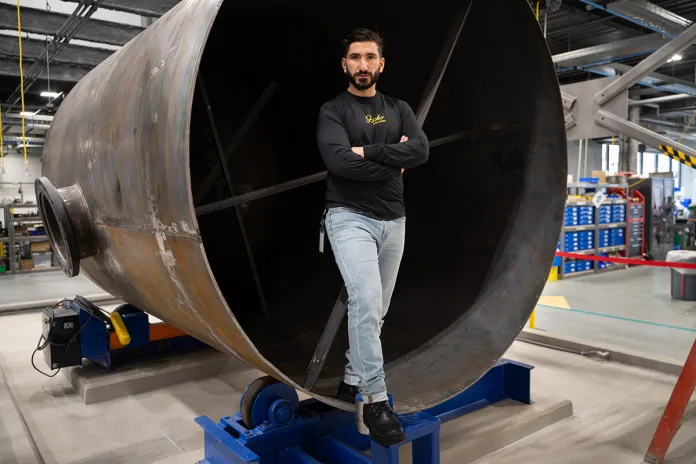
And Loosaraian is part of that rebirth. It wasn’t an easy climb. He admits to failing more often than not, even moving to California briefly because that is where he thought the future of robotics was, before returning and vowing never to give up.
As his wall-climbing robots and sensor data-collecting drones move around the facility, it is impressive to see someone’s idea become a reality.
