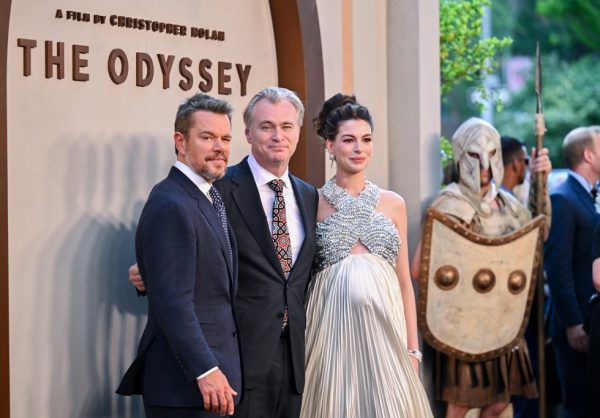
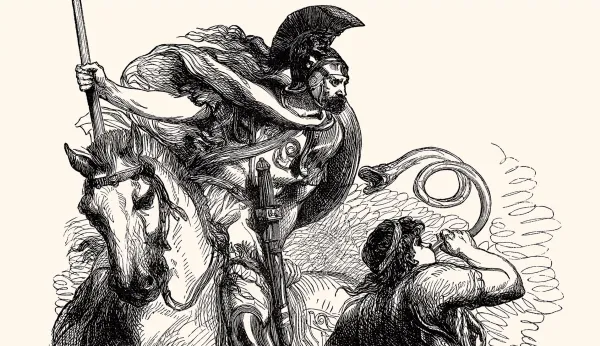
On the basis that there’s no such thing as bad publicity, Christopher Nolan’s movie, The Odyssey, is having a second helping of great notoriety this week. It comes courtesy of an admission from actress Lupita Nyong’o, who conceded that until she was cast to play Helen of Troy, she had never heard of Homer’s great tale of gods and men.
In an interview for a fawning profile in Elle magazine, Nyong’o said, “I really had no idea what The Odyssey was. I was like, ‘Oh snap, I don’t know the first thing about this.’” Although she had performed a few monologues from Greek mythology when she was at Yale drama school, Nyong’o was “unfamiliar with the source material.”
Recommended Stories
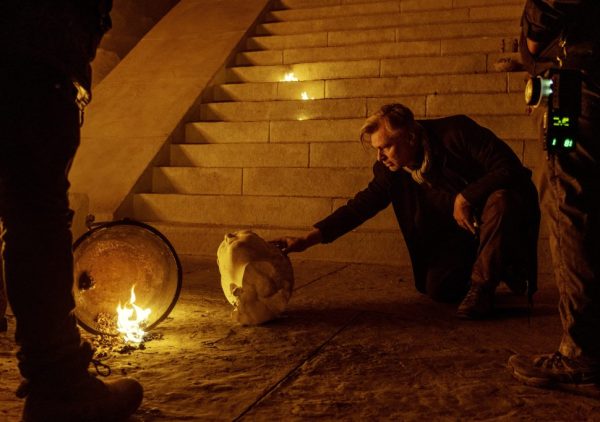
To which the obvious response is, how could someone get into an MA program at Yale while entirely ignorant of the 2,800-year-old epic, a foundational text and one of the cardinal works of classical literature? There was a time when Yale would reject any applicant who could not read, construe, and parse works in Greek and Latin; now it lets in students whose minds the existence of those works has never intruded.
Social media debate over this and other matters about The Odyssey will doubtless help at the box office when the film is released on July 17. But this is not, as noted, the first controversy about the movie, nor even the first one centered on Nyong’o.
As her name suggests, Nyong’o is black. She is beautiful, and her beauty is perhaps capable of launching a thousand ships, as the 16th-century English playwright Christopher Marlowe first said of Helen of Troy. But Helen was not black; Homer repeatedly describes her as “white armed,” a poetic convention emphasizing a paleness of skin prized in aristocratic Greek women.
Those of us who object to the casting of Nyong’o are bluntly dismissed as racists, but even if that epithet, deployed to shut down debate, were not too hackneyed to have any rhetorical force, it would be misplaced. For it is legitimate or necessary on purely artistic grounds to question a casting decision that deliberately repudiates the sensibility of the original artwork.
It does more than that. Anachronistically casting black actors and actresses — yes, I know people want to eradicate the word “actress,” as well — to play the parts of white people taxes credulity. Suspension of disbelief is necessary for any creative drama to work, so a production is undermined by acts of deliberate implausibility. A performance is harder to enter into, less compelling, if the viewer is nagged by questions about issues extrinsic to the drama itself.
Casting black actors and actresses in the roles of people whom circumstances make plain are white, as the Shakespeare Theater Company in Washington recently did with Chekhov’s Uncle Vanya, or as PBS Masterpiece and the BBC did in their otherwise superb adaptation of Hilary Mantel’s Wolf Hall by putting black noblemen and ladies in the court of Henry VIII, is a political decision, not an artistic one. This turns art into propaganda. When the modern obsession with race extends this far into creative work, it is as baneful in effect as was the Soviet preoccupation with class.
If the problem were only that isolated productions were marred, one might think, so what? Botched productions might be assumed to damage only themselves and matter little. But that is not the case
For there is a further and deeper concern over both the casting of Nyong’o as Helen and over her ignorance of the work in which she is a star. These two problems are facets of the same phenomenon, which is the deliberate and systematic expunging of our culture and of the great inheritance of learning and sensibility bequeathed to us by our civilization. The movement mislabeled “progressive” is everywhere cutting off the roots of the culture from which we spring.
It is determined to alter our understanding of our history and annihilate at least some parts of it. This reminds one of the quip about Marxism that while its glorious future is fixed and certain, its past has to keep being changed. An example was the repeated doctoring of photos in Stalin’s Russia to remove images of people suddenly unacceptable to the tyrant.
We laugh at such clumsy falsifications, but we are now doing the same thing ourselves. Progressives, imbued with arrogant presentism, work every day to wipe the past clean of its messy truth on race, class, and gender. It’s why, for example, they present slavery as a sin that uniquely and forever damns the West, not truthfully as an institution practiced by all humanity since prehistory until the peoples of the West fought successfully to end it. It makes the European people of the West the villains of a fictional past, when they were, on that issue, the belated heroes.
Without our literature and our learning, we are cut off from the truth of our past. We become ignorant not merely that Homer wrote The Odyssey. Gradually, perhaps quickly, the threads of human activity and creativity that made us who we are frayed and snap.
In her recent collection of essays, “Good Bones,” literary critic Brooke Allen wrote that “just as that invention [of the printing press] turned the Western world into a literary society, so we are now transitioning to a post-literate one.” If learning is shrugged off, if literature is sidelined, we will become a people who can be shaped and molded into what the Left-dominated universities, movies, TV, and entertainers prefer that we should be.
Christopher Nolan defended casting a Black actress as Helen of Troy by saying he “wanted to nod towards the idea that this story has been handed down as oral poetry, which is analogous to rap.” Nyong’o shrugged off the controversy, noting that The Odyssey is, after all, a myth.
CHRISTENDOM AT WAR WITH ITSELF
They and countless others are creating false new collective memories to displace our knowledge of the truth. If or when our literary society has been conquered by the illiterate one, we will no longer have the mental equipment, nor the institutions to recognize the truth. We will accept lies of the type evoked by George Orwell in his novel 1984 when he wrote that as “Oceana was at war with Eurasia; therefore Oceana had always been at war with Eurasia.”
False new truths will be accepted. As the West is multicultural; therefore it has always been multicultural.