

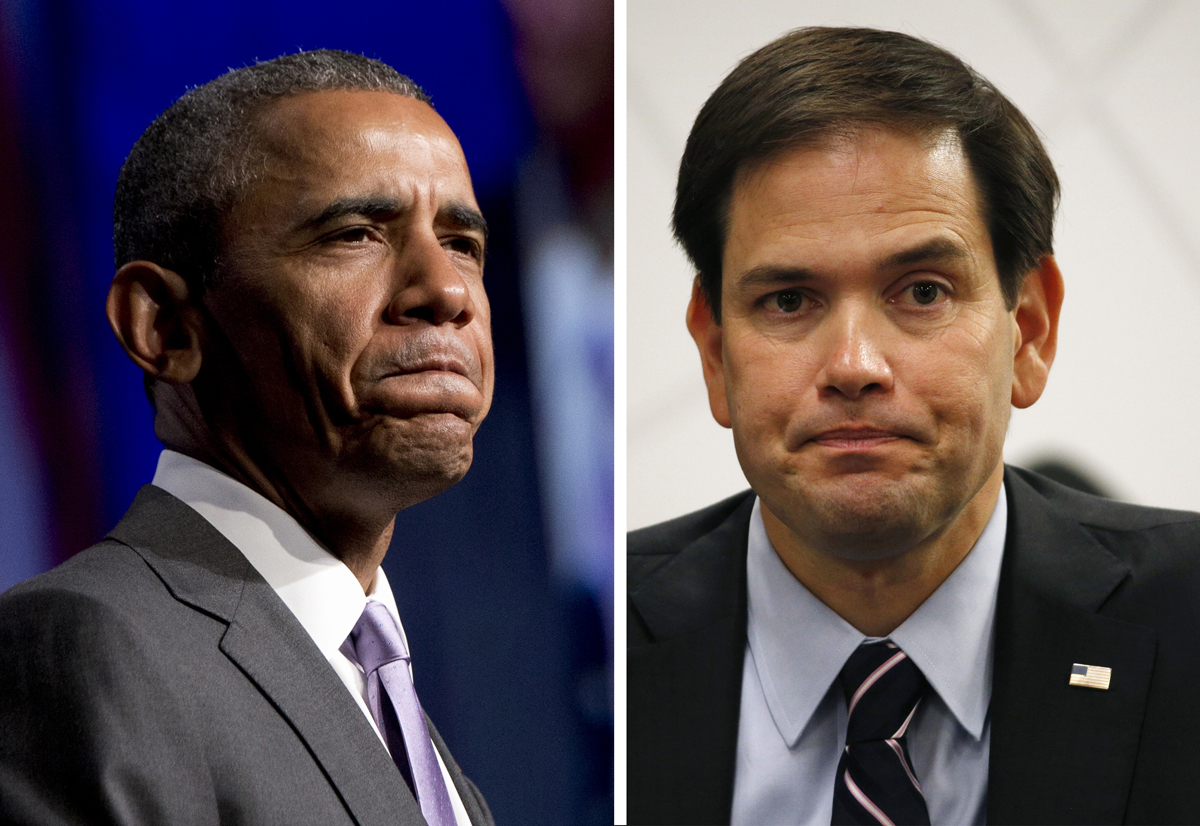
The New York Times runs with a somewhat puzzling hit piece on Marco Rubio’s financial problems. The thing is, yes, there’s a story here, and it deserves to be written, but — where have you guys been for the last eight years?
It’s instructive to compare the Times’ descriptions of Rubio’s finances as of 2015 with what we know about President Obama’s finances as of 2007.
Recommended Stories



Houses:
NYT on Rubio: “Then, by the end of 2005, the Rubios completed the purchase of a new home, twice the size of their previous one, for $550,000. The house, among the more expensive in West Miami, stood out from the aging homes nearby: It includes an in-ground pool, a handsome brick driveway, meticulously manicured shrubs and oversize windows.”
Obama: Also in 2005, the new Sen. Obama bought a mansion in Hyde Park for $1.65 million. He might have had to pay significantly more than that, because the seller insisted on selling the house along with an undeveloped adjacent lot, and wasn’t willing to sell just one. But Tony Rezko (now a federal prisoner who paid cash bribes to another prominent Illinois politician) agreed at that same time to buy that undeveloped lot from the same seller for more than $600,000. So Obama’s purchase at the price he bid was made possible.
Book deals:
NYT on Rubio: In discussing his financial problems, the Times notes: “[I]n 2012, financial salvation seemed to have arrived: A publisher paid him $800,000 to write a book about growing up as the son of Cuban immigrants.” The report adds that Rubio splurged and bought an $80,000 speedboat, implying that he’s a bit of a spendthrift.
Obama: Around the time of his election, he got a seven-figure, three-book deal with Random House, with a $1.9 million advance on the first book, The Audacity of Hope. Obama scheduled the signing to take place just before he was sworn in to the U.S. Senate and after he had resigned from the Illinois Senate. Smart choice — if he had waited longer, he would have had to comply with U.S. Senate ethics rules on book advances. No doubt he’s earned out his advance by now, but it would have been a hassle — and no one foresaw him becoming president at the time.
Overall financial situation:
Rubio: “Shortly before running for the Senate, Mr. Rubio agreed to teach at Florida International University, for $69,000 a year (the salary was later reduced).”
Obama: He also had a teaching position at a local university (for $39,000 a year — so Rubio wins this one).
Overall Financial situation
Rubio: “[I]t was clear that Mr. Rubio’s finances were stretched.” The Times notes that Rubio took the teaching job because he needed the money.
Obama: Obama needed money, too — and he is quite open about his financial problems in The Audacity of Hope. He includes an anecdote from the 2000 Democratic convention in Los Angeles, where his credit card was declined for a car rental. He notes that his state senator salary was modest ($58,000 as of 2000), and that the obligations of family required him to find other income.
Luckily, state Sen. Obama found a cash cow aside from his teaching post. A businessman named Robert Blackwell, Jr. put Obama (who is also an attorney) on retainer for $8,000 per month at the same time Obama was serving in the Illinois legislature. Meanwhile, in his capacity as a state senator, Obama wrote a letter that helped his legal client, Blackwell’s company, get its first state grant out of what would ultimately be $320,000 — or a bit less than three times the total sum that Blackwell ended up paying Obama.
Blackwell also co-hired Obama’s state Senate staffer — again, somehow this was legal — who did part of the work helping him get the state grants. Blackwell also contributed a lot of money to Obama’s campaigns over the years.
Of course, it is better known that when Obama was elected to the Senate, his wife also received a promotion and a substantial raise from her employer, the University of Chicago Medical Center. (After Obama was elected president, she left the job and was not replaced.) Around the same time as she was promoted, she was also named to a paid position on the corporate board of a Walmart supplier and — well, you get the picture.
So anyway, it’s fair to dig into candidates’ finances. But not all candidates get treated the same way.
