

On Friday night, as Jews will gather to commemorate their liberation from captivity in Egypt, there’s one line during the traditional Seder that will sadly have more resonance this year than at any point in my life: “It is not only one that has risen up against us to destroy us; rather, in every generation, they rise against us to annihilate us.”
Growing up Jewish in modern America means feeling more secure than Jews have felt at any point in our history. I never experienced much in the way of anti-Jewish sentiment as a child. Tales of the Holocaust were always haunting, but I never feared anything like that could happen again, especially in America.
Recommended Stories


The existence of anti-Semitism seemed so distant, that it was even something to laugh at, as in the paranoia displayed by Alvy Singer, the protagonist of Woody Allen’s “Annie Hall.” In one famous scene, Singer recounts a lunch in which he asks his companions if they’ve eaten yet and they respond, “not did you eat, but Jew eat?”
Events of the past year — culminating with Thursday’s capitulation to a radical Islamic regime seeking the tools to exterminate Israel — have unfortunately forced those Jews who are willing to face reality to recognize that we’re still in the crosshairs.
Last summer, as Israel defended itself against terrorists who were launching rockets at its major population centers and trying to use tunnels to mass murder civilians, the global media portrayed Jews as the aggressors.
Throughout Europe, attacks on Jews have become so widespread that anti-Semites have stopped bothering to disguise their hatred merely as an expression of criticism of Israeli policies. When people target a synagogue or a kosher market, they aren’t making a statement about Palestinian olive trees — they are trying to hurt or kill Jews. This week, Haaretz reported that, “An insurance company has refused to renew the policy of a Jewish kindergarten in Brussels, claiming that the risk of doing so is too high, given the clear threat of anti-Semitic attacks.”
Even in the United States, where pro-Israel sentiment remains high — especially among Evangelical Christians — the movement to boycott Israel has infiltrated college campuses. At the same time, there are disturbing reports of anti-Semitism that cannot be reasonably classified as disagreement with Israeli policy.
At U.C.L.A. recently, a supposed bastion of liberal tolerance, a nominee for the schools student judicial board was interrogated because of her religion. “Given that you are a Jewish student and very active in the Jewish community,” she was asked, “how do you see yourself being able to maintain an unbiased view?” After the nominee left the room, the council spent 40 minutes discussing whether her Judaism would allow her to be fair.
But by far the greatest threat to Jews comes in the form of a “framework” that the U.S. struck that, if implemented, would pave the way for nuclear weapons to be in the hands of radicals who are determined to complete another Holocaust.
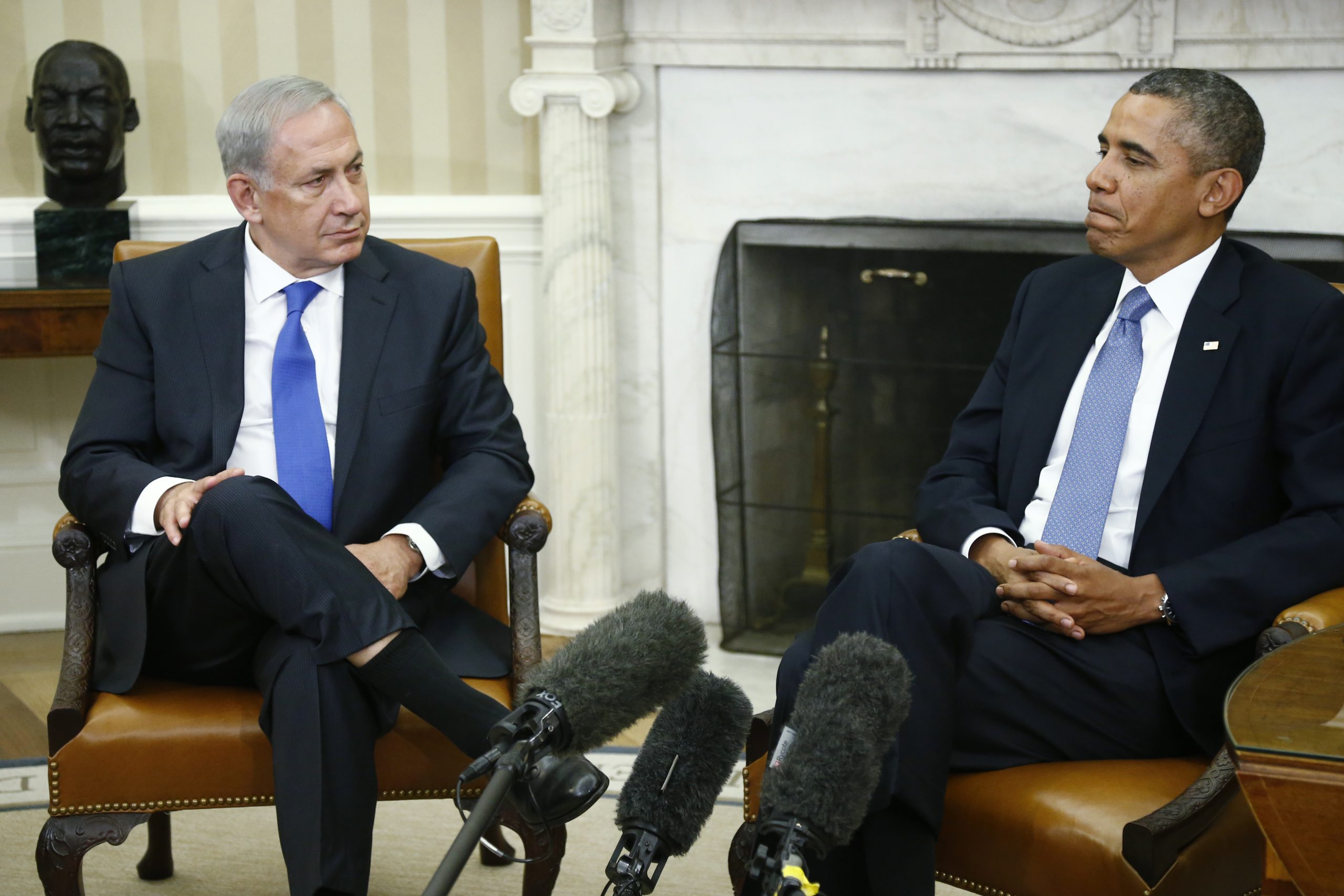
As President Obama has governed with an increasingly hostile tone toward Israel, he has dedicated his administration to elevating the status of a country that has for decades been an enemy of the United States and the leading state sponsor of terrorism.
Deliberately misinterpreted pre-election comments by the leader of Israel are used as a pretext to reassess the U.S.-Israel relationship, and yet calls by the leader of Iran for “Death to America” are met with more concessions at the negotiating table.
Under the preliminary framework released on Thursday, Iran — which originally wasn’t supposed to be enriching uranium, then was supposed to be limited to 1,500 centrifuges — will now be granted international recognition for over 6,000 centrifuges. Fordo, a nuclear facility built underneath a mountain, will remain open. For peaceful research purposes, we’re told, because typically peaceful programs need to be built under mountains.
“If Iran cheats, the world will know it,” Obama said in making the case for the framework. But the question isn’t whether the world will know, the question is: What will the world do? For decades dating back to the 1980s, Iran has cheated on nuclear agreements, financed terrorism, jailed journalists, oppressed its people, threatened other countries, and yet it’s being welcomed into the international community.
More specifically, what is Obama going to do if Iran cheats? He drew a red line on the use of chemical weapons by Syria, and not only did he ignore it, but his Secretary of State John Kerry has said the U.S. will have to negotiate with dictator and war criminal Bashar Assad.
Iran’s Supreme Leader Ayatollah Ali Khamenei, who has become Obama’s pen pal, has referred to Israel as a “cancerous tumor that should be cut and will be cut” within the context of seeking a nuclear weapon. Now, thanks to Obama, it’s much more likely that Khamenei will be able to follow through on his threat.
Some would argue that this is just a problem Israel to deal with on its own. Even putting aside the threat that a nuclear Iran poses to America, it’s important to recognize that Obama has made it a lot more difficult for Israel to act unilaterally. During his first term, Obama pressured Israeli Prime Minister Benjamin Netanyahu not to act while promising “we’ve got Israel’s back.”
In his second term, however, anonymous administration officials said Netanyahu was a “chickenshit” and “coward” for listening to Obama instead of acting when he had the chance. “It’s too late for him to do anything,” a senior administration official told Jeffrey Goldberg in the Atlantic last fall. “Two, three years ago, this was a possibility. But ultimately he couldn’t bring himself to pull the trigger. It was a combination of our pressure and his own unwillingness to do anything dramatic. Now it’s too late.”
Even if it isn’t too late for Israel to act militarily, a deal signed by Iran with all the world’s major powers including the United States would make the diplomatic cost of a unilateral Israeli action that much greater.
Israel is a small country to begin with, and 44 percent of the population lives within the Tel Aviv metropolitan area. This tiny area is home to about 3 million Jews, or more than one-fifth of the world’s Jewish population. Make no mistake, an Iranian nuclear weapon is a clear existential threat.
This is the harrowing reality that Jews will be confronting when they sit down to celebrate Passover Friday evening. But there is a silver lining, which is the second part of phrase I quoted at the outset.
“It is not only one that has risen up against us to destroy us; rather, in every generation, they rise against us to annihilate us,” the line starts. Then it continues, “But the Holy One blessed be He saves us from their hand.”
Ultimately, Passover reminds us that the story of Judaism isn’t one of victimhood, but of survival — and of defeat for those who seek our destruction. And so even as I contemplate the dark days ahead, I can rest assured that the Jewish people will be here a lot longer than the so-called Islamic Republic of Iran.
