

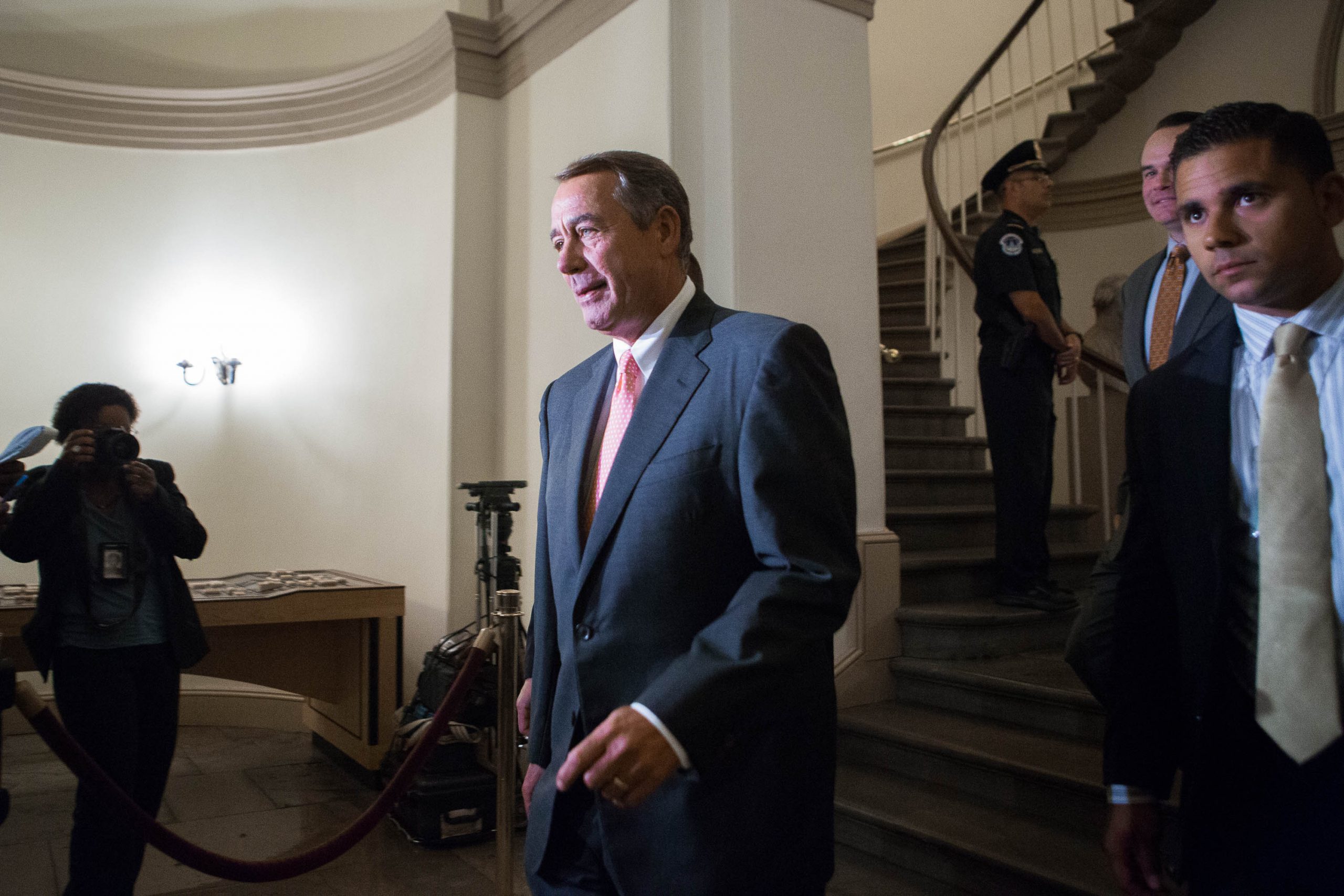
Having finally brought a Pope to address Congress after decades of trying, John Boehner called it quits Friday as speaker of the House.
That crowning achievement was, of course, not the only reason he decided to head for the exit. By his own account, Boehner overstayed his intended tenure and would have stepped down sooner but for the unexpected primary loss last year by former House Majority Leader Eric Cantor, R-Va., who could have been expected to step into his shoes.
Recommended Stories


But Boehner, who has had an especially difficult tenure, was also staring down the barrel of another government shutdown, a battle he was eager to avoid. His resignation announcement has not only spared him that grueling experience, but also averted that shutdown for everyone, at least for now.
Boehner’s tenure has been viewed with suspicion by many conservatives, and it has coincided with a general loss of faith in the party’s leadership. Even so, right wingers give him an undeservedly bad rap. As a Republican speaker with a Democratic president, he never had a chance to do several of the things they clamored for him to do. Sometimes his most critical Republican colleagues’ demands that he get rid of Obamacare or, more recently, defund Planned Parenthood, have suggested a fundamental failure to grasp the mechanics of the system of government in which they work.
Boehner was not in a position to enact a sweeping, positive agenda. It could not have progressed through the narrowly divided Senate, let alone of overridden President Obama’s inevitable veto.
The best accomplishments Boehner could hope for were mostly defensive and negative. The beginning of the his speakership marked the end of Obama’s legislative agenda, although sadly the president took this as a cue to exceed his proper powers and bypass Congress, governing by fiat.
Boehner also presided over the decision to put fiscal sequestration in place, which has resulted, painfully but needfully, in the largest federal spending reductions in decades.
Boehner’s speakership also gave conservatives in the House much greater influence and freedom than they had enjoyed previously, and they often used it against him. A comparison to the era when Republican former Rep. Dennis Hastert was speaker is illuminating. In those days, conservatives who dared defy the leadership even on minor amendment votes were routinely punished with the loss of pork for their districts.
Boehner’s decision to eliminate earmarks, one of his best and most critical decisions as speaker, stripped him of that form of discipline. As a result, only far more serious acts of disloyalty, such as floor votes against rules or votes against the party’s choice for speaker, were punished, and with more serious penalties such as the loss of chairmanships or coveted committee assignments.
Boehner’s biggest problems in his dealings with his right flank arose from something over which he had no control, his party’s minority status in the Senate prior to this year. During the Senate-initiated government shutdown of 2013, Boehner played along with conservative attempts to defund Obamacare as long as he could. But in the absence of any endgame that led to a win, and lacking any serious counter-threat to make against Obama (who was more than happy to keep the government closed as long as he had to), Boehner never had much of a choice about whether he could capitulate in the end.
In the time since Republicans retook the Senate, Boehner has come under fire for failing to put enough pressure on Obama. The criticism might be valid to some extent, but he was not the dealt the cards for a winning hand.
Some conservatives have reacted to Boehner’s exit with unattractive jubilation. They may have an opportunity to replace him with someone more sympathetic to their cause. But they should remember that their outgoing leader was also a conservative and they would do well to recall the truth of the old maxim that politics is the art of the possible. Whoever becomes the next speaker and whatever his personal ideology, he will not find the job easy. He will be tempted immediately to restore the tools that earlier and even more conservative leaders used to suppress dissent.
Boehner did his job well, and with the sort of patience that conservatives may not appreciate until he is gone.
