

A House Appropriations panel last week chose just the right pay rise for lawmakers: zero.
The Legislative Branch Subcommittee, chaired by Rep. Tom Graves, R-Ga., did not save taxpayers much money by stopping a pay increase that would otherwise have taken effect automatically. But it set an important example at a time when many families across the nation are struggling.
Accepting this is not to imply that working in Congress is easy, or that those who do so are not, most of them, fairly impressive and capable people.
But with jobs increasingly scarce for people of working age, and with most pay frozen in real terms for years now, Americans are increasingly convinced that the system is rigged against them. Hence the rise of Donald Trump and Bernie Sanders, clear evidence that this belief is shared across the ideological spectrum.
It is important for politicians to adapt to the time in which they live, and to absorb and accept that the national mood today is not one favoring largesse for lawmakers.
For many years, Congress has been exceedingly unpopular. Its 17 percent approval rating, while not quite its worst of the past 10 years, is less than half of what it typically was during the Clinton and Bush presidencies, even when the House was impeaching the former.
Members of Congress work hard. In addition to their legislative and committee duties, they have to strive for reelection. But they are still already among the world’s highest paid legislators, and their jobs are among the best paid in America. They get $174,000 a year. This puts them roughly on par with dentists and pediatricians, according to the Bureau of Labor Statistics, but they don’t have heavy loans to pay back from medical school.
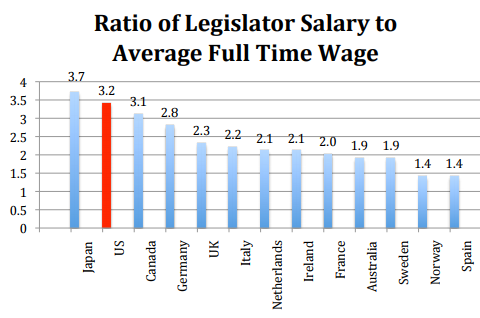
The average full-time worker makes $55,000. Congressmen and senators make 3.2 times that, plus a health and retirement package far better than what most workers get. According to a 2014 study by the Taxpayers Protection Alliance, Japan is the only nation in the industrialized world that pays legislators in greater disproportion to the population they govern.
The concern that members of Congress most often air when arguing for higher pay is that they must maintain two homes, one in Washington and another in their district. But it’s not up to taxpayers to make sure they have two complete households. Congress members can set up and live in Washington and frequently visit home. Or they can set up in their home state but rent modest accomodations in Washington.
They need only one place to live; the other is just a place to stay. Rents are higher than average in Washington, but the current salary should suffice. Members of Congress from both parties have made this work for some time, often by sharing apartments together on Capitol Hill to cut costs.
In ancient Athens, prominent citizens rose to leadership positions by spending large amounts of their own money on public works. No one should expect that from today’s lawmakers, but neither should people get into lawmaking with either the aim or the expectation of making money. Politicians like to boast about their “public service,” and it needs to be more than a boast. Service involves sacrifice. Congress should be approached as if it were the Peace Corps, but a version where everyone wears suits and ties and has a legislative staff.
Many in Congress are lawyers, doctors and other professionals who could make more money elsewhere. But they choose politics, and their time in Congress should not be viewed as a wealth-building period in their lives. Governing the country is an immense privilege, and it should be undertaken by those ready to take the rough with the smooth. That means long hours, time away from family, and, appropriately, modest financial sacrifice, too.
In an era when Donald Trump and Bernie Sanders are finding huge support, members of Congress must understand that many members of the public would rather throw them out of office than pay them more to stay in it. The voters who hired them have not been getting pay raises now for several years.
In light of that and of the nature and character of public service, the House and Senate would do well to follow the lead of the subcommittee and keep congressional salaries where they are.
