

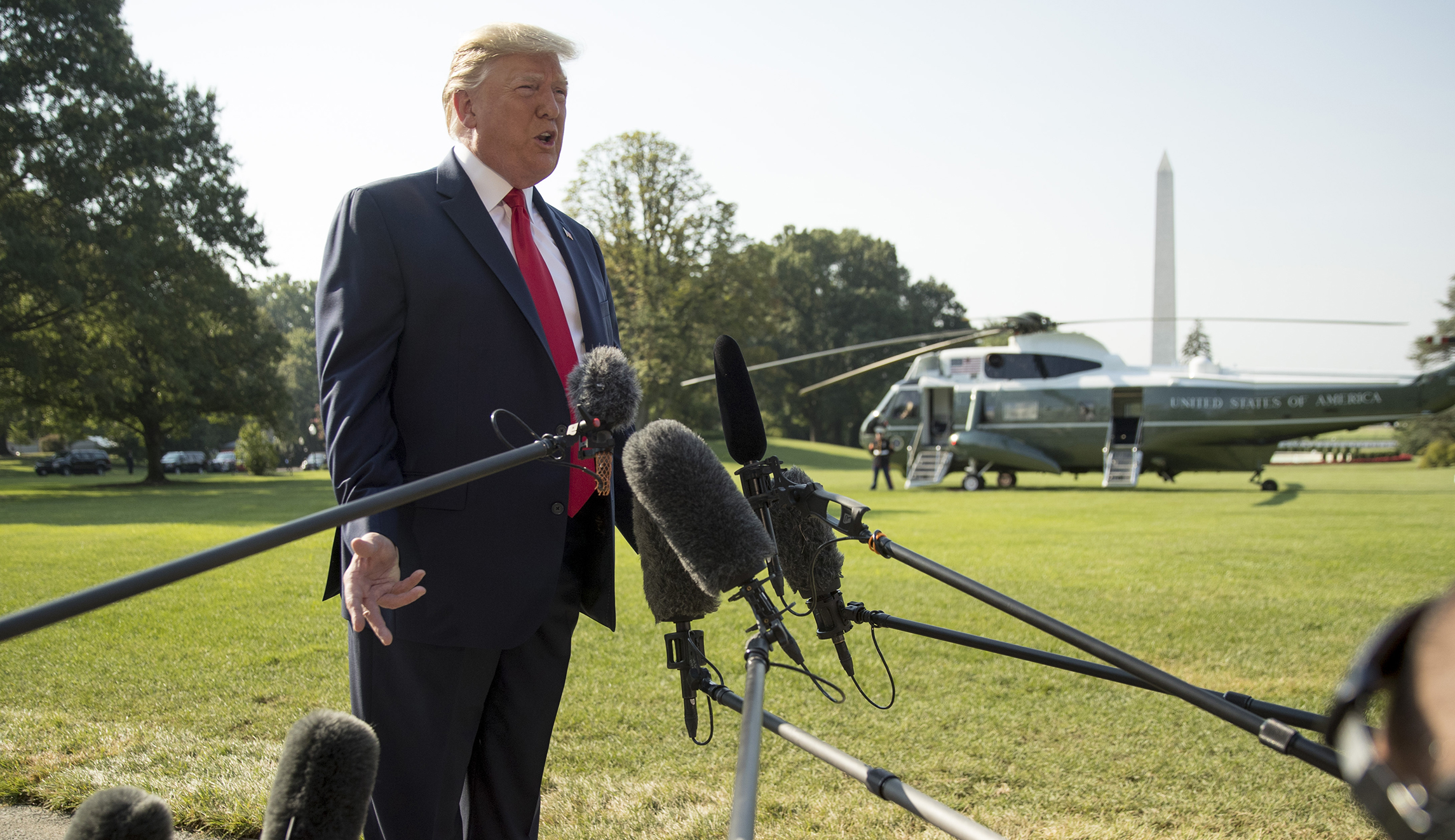
President Trump is broadly unpopular around the world. But I’m sorry, Nick Paton Walsh, the global popularity of a president doesn’t matter all that much.
What matters is not whether a president is popular, but whether a president advances critical American and human interests. Peace, security, economic prosperity, these things matter. They make lives better, freer, safer, and thus more amenable to the pursuit of happiness.
Recommended Stories


CNN correspondent Nick Paton Walsh sees differently. In a recent CNN.com piece, Paton Walsh says that the American idea has turned “ugly.” Under Trump, he asserts, America has lost the mantle of moral leadership. For Paton Walsh, America is now unbound from the great moral purpose of pushing forward that which has made the world better since the end of the Second World War.
I profoundly disagree with Paton Walsh’s key takeaways, even if his argument isn’t entirely without merit. The CNN correspondent rightly critiques the prevalence of anti-social behavior on social media. He also rightly criticizes the president for his oratorical excesses in favor of prejudice. Paton Walsh also has an impressive war reporter resume. But he is misguided in his lament for America’s present situation. My central concern here is Paton Walsh’s concluding question about America. He asks, “Does it lead the free world again, or allow China’s alien authoritarianism to fill the vacuum?”
First of all, that’s really up to the free world, isn’t it? Will four or eight years of Trump’s boorishness, or worse, blind any serious world leader to what’s happening now in Hong Kong? If so, then the free world never had much of a chance anyway.
But more to the point, here is no rational doubt as to whether Trump has been more effective than his predecessors against China’s authoritarian expansionism. Where Barack Obama allowed Chinese expansion against international norms of territory and commerce, President Trump has increased and escalated U.S. Navy patrols thru areas that China illegitimately claims as its own. Whatever you think of his tariffs, Trump has also cracked down on Chinese intellectual property theft to a much greater degree than Obama.
Indeed, his rhetoric aside, Trump’s foreign policy is hardly opposed to the international order. Trump is most definitely tougher on Russia than Obama was (though still not tough enough), he is constraining the Iranian hardliners’ ability to blow up patriotic politicians in places such as Beirut and Baghdad, and for the time being at least, he has stopped North Korea from firing off intercontinental ballistic missiles.
Paton Walsh also adopts center-left tropes on broader geopolitical issues.
On Brexit, he says, “When it comes to racism it’s not just America, it’s everywhere. Europe has been having its own ugly dance with it. Brexit is a form of xenophobia masked behind dislike at European trade regulations few voters know much about.”
Just plain wrong. From both personal experience (I lived in Britain for my first 26 years and retain many family members now) and professional analysis, I am convinced that most pro-Brexit voters knew what at least some of those regulations were (the common fisheries rules, for example), and that they voted in tune with their distaste for them. That’s what the exit polling shows, too — that Brexit voters wanted free trade with the wider world and not just the stagnant European bloc. The basic point, however, was always that when an external parliament elected mostly by foreigners can override domestic legislation passed by your nation’s rightful elected government, then your voice doesn’t matter any more.
Yet I think the flaw with Paton Walsh’s argument is more simple than that, because it prioritizes kind words to durable action. Like many liberal-leaning journalists, he positively references Chancellor Angela Merkel as a better archon of the liberal democratic order than Trump. But is this fair? Merkel has been quite useless in upholding the international democratic order. As always, policy actions and outcomes matter more than inane, racially insensitive, or otherwise pathetic tweets. And on that count, Trump is doing broadly good work for the world, whereas Merkel has done nothing but give way to Vladimir Putin.
The story of America, however, is one of an enduring if imperfect defense of human interests. It is not a coincidence, for example, that those nations conquered and temporarily occupied by America in the Second World War went on to become thriving and independent economies. They are so because the American people were willing to bury the hatchet in the interest of the peace and security of the present.
