

It is not every day that you see someone defend an entity’s entire reason for existing while also putting that entity down.
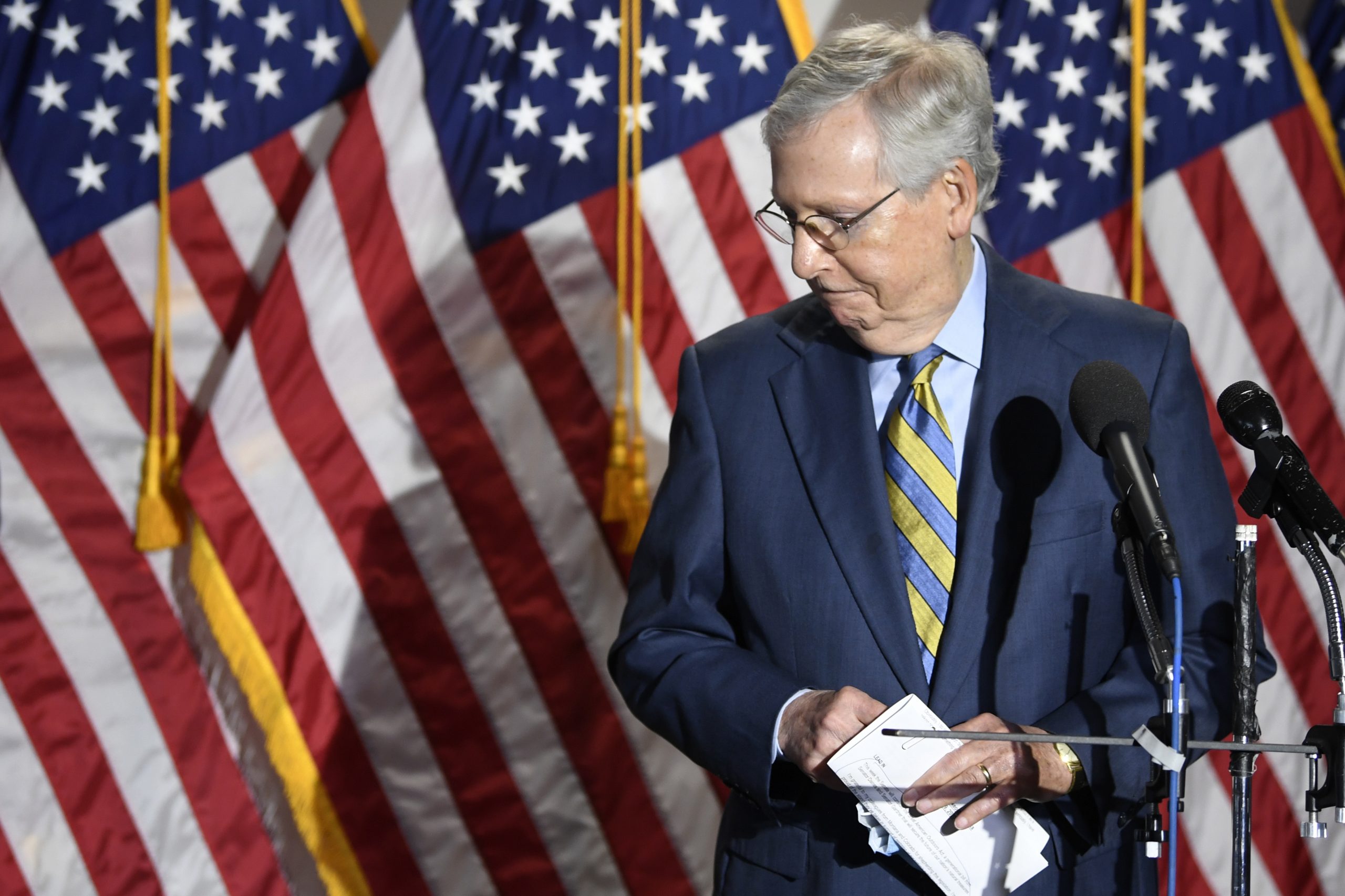
But that is exactly what Senate Majority Leader Mitch McConnell did Wednesday as he defended the principles of the First Amendment while mocking the New York Times for ceding ground again to the mob.
Recommended Stories



“One of our nation’s most storied newspapers just had its intellectual independence challenged by an angry mob, and they folded like a house of cards,” the Kentucky senator said with a slight smirk. “A jury of people on Twitter indicted them as accessories to a thoughtcrime, and instead of telling them to go take a hike, the paper pleaded guilty and begged for mercy.”
The New York Times this weekend wrestled a resignation from editorial page editor James Bennet following the publication of an op-ed by Republican Sen. Tom Cotton of Arkansas.
The offending article, titled originally “Send in the Troops,” argued that the military should be used to assist the police departments that have been overwhelmed by the rioters who have taken advantage of the protests surrounding the wrongful death of George Floyd. The article was explicit that the military should be used only to supplement police forces, that it should be used only in response to violent rioters, and that it should not be turned on the peaceful, lawful demonstrators.
Despite these careful clarifiers, however, Cotton’s op-ed pitched several New York Times staffers into full-blown fits, with many of them claiming the article put their lives in danger. These complaints were amplified by social media users who vowed to cancel their subscriptions unless the New York Times did something about the op-ed.
Unsurprisingly, the newspaper’s executive editors bowed (again) to the mob’s demands. On Sunday, the New York Times announced the abrupt resignation of Bennet, Cotton’s article was withheld from the paper’s print edition, and the editors affixed a groveling 300-plus-word editor’s note to the op-ed apologizing for its tone and content.
For reference, a recent New York Times opinion article authored by a top Taliban officer bears no similar note of clarification. It bears no note because the paper’s staff and readership did not complain about the op-ed, despite the fact that it contains straight-up, pro-Taliban propaganda.
On Wednesday, McConnell defended the New York Times’s First Amendment rights, all while characterizing the newspaper as an illiberal institution that has hoisted itself on its own petard.
“Our American culture of free expression and open debate is not only threatened from the top down by government,” he said, “it can also dry up from beneath. If we are to maintain the civic discourse that has made us great, American citizens and American institutions need to want it.”
McConnell added, “In the last several years … the New York Times has published op-eds from Vladimir Putin, the foreign minister of Iran, and a leader of the Muslim Brotherhood. They have published an essay arguing for greater normalization of pedophilia. As far as I know, none of those decisions occasioned public revolts from the paper’s staff, hand-wringing apologies from the editors, or an overhaul of the masthead.”
But then, the senator continued, the paper met its match last week.
“Nothing — nothing! — could have prepared them for 800 words from the junior senator from Arkansas,” McConnell said.
“In a free and open society,” he added on a more serious note, “speech begets speech. Arguments beget counterarguments. We discuss and debate as fellow citizens. But that’s not quite what happened. Instead of trying to win the argument, the far-left tried to end the discussion.”
The senator then brought his point to its conclusion, arguing that the Cotton episode points to a larger, more troubling trend.
“This broader, left-wing obsession with banning heretics from the public square will be poison for this country if it persists. Our republic can survive a pandemic. It can survive civil unrest. But ideas and deliberation are our very foundation,” McConnell said.
He added, “America cannot be America if civil disagreements become a contradiction in terms. The liberal tradition in this country used to pride itself on being broad-minded. But we’ve spent years watching major universities slowly exchange debate for uniformity and rigor for psychological comfort. Now, we see the free press repeating that error. Let’s hope we look back on this as a silly anomaly and not a sad turning point for our democracy.”
