

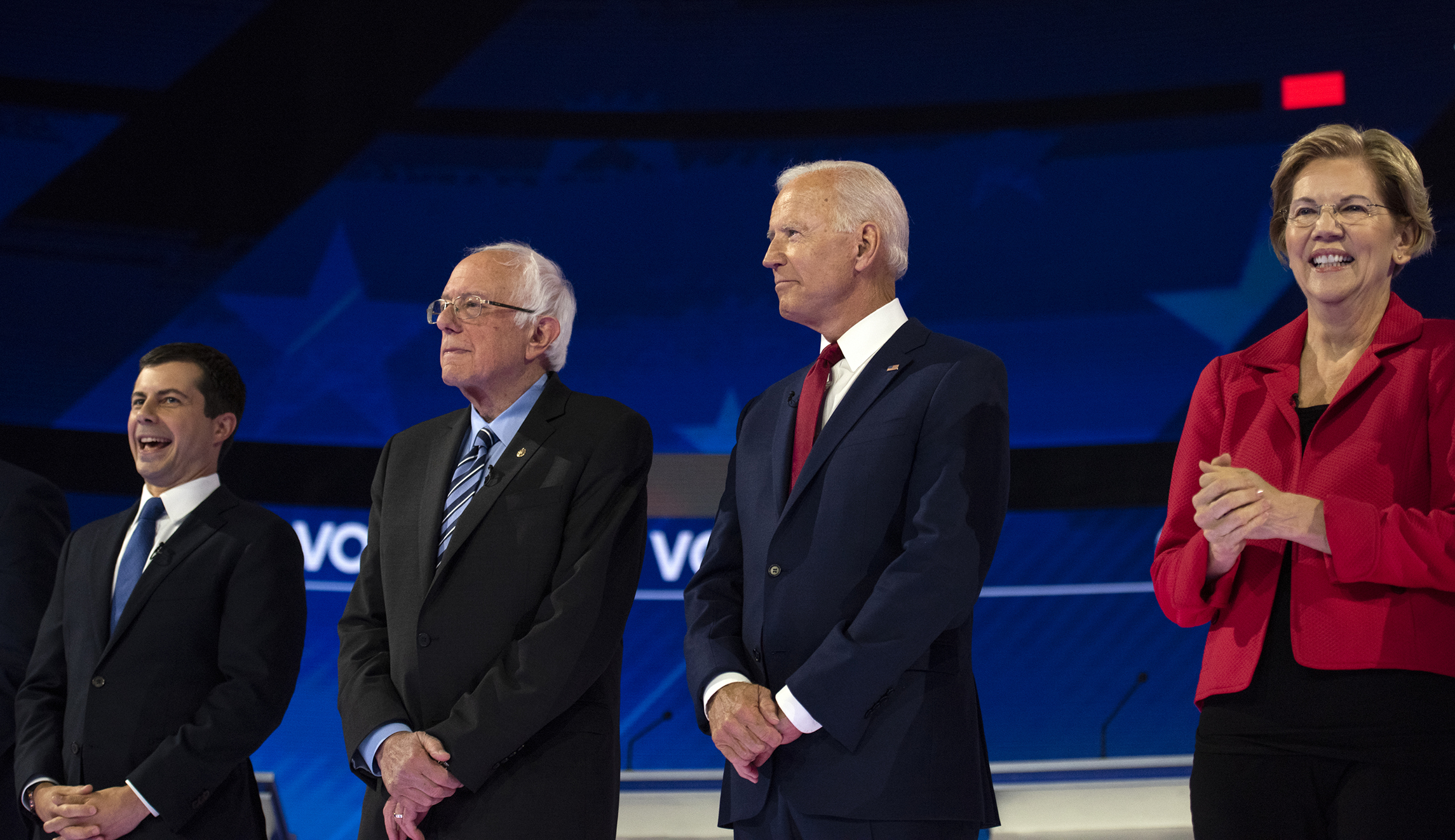
HOUSTON — In the last few weeks, Democratic presidential candidates have focused on fears of a recession, accusing President Trump of recklessness in handling the nation’s economic affairs.
“The warning signs for another recession are flashing,” Elizabeth Warren tweeted recently. The economy is “teetering on a recession,” Joe Biden said a few days later, probably meaning that it is teetering on the edge of a recession. “We’re now about to enter the Trump recession,” said top Bernie Sanders aide Jeff Weaver. Democrats took note of a Washington Post poll saying that Trump’s approval rating has fallen in light of the fact that 6 in 10 Americans fear a recession will arrive in the next year.
Recommended Stories


So on Thursday, at the Democratic Party’s first one-night presidential debate, the first opportunity to showcase the party’s 10 leading candidates, what role did the nation’s widespread economic anxieties play?
Almost none. The candidates simply didn’t talk about it. (Nor did the ABC News moderators ask.) The word “recession” was uttered just once in the entire debate. (By Julián Castro, who noted the poll’s finding of recession fears.) Nor was the word “unemployment” ever spoken. Nor was there a discussion of job creation. Nor was there much of a discussion of wages.
On the government side, no one, moderator or candidate, said the word “deficit.” No one discussed the mismatch between the federal government’s revenues and its spending. No one talked about the national debt.
There was talk about the president’s tariffs, but beyond that, there wasn’t much talk of the economy at all. Odd as that might seem, it was in line with earlier Democratic debates. For example, after the first marathon two-night session in June, the Atlantic wrote:
Thursday, as in June, the relative Democratic silence on the economy might be taken as a concession to the president. The candidates didn’t even try to argue that the economy is terrible. Nobody would buy it.
In past elections, voters have traditionally accorded jobs and the economy a very high place among the issues they consider most important. But the fact is, in this time of low unemployment and rising wages, Democratic voters simply do not place economic issues at the top of their list of concerns.
A CNN poll released the day of the debate asked how important a number of issues will be for the voters’ decision next year. The top issue which Democrats listed as “extremely important” was healthcare (59%), followed by climate change (56%), followed by gun policy (51%), followed by the economy (45%). Other polls have shown similar results.
So yes, the economy is important to Democratic voters. It’s just that there are more important issues. With the economy in good shape — despite the recession fears some were hyping just days ago — there was no need to spend much time on the the economy. So they didn’t.
Nor did they spend much time — actually any time at all — on an issue roiling their party in Washington: whether to impeach the president. The I-word never came up in the debate. No moderator asked about it. No candidate brought it up, even though five of them, Warren, Sanders, Amy Klobuchar, Cory Booker, and Kamala Harris, would have to vote on the issue if impeachment reached the Senate for a trial.
On other issues: To no one’s surprise, the debate opened with healthcare, and the discussion went on and on and on. Sanders, Warren, and Biden argued about their plans at length, often with a sense of wonkiness that seemed not to connect with the millions of people who are concerned about their healthcare. The argument lasted so long that at the 30-minute point, Harris blurted out, “This discussion has given the American people a headache.” A few minutes later, Pete Buttigieg noted that presidential debates “are becoming unwatchable.”
They were both right.
Sometimes a debate brings out a statement of the purest essence of an issue. At Thursday’s debate, it was guns. Beto O’Rourke, who has made guns a particularly passionate issue since the El Paso, Texas, shooting, was asked about his proposal for “mandatory” buybacks of “assault weapons.” “You know that critics call this confiscation,” moderator David Muir said to O’Rourke. “Are you proposing taking away their guns?”
“Hell, yes, we’re going to take away your AR-15, your AK-47,” O’Rourke said.
The ABC moderators failed to ask if anyone agreed. But O’Rourke’s words were so strong and so memorable it seems likely that in the future Democrats will be asked whether they share O’Rourke’s opinion. Some conservatives have suspected Democrats favor gun confiscation, and now they have discovered one — a presidential candidate, no less — who does.
As with any debate, there were some oddities, as well. Andrew Yang, the candidate who supports a $1,000-a-month universal basic income, turned his campaign into something of a game show when he announced that he will “give a Freedom Dividend of $1,000 a month for an entire year to ten American families.” He invited people to enter the contest by writing into his website to explain how much $1,000 a month would help them.
When the debate ended, there was plenty of the usual who-did-what analysis. Klobuchar and Booker helped themselves, people said. Biden didn’t hurt himself, or at least didn’t hurt himself much. Warren was OK. Bernie was Bernie, because Bernie is always Bernie. Castro shot himself in both feet with an ill-considered attack on Biden. (He suggested Biden had forgotten something he said just two minutes earlier, when in fact Castro was the one who had it wrong.)
None of that seems likely to affect the fundamentals of the race. A number of observers believe it is turning into a three-candidate contest: Biden, Warren, and Sanders. If so, that probably didn’t change much Thursday night. Perhaps next time, a candidate who wants to stand out will take a risk and bring up a novel topic, like the economy.
