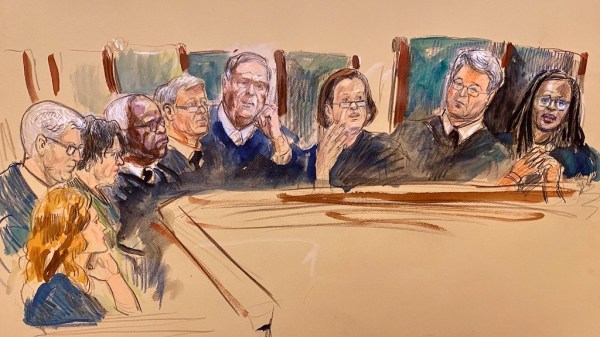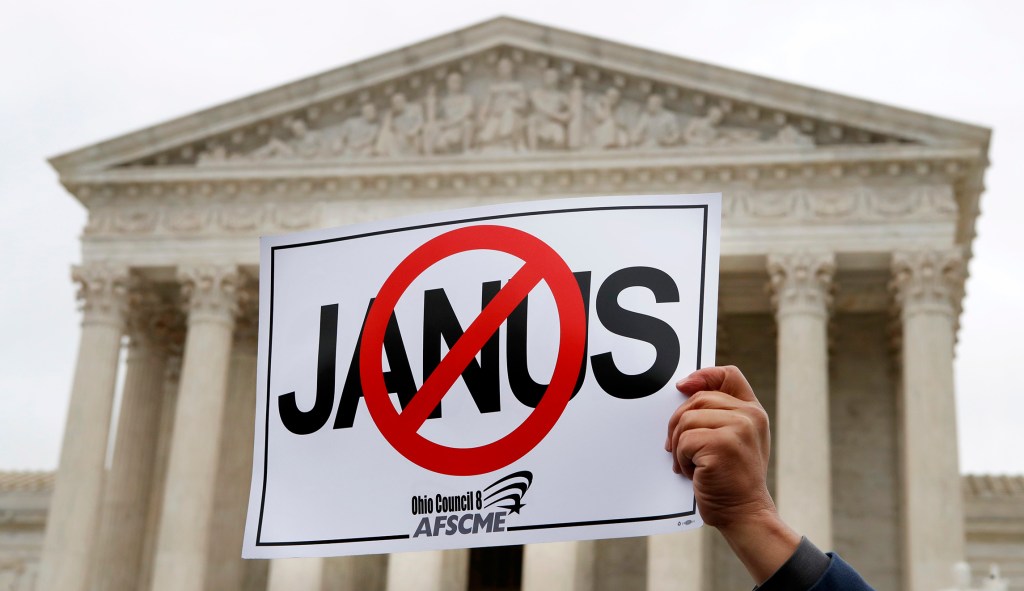
We didn’t learn anything from this morning’s argument in Janus v. American Federation of State, County and Municipal Employees, which asks whether state laws that compel the payment of “agency fees” by nonmembers of public-sector unions violate the First Amendment by forcing those workers to support policy positions they don’t like. None of the eight justices who heard the Friedrichs v. California Teachers Association case on the same issue two years ago—which ended up 4-4 after Justice Antonin Scalia’s death—appeared to have changed their minds. The ninth, Justice Neil Gorsuch, didn’t ask a single question or otherwise show his hand.
Justice Ruth Bader Ginsburg opened the questioning by asking about the validity of student activity fees and bar dues if Illinois state employee Mark Janus were to prevail, as well as how such a ruling would affect private-sector unions. Janus’s lawyer, Bill Messenger of the National Right to Work Legal Defense Foundation, responded that different state interests were at play there, and that there’s no state action in the private sector and so no First Amendment harm. (Justice Scalia, in a 25-year-old case called Lehnert v. Ferris Faculty Association, made the same point, which is why he was considered the swing vote in Friedrichs—though he showed himself to unambiguously be on Rebecca Friedrichs’s side during oral argument in that case.)