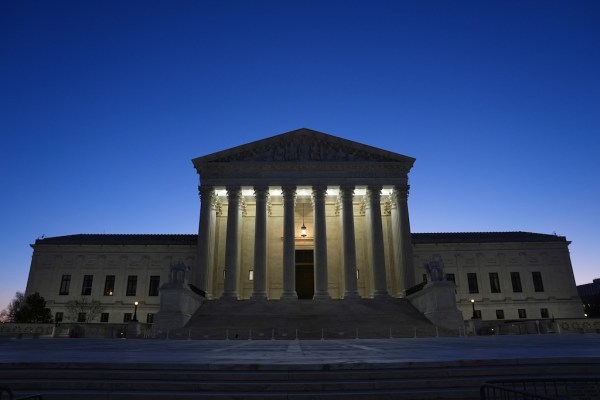
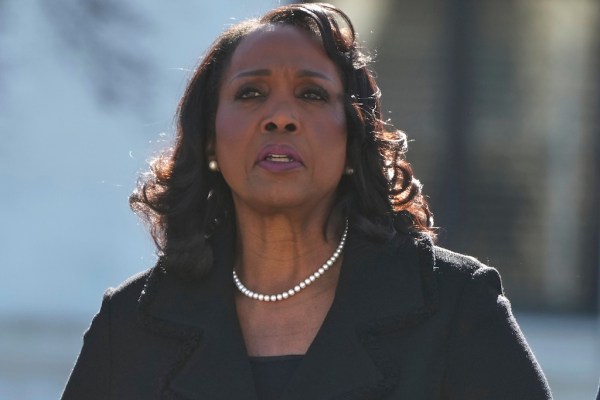
The Supreme Court‘s recently concluded term was dominated by cases involving President Donald Trump, but different justices dominated different parts of the term, from Justice Ketanji Brown Jackson‘s long questioning at arguments to Chief Justice John Roberts‘s near-perfect record of being in the majority ruling.
The Supreme Court’s term began with oral arguments in Villarreal v. Texas on Oct. 6, 2025, through the final opinion release day on June 30, with the 6-3 ruling in Trump v. Barbara, where the high court struck down Trump’s birthright citizenship executive order. The Supreme Court’s oral arguments and rulings offered key insights on how the justices operate, beyond the rulings themselves.
Recommended Stories
Vocal Jackson and reserved Thomas on opposite ends of oral arguments
During oral arguments for the 58 cases the Supreme Court ruled on this term, the justices said a total of 342,840 words, according to a Washington Examiner analysis of Supreme Court transcripts. The most vocal member of the Supreme Court bench was Justice Ketanji Brown Jackson, making up 21.96% of the words said by justices during all oral arguments, while the least vocal was Justice Clarence Thomas, whose questioning only made up 2.96% of the words said by justices during arguments.
John Shu, a court watcher and constitutional law expert who served in both Bush administrations, noted to the Washington Examiner that “traditionally, the junior justice does not take 20% of the total oral argument time.” He also attributed the vast disparity in speaking time between Jackson and Thomas to their questioning style.
“One of the reasons that Justice Jackson speaks the most is because she often doesn’t just ask a question. She often has a long windup and pontificates before she asks the actual question,” Shu said. “In contrast, Justice Thomas is very direct and no-nonsense. On the rare occasions that he asks questions, he goes right to the heart of the matter.”
The other two most and least vocal justices for the term were Justice Sonia Sotomayor, making up 14.84% of the questioning, and Roberts, making up only 5.68% of the questioning. As chief justice, Roberts also directs the questioning of the high court along with other procedural announcements, which inflate how much he speaks compared to the other justices.
All of the other justices took up somewhere between just under 10% and just over 12% of the questioning each during the full term. Only one of the oral arguments did not feature the full bench of all nine justices, due to Justice Samuel Alito recusing himself from deciding the case Chevron USA v. Plaquemines Parish over a financial interest in one of the companies listed as a party to the case.
While Jackson was the most vocal justice during oral arguments for the term broadly, she also was the most vocal justice in 42 of the 58 oral arguments. Of the other 16 oral arguments, Justice Brett Kavanaugh was the most vocal in five of them, Justices Elena Kagan and Neil Gorsuch were the most vocal in three each, Justices Sotomayor and Amy Coney Barrett were the most vocal in two each, and Alito was the most vocal in one oral argument.
During oral arguments, Jackson had a tendency of saying she didn’t understand when questioning lawyers on both sides of the case. Throughout the 58 oral arguments from October 2025 through April 2026, Jackson said some variation of “I don’t understand” 89 times.
The variations of the phrase said by Jackson during arguments included “I don’t understand” 56 times, “I guess I don’t understand” 22 times, “I just don’t understand” seven times, “I’m not understanding” twice, and “I didn’t understand” twice.
Thomas, the least vocal justice for oral arguments generally, was also the least vocal justice in 27 of the 58 oral arguments. Kavanaugh was the least vocal justice in 11 oral arguments, Roberts was the least vocal in seven hearings, Barrett was the least vocal in six oral argument hearings, and Gorsuch was the least vocal in two hearings.
Thomas ending up as one of the more quiet justices during oral arguments aligns with how he has always been, but the senior justice has seen his share of questioning tick up in recent years, Carrie Severino, president of the conservative advocacy group Judicial Crisis Network, told the Washington Examiner.
“For over a decade, Justice Thomas asked zero questions in oral argument. It’s really only since 2020 we’ve seen him ask any questions at all. So this is not surprising. He never has viewed his main contribution on the court as being asking questions in oral argument. I think he prefers to let the advocates make their case,” Severino said.
Despite the high court’s 6-3 ideological split, the amount of time the two ideological sides spent questioning lawyers was almost equal. The six justices appointed by Republican presidents made up 50.91% of the words said during questioning, while the three justices appointed by Democratic presidents made up the remaining words said during questioning.
Roberts proves his ‘chief’ title with rulings in key cases
Roberts marked 20 years on the high court at the beginning of the term, and made his mark felt as the top justice on the bench. The top cases involving Trump’s key issues were almost exclusively written by Roberts, and he only joined in the dissent three times over the 58 cases heard during the term.
Roberts wrote the majority opinions in Learning Resources, Inc. v. Trump, dealing with Trump’s sweeping tariffs; Trump v. Slaughter, regarding Trump’s firing ability over independent agency heads; Trump v. Cook, over the president’s attempt to fire Fed governor Lisa Cook; and Trump v. Barbara, regarding Trump’s birthright citizenship executive order. Alito wrote the opinion in Mullin v. Doe, which dealt with Trump’s bids to end temporary protected status for Haiti and Syria.
“This chief justice tends to end up in the majority a lot of the time. When he came on the court, he emphasized wanting to have more unanimity on the court, fewer separate opinions. So I think he’s practicing what he preaches there. He’s less likely to have a distinctive viewpoint that he really wants to get out there,” Severino said.
While Roberts became a key indicator of whether a party likely would win its case, Kavanaugh similarly was only in the dissent in three cases.
All of the justices wrote either six or seven majority opinions, keeping with Supreme Court tradition of splitting the majority opinions evenly between the justices. Roberts wrote the least amount of opinions, only writing his six majority opinions and declining to pen any concurring or dissenting opinions.
“The chief justice intentionally tries to get as close to unanimity as he can. Furthermore, he’s not a big dissenter,” Shu told the Washington Examiner.
The two justices who wrote the most opinions during the term were Thomas and Jackson. Thomas wrote 28 total opinions, including six majority opinions, 15 concurring opinions, and seven dissenting opinions. Jackson wrote 26 opinions, including six majority opinions, eight concurring opinions, two opinions concurring in part and dissenting in part, along with 10 dissenting opinions. Thomas wrote the most concurring opinions of any justice, while Jackson wrote the most dissenting opinions of any justice.
“He likes to write his concurrences, and often when he’s in dissent as well he has a distinct perspective, so that’s a very typical statistic. He is a prolific author,” Severino said, regarding Thomas leading the way in opinions written for the term.
Jackson was the only justice who wrote only unanimous majority opinions, while among the other two liberal justices, Sotomayor wrote two 5-4 majority opinions and Kagan wrote the majority opinions for one 6-3 ruling and one 8-1 ruling, in addition to their unanimous rulings. Roberts wrote no unanimous majority opinions, with his closest being the 8-1 ruling he penned in FCC v. AT&T. Thomas filed the lone dissenting opinion in the FCC case.
Severino said Jackson only getting unanimous majority opinions is “typical for a junior justice to get assigned the simpler cases,” while Shu attributed it to Jackson’s apparent inability to convince her colleagues in closely contested cases.
“The fact that all of Justice Jackson’s opinions this term were unanimous ones shows that she probably was unsuccessful in persuading people to come over to her side. Otherwise, she would have had 5-4 or 6-3 opinions. For example, there could be a situation where the count was four to five, and if she could persuade someone to come over to her side, the vote is now 5-4 in favor of her position. It doesn’t seem like that ever happened for her this term,” Shu said.
While the Supreme Court’s most bitterly divided rulings tend to dominate headlines, most of the rulings from the high court this term, 25, were unanimous. The second most common split was 6-3, with 17 such rulings, but despite that split matching the ideological divide on the bench, there were multiple 6-3 rulings where it was not an ideological split.
JUSTICE KETANJI BROWN JACKSON TOOK UP MORE THAN 20% OF SUPREME COURT’S QUESTIONING LAST TERM
The Supreme Court’s next term is scheduled to begin in October, when oral arguments begin and continue through the end of April 2027. The high court will conclude that term at the end of June 2027 when all rulings are issued.
The upcoming Supreme Court term will mark the fifth term with the same lineup of justices, barring a vacancy over the summer, since Jackson was seated on the high court in June 2022. The unchanged lineup of justices at the Supreme Court is the longest streak for the high court since from August 2010, when Kagan was confirmed to the bench, until February 2016, when Justice Antonin Scalia died.