

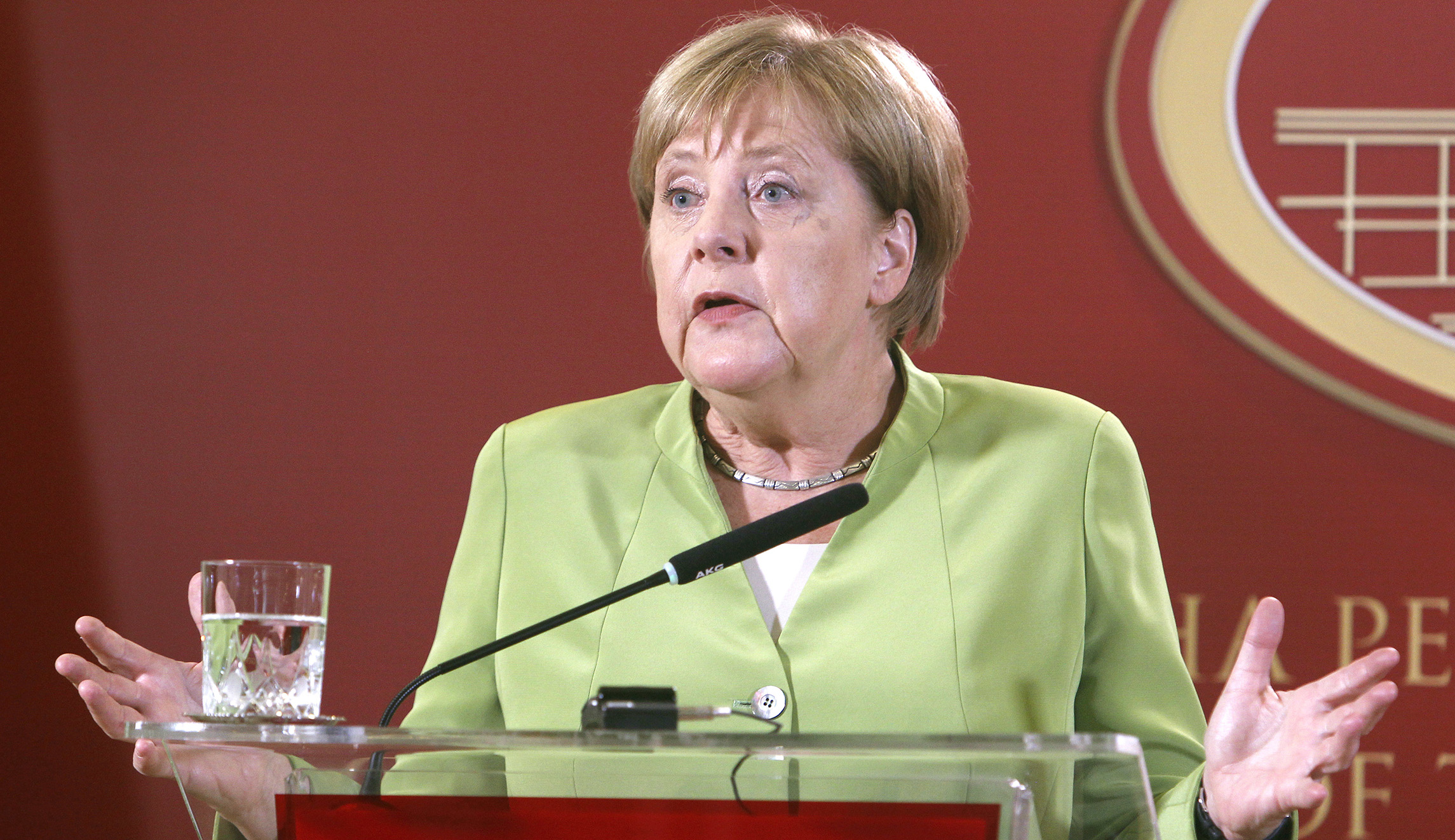
German Chancellor Angela Merkel is used to getting herself out of jams and surviving for another day. Throughout her more than 12 years at the helm, she has dominated the German political scene like no other politician in the country. Merkel has a knack for tossing principle and ideology by the wayside for political expediency; when the German public soured on her open-door refugee policy — a policy she stubbornly defended as a humanitarian necessity when no other country was showing leadership on the issue — Merkel cut a deal with Turkey’s Recep Tayyip Erdogan that would result in an exponential decrease in the flow of people through the Balkans and into Northern Europe.
The chancellor, however, has had a difficult year. While her Christian Democratic Union won the country’s parliamentary elections last year, it was the party’s worst electoral showing since 1949. Merkel spent months trying to cobble together a coalition government, an effort made more difficult given the perception of her waning political authority and acumen. The first attempt hit a dead-end when the Free Democrats walked away from the table. She finally got it done, but her renewed partnership with the Social Democratic Party looked to a lot of Germans like the same old establishment politics that governed the country for decades. The CDU/CSU-SDP coalition was a gift to the Alternative for Deutschland, a party that was now considered the biggest opposition bloc in the Bundestag.
Recommended Stories


Months after that crisis ended, in late June and early July, a new one plopped down on Merkel’s lap. Faced with a strong challenge by the AfD in Bavaria and worried about being challenged from his Right, CDU chief and Interior Minister Horst Seehofer demanded a tougher asylum policy. Scared of siphoning voters to the AfD in the upcoming Bavarian elections, Seehofer threatened to collapse the government if Merkel refused to close Germany’s border with Austria to more migrants. The chancellor was on such thin ice that the European Union held an emergency migration summit to dig her out of a hole; the deal struck in Brussels and a subsequent arrangement with Seehofer lacked detail, but they at least gave her more time.
Now, a month later, Merkel is presented with another crisis: that of a far-right extremism spreading in Eastern Germany. The right-wing protests in Chemnitz in late August, a town about an hour’s drive south of Leipzig, have proven to be just as politically embarrassing to Merkel’s authority as they were ugly on videotape. Thousands of demonstrators, some purportedly chasing non-Germans into alleyways and marching proudly with the Hitler salute, is the precise opposite of what Merkel wants for Germany — a cosmopolitan, tolerant, generous, and kindhearted nation that sets an example for all of Europe. The riots in Chemnitz should have been one of those rare instances when German politicians of all stripes could unite in their condemnation of the harassment.
Merkel’s coalition, however, couldn’t even do that. What Merkel termed “hate in the streets,” Seehofer regarded as an expression of the German people’s frustration with migrant-fueled crime — one he would have participated in if he wasn’t a minister.
Merkel is no doubt a political survivor. But it’s virtually impossible to avoid the feeling that she has lost some of her step. She may still be Germany’s — and Europe’s — most powerful head-of-state, but it increasingly looks and feels like the political earth is shifting beneath her feet. Merkel’s coalition government seems caught unaware with every mini-crisis. What this means for the future of the chancellor or the CSU is hard to determine. But you can be sure younger members in the party who want Merkel to hand power to the next generation are wondering when her political star will dim.
Daniel DePetris (@DanDePetris) is a contributor to the Washington Examiner’s Beltway Confidential blog. He is a fellow with Defense Priorities.
