

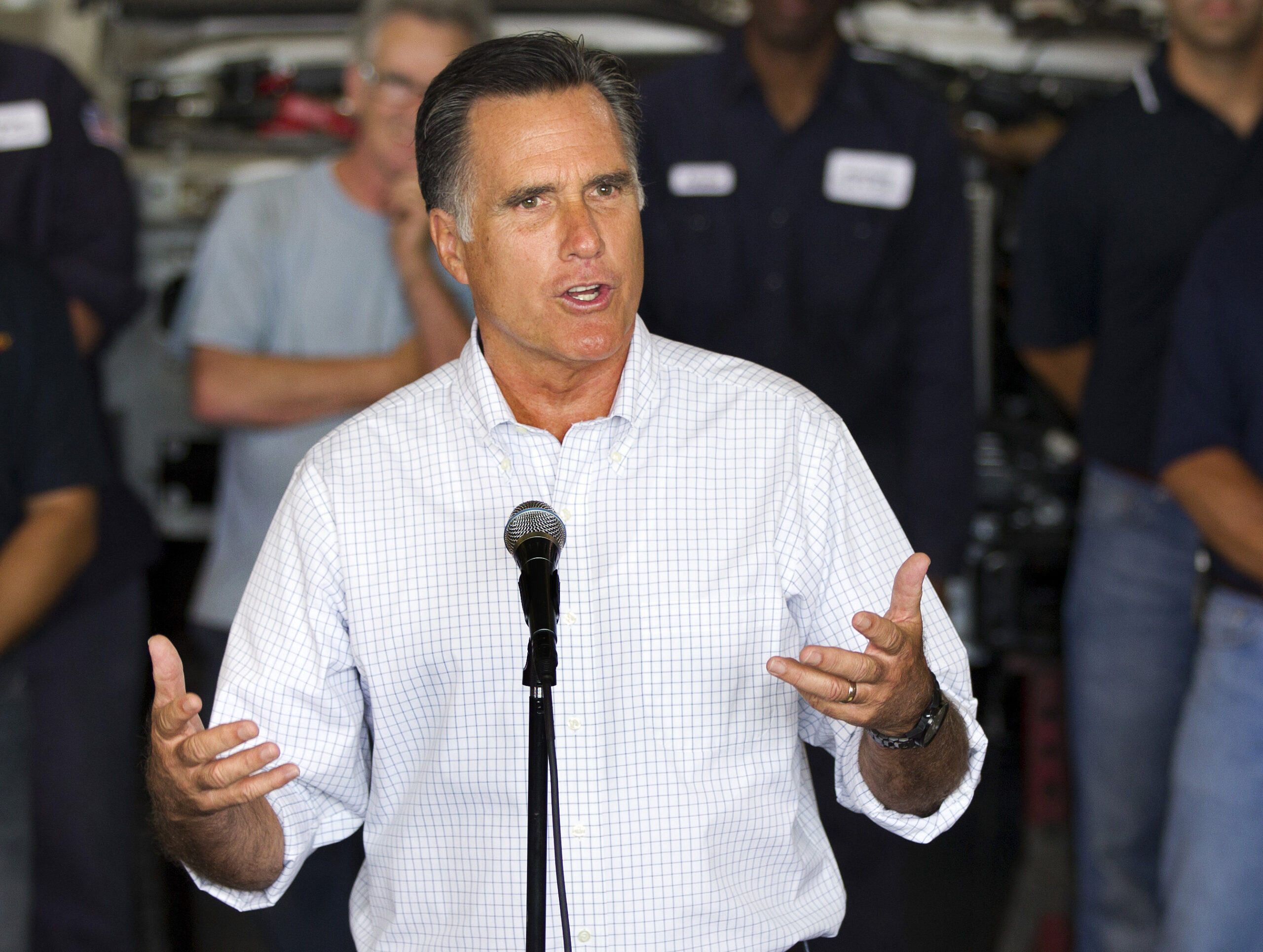
This week’s polling — both nationally and in key states like Florida and Virginia — indicates that President Obama is vulnerable in the November election. But does his Republican opponent, Mitt Romney, have what it takes to win the presidency? We might be getting the answer in the aftermath of Obama’s recent comments about business owners. Romney loses ground every time he runs away from free-market capitalism. He wins when he embraces and defends it.
Obama helped him this week with his declaration that “If you’ve got a business, you didn’t build that,” a statement that has generated a great deal of controversy. Obama’s defenders charge that it was taken out of context — that his apparent disparagement of business owners was a simple misunderstanding of what the ambiguous “that” refers to. But in full context, Obama unmistakably spent several sentences arguing that small-business owners owe far more of their success to government and its institutions than they are willing to admit, and should therefore be willing — grateful, even — to pay the higher taxes he would impose on them.
Recommended Stories


Obama’s argument is feeble for two reasons. First, the general truth that government confers benefits on all business is not an argument for taxing them at any particular rate. Second, and more fundamentally, it glosses over the fact that businesses ultimately generate all government revenue. The political stability and infrastructure that government brings to the table (at its best) are funded entirely by taxes paid by business owners and the people they employ. Business owners compose the one group that can, in fact, point to every road and bridge in America and say, “Yes, we built those.”
But aside from their merits, Obama’s comments are political poison. They reinforce the impression that Obama is anti-business or at least doesn’t respect the contributions of business to civil society. Romney and his entire campaign began pushing the message that he understands what America’s hardworking small-business owners go through, whereas Obama does not. This has put Team Obama on its heels.
Contrast this successful execution with Romney’s sorry performance over the last few weeks. Romney had been flailing over a story about his old private equity firm, Bain Capital, and the investments it made in companies that do business overseas. From back on his own heels, Romney and his communications team insisted that he was not responsible for “outsourcing” jobs, even though “outsourcing” is usually just an inevitable consequence of worldwide economic forces. He protested that he had not been at Bain when certain decisions were made. He even embraced the loaded term “outsourcing” and tried to apply it to Obama, because his stimulus money had gone to firms that hire employees overseas. This is a snapshot of a Mitt Romney who would lose in 2012.
Romney’s greatest strength as a candidate is not that he made millions in business, but that he can look employers and employees in the eyes and tell them truthfully that he understands the struggles they face. His winning message is that a President Romney would prevent clueless government officials from “crucifying” businesses by heedlessly raising regulatory obstacles. He would keep their taxes at a reasonable rate. Romney must keep playing to this strength whenever Obama gives him a chance. It is his path to victory, both on the issue of the economy and in the election.
