

Seventy-five years ago, the United States discovered the atomic bomb, fundamentally changing the strategic calculus of war. By espionage, the Soviet Union quickly developed its own nuclear weapons, leading to the world’s first nuclear stalemate. War planners soon realized that nuclear stalemates were unexpectedly stable, a development that later became known by the rather terrifying name of “mutually assured destruction.”
Ever since the discovery that mutually assured destruction produces a stable equilibrium, some strategists have questioned the importance of nuclear nonproliferation. These strategists argue that nuclear weapons are, in practice, unusable, so there is little point in expending military and diplomatic resources to check their spread.
Recommended Stories



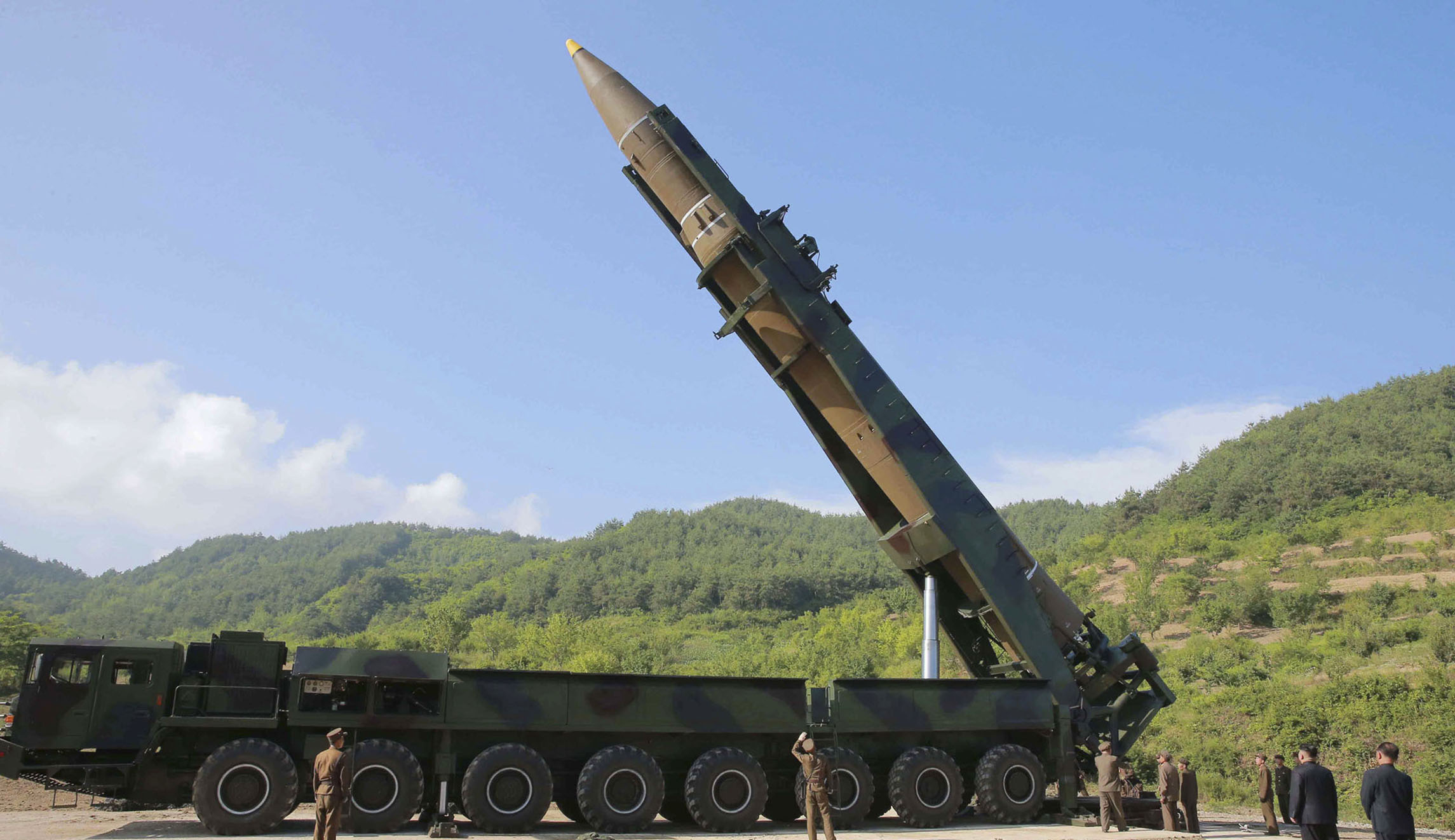
Recently, a few foreign policy experts, such as the Atlantic columnist Peter Beinart, have adopted this approach to North Korea, arguing that the next American administration should ease economic and diplomatic sanctions.
These experts correctly realize that North Korean dictator Kim Jong Un has no intention of ever scrapping his nuclear weapons program. Therefore, by focusing on other issues, they argue that the U.S. might be able to make progress with China and with our ally South Korea, as South Korean President Moon Jae-in has adopted a much more conciliatory approach to the North. South Korea has even recently prosecuted North Korean defectors for acting out against the Kim regime.
This argument is intuitively appealing. But it is wrong — and dangerous.
It remains a vital national security interest of the U.S. to limit, to whatever extent we can, North Korea’s nuclear enrichment program.
There are (broadly) three steps involved in creating nuclear weapons. First, a regime must acquire fissile material, invariably (for the first weapons) Uranium-235, a specific isotope of the metal uranium. Uranium is abundant in nature and produced as a byproduct of civilian mining.
Next, a regime must enrich the uranium, and 99.27% of uranium found in nature is Uranium-238, which cannot sustain a nuclear chain reaction. Only 0.73% or so is in the rarer isotope form of Uranium-235, which can. Engineers must, therefore, separate and purify the U-235.
Enrichment is a difficult and time-consuming process because the two isotopes are so similar. The only practical method for large-scale enrichment so far developed is centrifuge-based. In centrifuge-based enrichment, uranium yellowcake is fitted into canisters. A machine, called a centrifuge, spins the canisters around at very high speeds.
U-238 is very slightly heavier than U-235 (it has three more neutrons). Therefore, at very high speeds, the U-235 is pushed very slightly to the outside of the canister. A machine then separates the outside of the canister from the inside. An engineer is left with an outside portion that has a slightly higher percentage of U-235 than the initial batch.
Repeating this process over and over, on hundreds of centrifuges, eventually enriches uranium to weapons-grade thresholds in excess of 60%.
Finally, once a regime has acquired highly enriched uranium, it must fashion that uranium into a nuclear bomb. Although this sounds complicated, the engineering is now very well understood and (relatively) easy to complete.
It is challenging to interrupt a country at the uranium mining stage, because there are many perfectly legitimate reasons to operate a commercial mine that happens to produce uranium as a byproduct. It is challenging to interrupt a country at the weapons engineering stage, because this process generally takes place secretly in a very small weapons facility that is easily hidden.
In practice, therefore, the international community largely interrupts regimes at the enrichment stage. Enrichment requires enormous blocks of massive centrifuges — instruments with no practical purpose other than uranium enrichment. When intelligence reveals vast new buildings using a lot of electricity, the International Atomic Energy Agency can send snap inspectors pursuant to the Nuclear Nonproliferation Treaty. If inspectors find gas-powered centrifuges set to the relevant settings, then the regime has been caught red-handed.
In addition, because centrifuge enrichment requires advanced industrial capacity, terrorist groups have so far been unable to enrich uranium — one of many reasons why terrorist groups have not yet been able to acquire nuclear weapons.
This entire enforcement system relies on the scarcity of highly enriched uranium. A single source of unmonitored, highly-enriched uranium would, therefore, be extraordinarily dangerous. With highly-enriched uranium, a terrorist group could manufacture a nuclear device far more easily, and rogue regimes could more quickly acquire nuclear capacity.
The Soviet Union was profoundly evil. Yet it played by the rules when it came to nuclear materiel. Even during the Cuban Missile Crisis, the Soviet Union permitted only Soviet personnel to handle highly enriched uranium.
North Korea has shown no such reluctance. Already the Kim regime has been caught trying to sell nuclear material to Syria. Some may hope that Kim’s government, so desperate for cash that it uses its diplomatic missions for narcotics smuggling, will follow international norms nuclear nonproliferation. I am not holding my breath.
Since North Korea seems willing to smuggle and sell its highly-enriched uranium, the North Korean nuclear weapons program remains a grave threat to U.S. national security.
Every day, North Korea continues to enrich uranium. In so doing, North Korea knowingly undermines the entire global nonproliferation system.
For this reason, the continued operation of North Korea’s nuclear weapons program remains a critical security threat to everyone, everywhere. It is vital that the next administration take that threat seriously.
It is hard to know what exactly is the right next step in confronting North Korea. But it is easier to see what would be the wrong next step.
Given the critical security threat posed by its clandestine nuclear program, suspending sanctions against North Korea would be a grave strategic mistake. Let’s hope the next administration avoids it.
Cory Evans is an assistant professor at Baruch College. His research focuses on strategy in East Asia, with a particular focus on Japan’s strategic history.
