

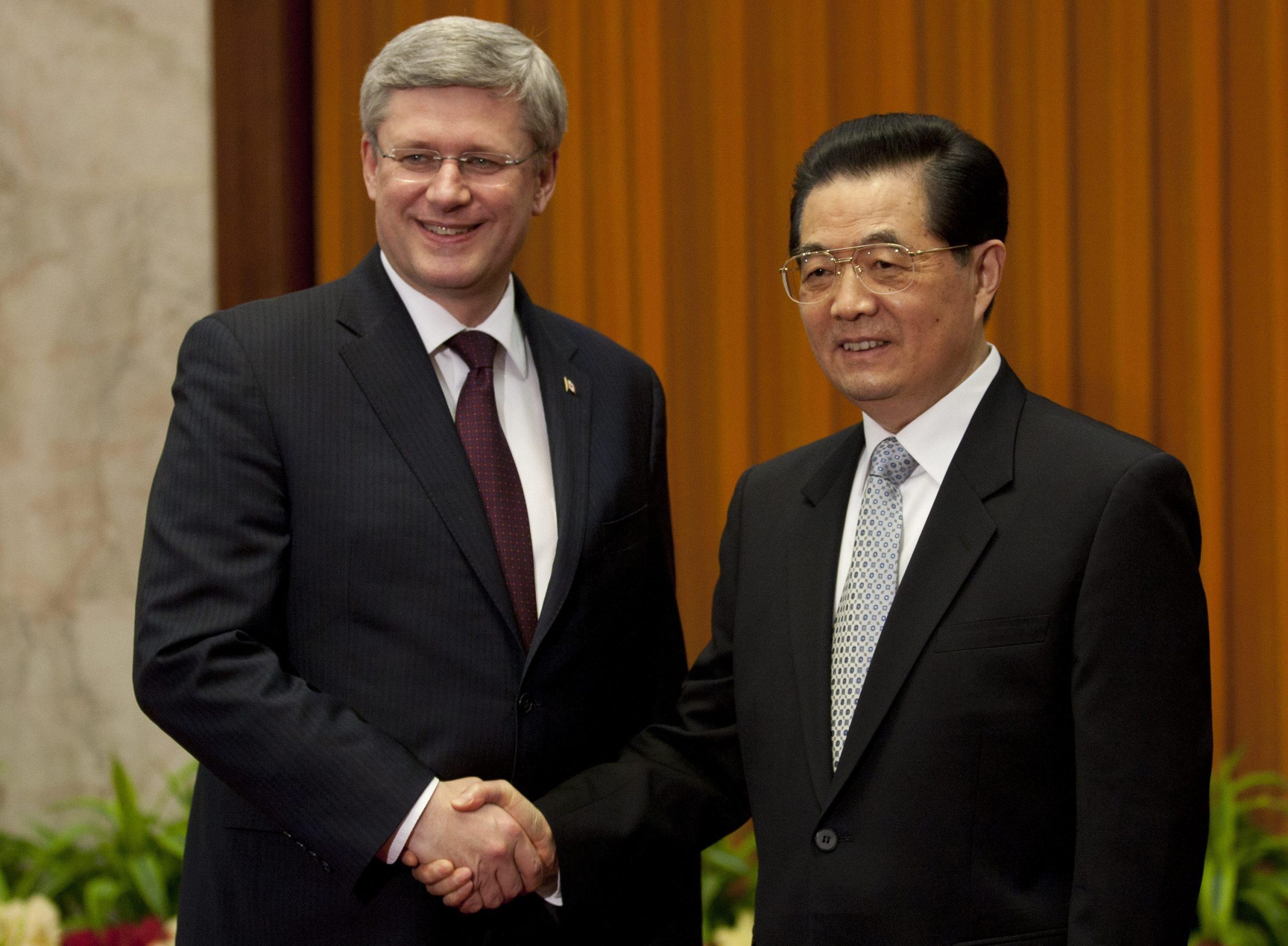
Just as he promised he would do if the United States rejected the Keystone XL pipeline, Prime Minister Stephen Harper headed to Beijing earlier this week on a four-day trade mission in which he is expected to seek a deal to sell millions of barrels of Canadian oil to China. Since China is aggressively pursuing energy deals around the world to support its economic expansion, expect Harper to come home with an official signature on the dotted line.
Harper is accompanied on the mission by dozens of Canadian business executives, including several from Syncrude, the consortium that produces thousands of barrels of oil daily from the Athabasca oil sands. That’s the place the Keystone XL pipeline — proposed by TransCanada, another north-of-the-border energy giant — would have funneled 700,000 barrels per day to the United States, if not for Obama’s rejection. Some portion of the estimated 20,000 new jobs that would have been created here will also be exported to China.
Recommended Stories



Meanwhile, here in the United States, besides continued high unemployment, drivers endured the most expensive January gas prices ever, according to the Los Angeles Times. “January is typically a month of falling gasoline prices because fuel demand falters in the slower travel weeks that follow the year-end holidays,” the Times reports. “Not so this year.”
The nationwide average price of regular gas was $3.37 per gallon last month, compared with $2.71 in January 2010 — a 24 percent increase. And things are going to get tougher for gasoline buyers because prices traditionally rise in February and March as spring approaches. That’s when refiners must switch over to more expensive federally mandated formulas that result in slightly lower emissions. According to USA Today, energy experts expect prices to be in the $4-per-gallon range this summer.
Obama rejected Keystone over purported environmental concerns, which had in fact been addressed already during the three-year review of the project by the State Department. But just two years ago, Obama’s State Department approved a similar pipeline constructed by yet another Canadian firm — the Alberta Clipper by Enbridge. At the time, State said approval was granted because “the department found that the addition of crude oil pipeline capacity between Canada and the United States will advance a number of strategic interests of the United States. These included increasing the diversity of available supplies among the United States’ worldwide crude oil sources.” It also didn’t hurt that several thousand “shovel-ready jobs” were created, at no cost to taxpayers, at a time when U.S. unemployment was above 10 percent.
An estimated 10,000 conservatives are attending the Conservative Political Action Conference (CPAC) today. The Keystone issue and Obama’s feckless energy policy should weigh heavily on their minds as they consider the importance of conservative unity this fall behind his opponent, whoever it may be. There is no reason why Harper should ever have had to add Keystone to his agenda in China this week.
