

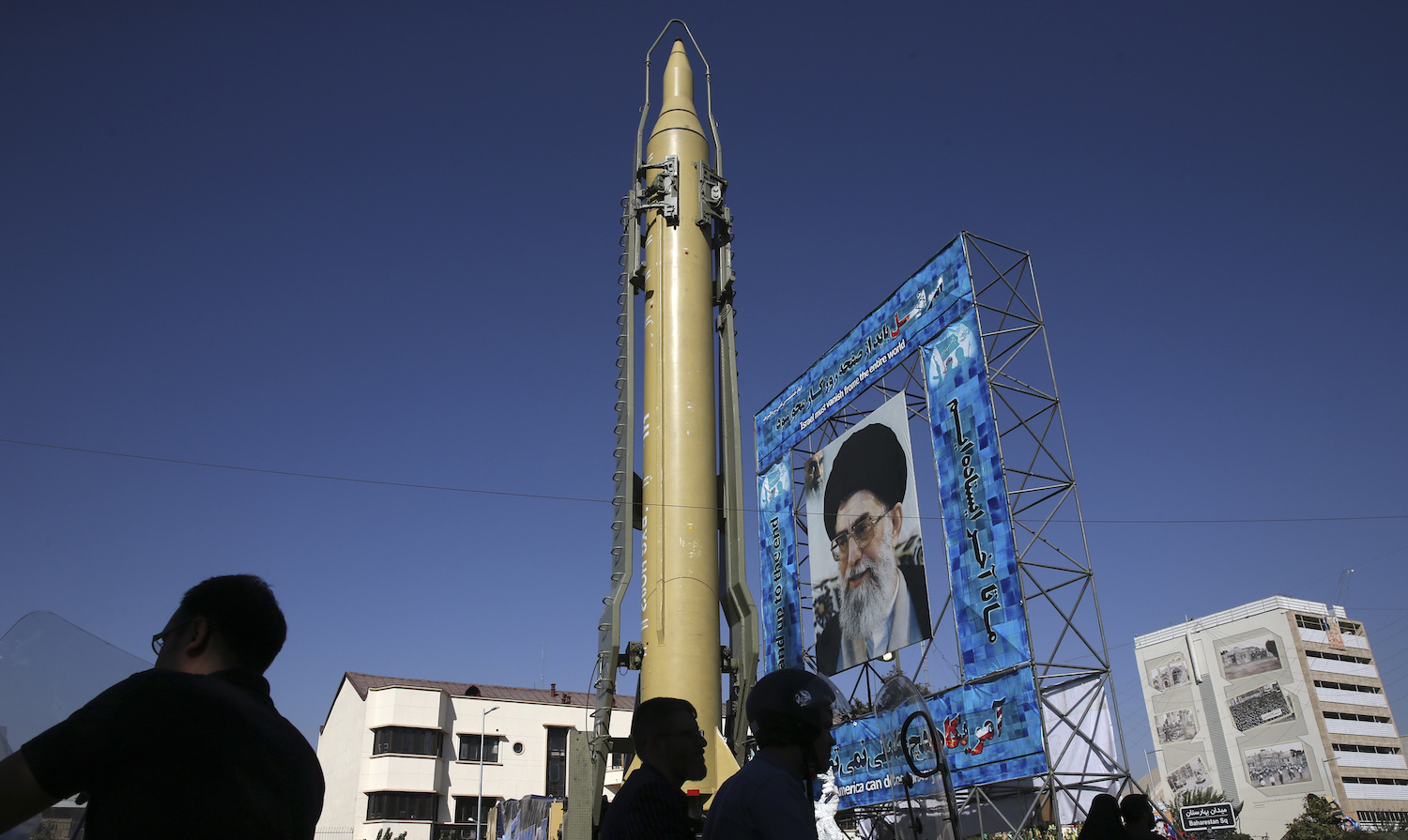
Iran has been firing missiles at a barge designed to look like a U.S. aircraft carrier.
It’s all rather silly and not terribly reflective of strength.
Recommended Stories


Iran’s own media coverage of the Islamic Revolutionary Guard Corps training exercise proves as much. It shows a helicopter’s rather leisurely flight toward the barge before firing a missile at it. The missile makes impact near the barge’s fake conning tower, causing some (but not much) white smoke to rise into the air. We then see various fast attack boats swarming the barge, commandos landing on it, and frogmen planting mines on its hull.
As I say, it’s silly. For a start, the idea of commandos being able to swim up or land on a U.S. aircraft carrier is patently absurd. Were a carrier operating in combat, it would be traveling at around 30 knots and moving in unpredictable ways. It would not be sitting still unless its two reactors were shut down. And shutting down the reactors would require inflicting so much damage that the carrier would be a burning wreck anyway. The carrier crew would also be training their Phalanx CIWS and RIM-116 close-in weapons systems against any approaching aircraft or incoming missiles. Oh, and a carrier has 6,000 personnel aboard. Any seizure operation would necessarily entail getting a very large assault force on the ship.
Regardless, the IRGC would struggle to the point of near impossibility to get anywhere close to a U.S. carrier. That’s because the carrier’s strike group escorts and air wing would target any enemy forces out at range. The air defense commander embarked on one of the strike group’s cruisers would direct saturation strikes on threatening aircraft and missiles. The surface and undersea warfare commanders would direct saturation strikes on threatening ships and submarines. And the air warfare commander would send the carrier’s four strike fighter squadrons against all these targets. At the same time, the strike group’s electronic warfare suite would be used to blind the enemy. To be clear, Iran’s ability to threaten U.S. aircraft carriers is very much less than that posed by China and Russia.
All of this raises a question. What’s the point of the exercise, then? After all, the IRGC, like the rest of the regime, is stretched for cash and can’t easily afford jaunts like this.
Well, I suspect this exercise is primarily designed to spark alarmist stories in U.S. media. Iran wants some reporting that these exercises threaten near-term doom for the U.S. Navy — and that the only way to avoid said doom is to elect Joe Biden and return to the 2015 nuclear accord (which, of course, did not deal with the conventional threats posed by Iran). In the short term, Iran wants the public to put pressure on President Trump to back away from crippling sanctions and intelligence activities designed to undermine Ayatollah Ali Khamenei’s regime.
The exercise’s secondary objective is to broadcast a message of strength to other Middle Eastern actors. The IRGC is concerned with growing resistance to its activities from the Iraqi government and the increasing political challenge facing the Lebanese Hezbollah. In the case of Hezbollah, the group’s attempted attack on Monday against Israel should be seen as a similar effort to appear strong.
Ultimately, however, this exercise should be seen for what it is. Antics designed to show strength but actually represent the Iranian regime’s fear and weakness. Watch elements of the Iranian news report below.
