

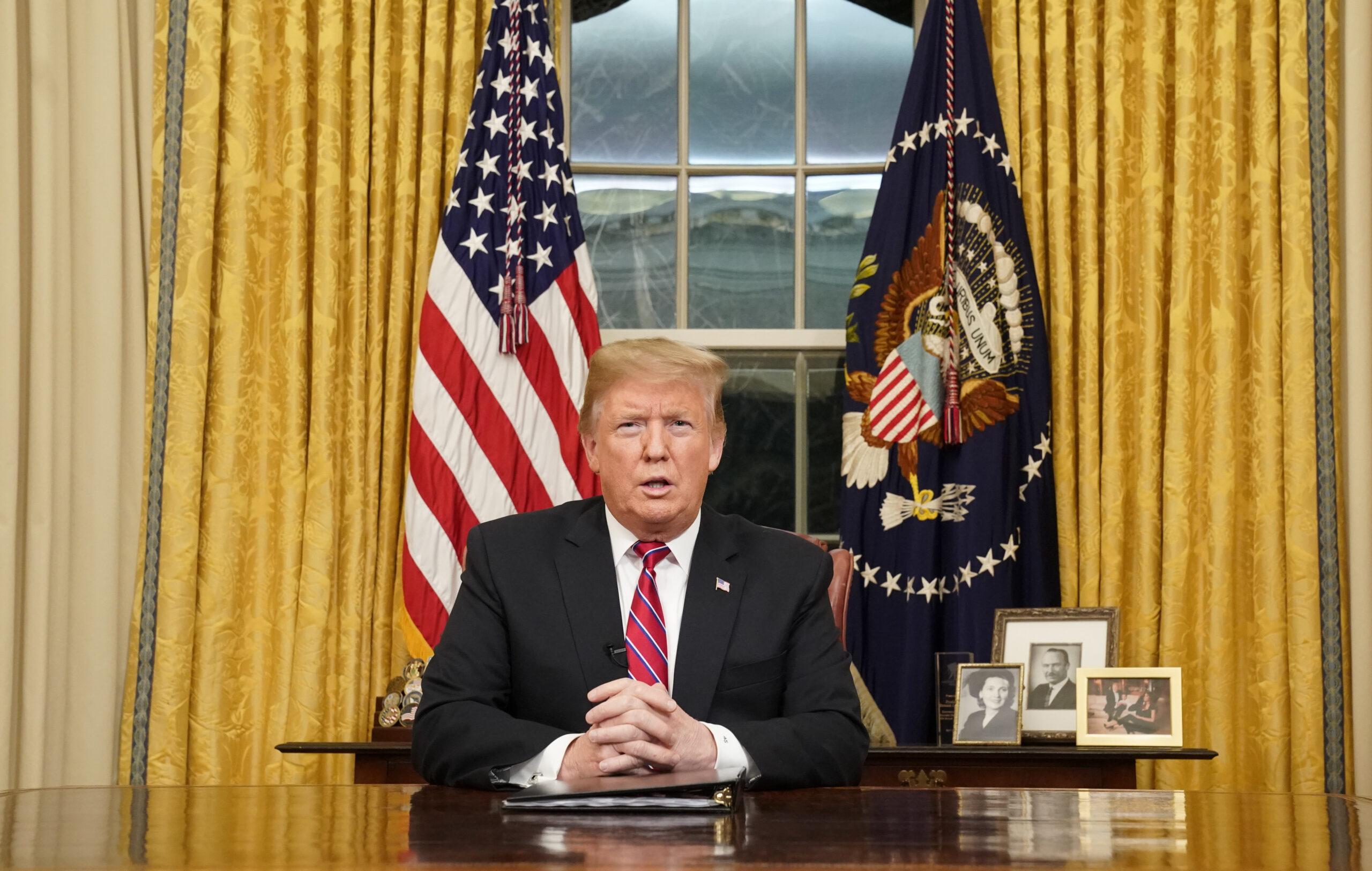
President Trump’s first televised Oval Office address failed entirely in its main goal of rallying voters to his side, according to a new Quinnipiac survey.
The president shouldn’t feel too bad, though. A whiffed appeal for public support happens to the best of them, including former Presidents Ronald Reagan, Bill Clinton, and Barack Obama.
Recommended Stories


The Quinnipiac survey, which polled 1,209 voters nationwide between Jan. 9 and 13, found that 59 percent of respondents believe the wall is “not a good use of taxpayer dollars.” Fifty-five percent believe the wall “would not make the U.S. safer.” An even larger fifty-nine percent believe the “wall is not necessary to protect the border.” Fifty-two percent even believe the “wall is against American values.” (The survey has a margin of error of plus or minus 3.3 percentage points.)
Lastly, a mere two percent of voters say the address “changed their mind, while 89 percent say it did not change their mind about building the wall,” the polling firm reported (to be clear, Quinnipiac does not explain how respondents changed their minds regarding Trump’s border wall. It’s possible the president may have lost supporters along the way).
In other words, the first televised Oval Office address of Trump’s presidency failed utterly to win over new allies.
The Quinnipiac numbers are obviously not great for the White House. But the numbers are also not unprecedented. As it turns out, televised prime-time Oval Office speeches have long failed to move the public’s opinion on key political issues, according to a report published in 2013 by the Pew Research Center.
“President Ronald Reagan, for instance, was unable to convince even a plurality of Americans that the United States should provide military aid to the Contra rebels fighting Nicaragua’s Sandinista government, despite three Oval Office addresses on the issue between March 1986 and February 1988,” the group reported.
Pew, which specifically researched presidential appeals for public support ahead of congressional action, goes on to note that an October 1990 televised address from former President George H.W. Bush similarly failed to win support for the deficit-reduction deal hammered out between his White House and Congress. Likewise, former President Bill Clinton’s televised address in August 1993 did nothing to earn widespread support for his economic-recovery plan.
However, as Pew reports, “Opinion did change somewhat before and after Clinton’s June 1995 speech on that year’s budget standoff with congressional Republicans, though perhaps not in the way he’d hoped: Before the speech, according to a Gallup/CNN/USA Today poll, support was about equally divided between Clinton’s plan and the GOP approach; afterward, a Time/CNN poll found 39 percent support for Clinton’s plan, 19 percent for the GOP plan, and 39 percent saying they didn’t like either.”
Later, in 2006, former President George W. Bush’s televised pitch touting an immigration reform plan that included a “path to citizenship” for illegal immigrants did absolutely nothing to move the needle on public opinion, according to Pew’s own polling. Prior to Bush’s address, 56 percent of Pew survey respondents said they supported the plan. Following Bush’s speech – 56 percent of respondents said they supported the plan.
Lastly, there’s former President Barack Obama, whose September 2013 address urging support for increased U.S. intervention in Syria did only slightly better than Trump’s apparent performance last week in terms of changing. Following Obama’s Sept. 10 Oval Office speech, 60 percent of respondents in a CNN survey said it is not in the U.S.’ “national interests” to be “involved in the conflict in Syria,” marking a drop of five-points from when 65 percent of the same respondents said in a Sept. 6-9 survey that intervention wasn’t in the U.S.’ “national interests.”
Obama managed to change the minds of only five percent of the people who watched him talk about Syria. Again, not great. But as you can see, also not unprecedented.
Honestly, the really interesting takeaway here is that the steady decline in the effectiveness of televised Oval Office addresses has also coincided with Congress’ general abdication of its power to the executive branch and the public’s willingness to let this happen. That the Oval Office has managed to accumulate more power while also losing its ability to sway public opinion on key issues is a contradiction deserving of far more attention.
