

WASHINGTON — It is often said our nation’s capital is filled with wealthy college-educated elites operating in a company town where everything is transactional.
A clubby set of folks who can “fail up” in their profession and rarely interact meaningfully with anyone who isn’t part of their peerage. They have lost touch with whoever they used to be wherever they used to come from.
Certainly, on the surface, things here look that way. But that is only the veneer.
Washington also serves as a destination point for Americans from across the country who often save up all year to come to bring their families to experience all of the history that has gone into forming this country, visiting both large and small museums, the U.S. Capitol, and the memorials honoring Thomas Jefferson, Abraham Lincoln, and the brave men and women who fought in World War II, the Korean War, and Vietnam.
At the Lincoln Memorial one recent day, thousands of parents, children, and grandparents climbed the 87 marble steps from the reflecting pool to the feet of the 16th president. Dozens of languages filled the air as young entrepreneurs swiftly dodged park rangers to sell ice-cold water from makeshift carts along the plaza.
“Dollar water! Dollar water!” chants formed crowds around the young cheerful capitalists.
With the Washington Monument in the distance, a group of sorority sisters dressed to the nines who said they graduated together at Howard University years ago laughed at their follies as they tried to orchestrate a selfie.
Just 300 yards northwest of the bustle of tourism, a different sojourner is found at “the wall.” Hundreds walk silently and respectfully past the chronological list of the 58,000 men and women who gave their lives in service to this country in Vietnam.
One man, his cap noting his service, stood with his hand connected to a name, weeping quietly. His skin bronze, his dark hair was streaked with white and pulled back in a ponytail. He was briefly inconsolable. His wife began singing a chant, the chords anguished. Strangers one by one gently pat his back as they pass by.
His wife said “it is a blessings chant … for healing.”
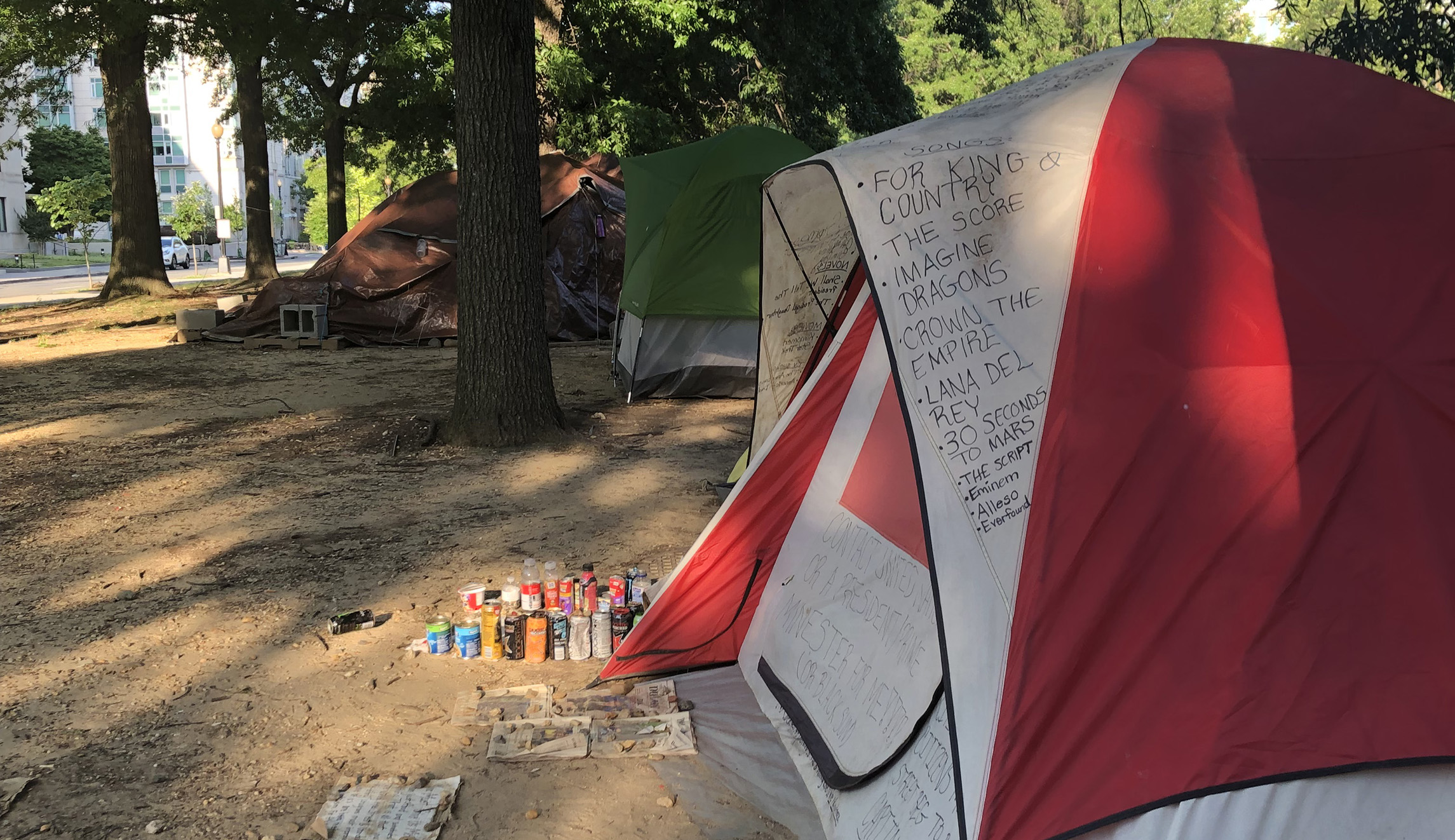
Two blocks away, a different anguish was visible in an encampment of homeless people on E Street within eyesight of the State Department and the leafy campus of George Washington University. People who have grown used to this anguish hurry past.
While city officials insist their family homeless problem has abated, there is an irony to the images of rows of tents filled with people unable to make some sort of go of it in a city surrounded by 6 of the 10 richest counties in this country.
Washington is just as complex as the small towns in Middle America that are often cast as homogeneous stretches of uneducated, immobile, resentful bigots.
In the past few months, I have driven through the backroads of Maryland, Virginia, West Virginia, North Carolina, South Carolina, Indiana, Ohio, Pennsylvania, Michigan, and probably some other states I am forgetting. My experiences are always the same: People are nice, helpful, giving, imperfect, hardworking, deeply proud of where they come from, and profoundly aspirational, no matter what trials they are struggling with.
But here’s the irony: As much as Beltway insiders are told they need to get out of D.C. and see the real America, those insiders could see the real America in their backyard if they opened their eyes.
We often miss what is right in front of us, no matter where we live. A several-mile walk through Washington reminded me that it truly does represent all of the aspirations and weaknesses and failures you can see and experience anywhere in this country.
