

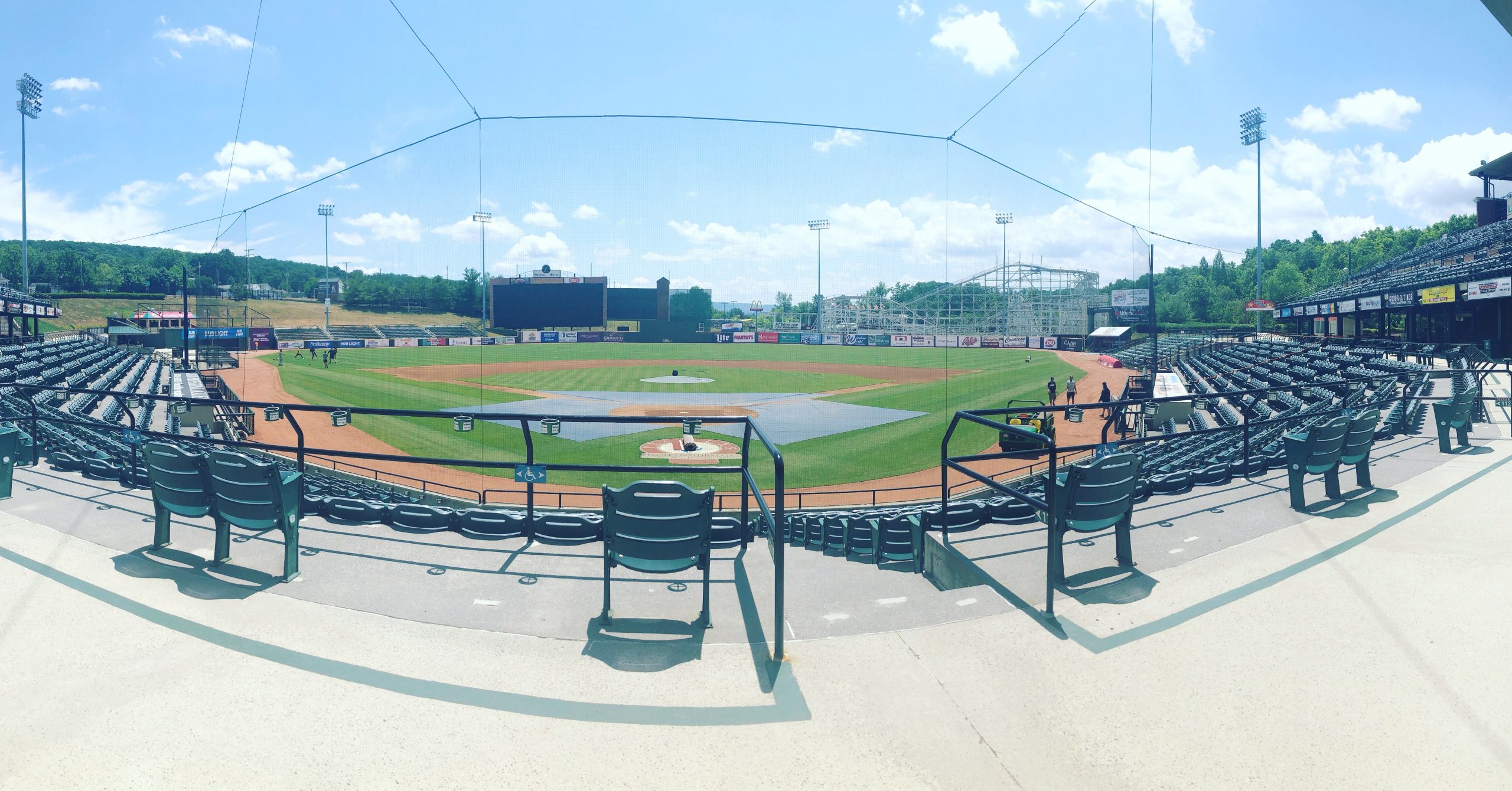
ALTOONA, Pennsylvania — As the scent of fresh-cut grass delicately fills the air, so do the aromas of the hot dogs and hamburgers coming from the grill on the lower deck. Just past right field there is an amusement park where you can hear the slow clink, clink, clink of the roller coaster as the chains and gears of the carriage climbs its ancient wood scaffoldings. The kitschy music found at any ballpark in America echoes throughout the ballpark.
On the field, the pitcher has taken the mound, the catcher is crouched in position, and an eternity passes as glances and signs are exchanged. The pitcher winds up, stretching his left hand behind his back, the ball sails toward home at a smidge over 90 mph, and “POP!” it lands in the weathered glove of the catcher.
All of the chords of America’s pastime have been struck. Almost.
The fresh-cut grass was not done by a professional grounds crew. That was David Lozinak, the COO of the Altoona Curve. The grill on the lower deck was fired up by the handful of staff left who weren’t furloughed, feeding not fans, but the players and coaches for a late lunch.
There is no one in the stands, nor any team in the visitors dugout, only the taxi squad for the Pittsburgh Pirates, who practice here daily.
There is no mascot doing cartwheels in the upper deck or T-shirt tosses for the kids, nor fireworks nights that are all the stuff minor league baseball is made of that makes its very existence a community event. It’s a place for all ages, particularly for families to be able to have an affordable night out, good food — their hot sausage sandwiches are legendary — and to be able to see young talent prepare for the big leagues.
It’s been nearly a month since Minor League Baseball announced it was canceling its season, and nothing about the void that decision left has really gone away or been replaced.
Having the Pirates taxi squad practice here almost makes the loss worse. At least before, there were no physical reminders of what could have been. Now, they are here daily, and no one is watching the next Gerrit Cole throw his first pitch on his way to greatness far outside this beautiful ballpark at the foot of the Allegheny Mountains.
It is arguably the best view in the minor leagues. Peoples Natural Gas Field, purposely designed to resemble a roundhouse, an homage to this region’s railroad past, is the home of the Altoona Curve, itself an homage to the nearby railroad engineering marvel, the Horseshoe Curve.
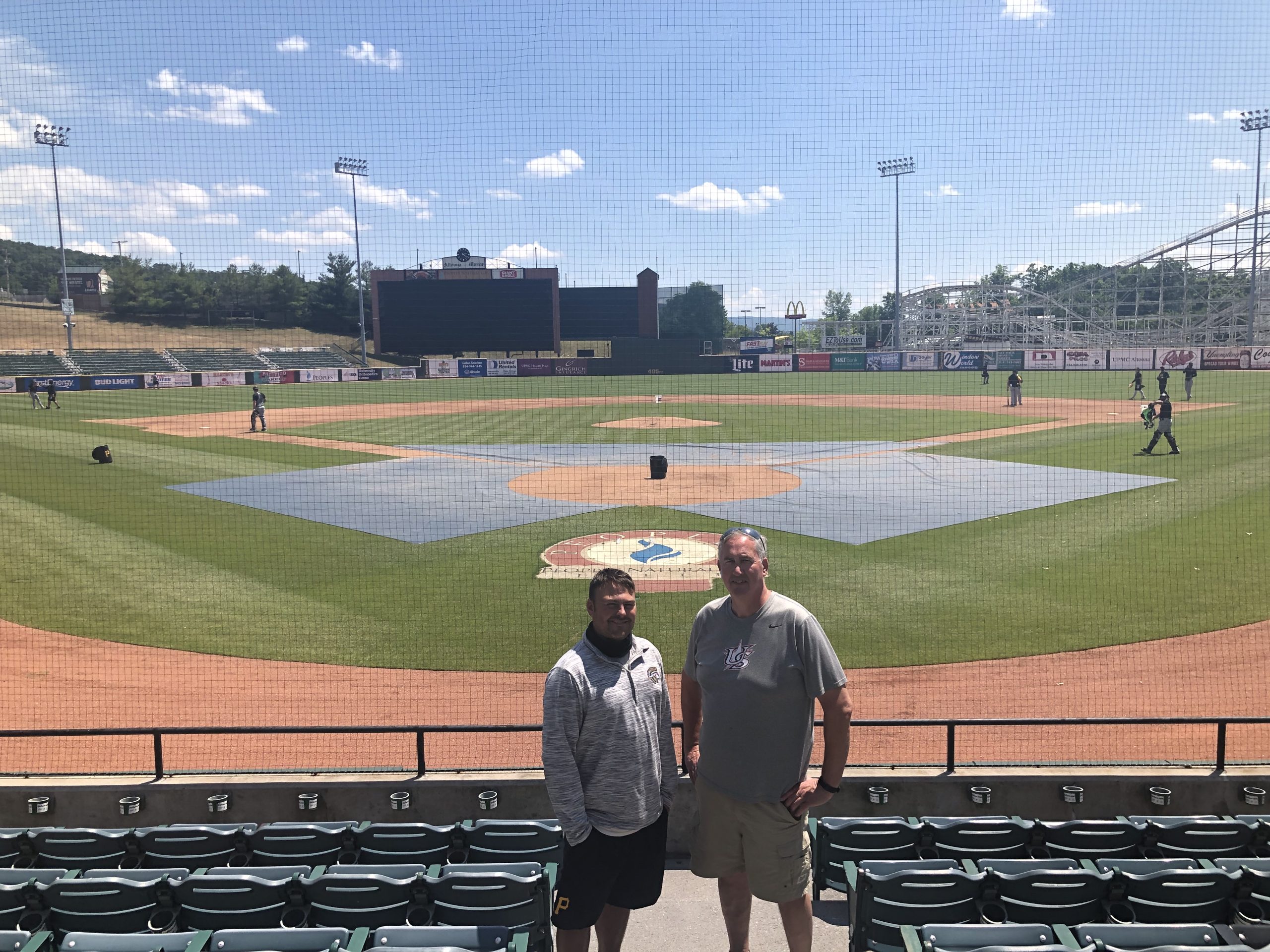
The team is the Double-A affiliate of the Pittsburgh Pirates. With its 2020 season canceled, it’s relying heavily on creativity and survival tactics to fill the gap between the last pitch of the 2019 season and the start of the 2021 season.
Minor league teams aren’t deep-pocketed enterprises living off the revenues of Major League Baseball. They are often small, family-owned businesses on the brink, like many other businesses that rely on in-person attendance.
“We are technically just like a mom and pop business,” said Lozinak, fresh off a 90-degree field that gifted him a thin film of perspiration for his efforts to keep the diamond manicured. “Whatever needs done, I do it. That’s another thing about minor league baseball, because your staffs are a little bit smaller. Especially this year, when you have a zero revenue, you got to do what you got to do.”
The county owns the ballpark; the family owns the franchise. Of their 26 full-time employees, they have had to furlough 15. But the team worked with local businesses to get their furloughed workers new jobs in the community.
Minor League Baseball is part of a ladder of systems, nearly all independently owned, that help prepare players competitively, emotionally, and physically for a spot on a major league team. They also provide the promise of tomorrow to communities, families, and children in small- to mid-sized towns across the country, people who often do not have the means, transportation, or desire to travel to a major league stadium to see a game.
On Sunday, JT Brubaker made his MLB debut for the Pirates, becoming the 171st Curve alum to reach the majors. Here in Altoona, they consistently draw attendees from four counties away. The ballpark holds over 7,200 fans.
Lozinak said his family has had roots in Altoona that go back generations. His parents, both born here, don’t just have Altoona in their blood; they have baseball in their DNA. “It was their dream to bring baseball at this level here since the 1970s,” he explained. “At that time, they were the owners of the Albuquerque Dukes,” he said of the former New Mexico Triple-A Pacific Coast League and Dodgers farm team.
Lozinak explained that his father Bob and his wife Joan were the original owners of the franchise from 1999-2001. They sold the team and owned the West Tennessee Diamond Jaxx, then reacquired their hometown team 12 years ago and have owned it ever since. Last year, Minor League Baseball named Bob “The King of Baseball,” a time-honored tradition bestowed on a veteran of professional baseball in recognition for longtime service to the game and to communities.
Today, despite the relentless sun and heat, locals steal a peek of the taxi team from the fences located hundreds of yards away along the parking lots or near the amusement park. They say they are there just to see hear the crack of the bat or to follow the signals or to see the game they love or maybe, even, to catch a ball knocked out of the park.
No matter how fleetingly the moment passes, they want to try to capture a glimpse of their former lives, of all of our former lives.
“This week past week, we introduced trivia night,” said general manager Derek Martin. “We purchased a membership with Kahoot! and displayed the game on the Jumbotron, had our regular announcer serve as the MC, and held it during the happy hour we have on the lower deck every Friday.”
It’s a way to give people access to the park and to create some revenue. Only 250 people were allowed in.
Martin began his career with the Pirates as an intern in Pittsburgh, went on to do a couple of stints at other minor league organizations, returned here as an entry-level ticket salesperson, then left baseball and Pennsylvania once he started his family.
“My wife actually saw an ad for the general manager job in the newspaper and called me and said, ‘Hey, did you look at the paper today?’ I said yes. She was like, ‘I think you should put your name in for it because that’s always been your dream, to be a GM.’”
Martin got the job, the ability to live the dream, and be close to family. He’s optimistic about next year. “We’ll be here. Baseball will be here. I can’t wait for that first pitch.”
