

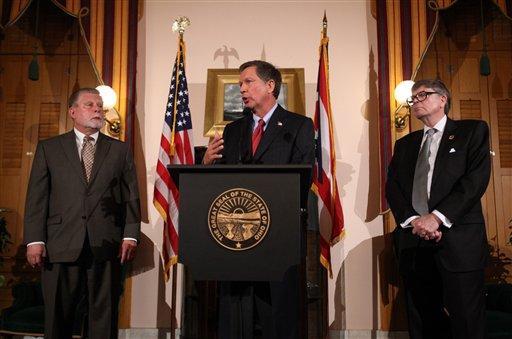
The biggest result was Ohio Governor John Kasich’s defeat on Issue 2. Voters cast 61% of their votes (as I write) to repeal Kasich’s law, which had been backed by Republican majorties in the legislature (with some defections). Kasich’s effort is part of a struggle to rein in public employee unions, which use taxpayers’ money (in the form of union dues) to elect pliable politicians who then confer benefits on their members —especially generous health care and pensions—which then result in economy-killing tax rates. It’s a kind of economic death spiral for states and localities where public employee unions are a major political force.
California Governor Arnold Schwarzenegger tried to rein in their powers with a series of ballot propositions in November 2005. The unions spent something like $100 million and defeated him. Unions spent a proportionate amount, more than $30 million it has been reported, in Ohio, a state whose population is about 30% the size of California’s.
Recommended Stories


There is some consolation here. The same Ohio voters—and the turnout seems to have been just about as high as in November 2010—who voted 61% against Kasich’s public employee union restrictions also voted 66% for Issue 3, which purported to shield Ohioans from any mandate to buy health insurance. This was a clear repudiation of Obamacare, and about half the folks that the unions turned out voted against Obamacare. There were something like 300,000 of them, or almost 10% of the total votes cast, reported as absentee balloters in the big industrial counties (Cuyahoga, Trumbull, Mahoning, Lucas, Montgomery, Franklin, Hamilton) before any other votes were counties.
But the real bragging rights here belong to the public employee unions and the Democrats. They got actual results: the Kasich reforms will not go into effect. The other side got a theoretical victory: for the federal mandate to buy health insurance, if upheld by the courts, will surely trump any state effort at repeal under the supremacy clause of the Constitution.
There is an additional charge here that may be laid against Kasich this year, just as it could be made against Schwarzenegger in 2005: political malpractice. They allowed the public employee unions to vastly outraise their side and failed to counter the unions’ ad barrages. They had effective arguments on their side that they simply did not communicate to voters. In 2005 this gave the public employee unions five more years to plunder the private sector in the states where they hold sway.
The Ohio result, on the other hand, is balanced off by the success of public employee union opponents to keep in place, by narrow margins, the restrictions imposed by Wisconsin Governor Scott Walker and the legislature by maintaining Republican margins on the state Supreme Court in an April election and in the state Senate in recall elections held this summer. Also restricting the public employee unions is the fact that taxpayers today simply do not have the kind of money to be plundered that everyone thought they did in the years immediately after Schwarzenegger’s defeat.
Other November 8 results were less negative for Republicans. At a time when polls show huge dissatisfaction with politicians of both parties, it is an interesting fact that incumbents did quite well this cycle. Democratic Kentucky Governor Steve Beshear was reelected 56%-35% just as Republican Louisiana Governor Bobby Jindal was reelected with 64% against a field of other candidates last month. Mississippi Republican Lieutenant Governor Phil Bryant was elected 61%-39% to replace term-limited Republican Governor Haley Barbour; similarly, West Virginia Democratic Governor Earl Ray Tomblin was elected 50%-47% for the rest of the term held by Joe Manchin, who resigned after he was elected U.S. senator.
In state legislative elections there was relatively little turnover. Incomplete returns suggested that the 39 incumbent state senators running for reelection yesterday in New Jersey were all reelected or running ahead, and a Democrat was winning 75% in the one open seat election in a heavily Democratic district. In the Assembly races it appeared that only one incumbent, a Democrat, was defeated and that no other seats changed party hands (I may have missed one or two). That means Governor Chris Christie will have to continue working, as he has with considerable success, with Democratic majorities.
In Virginia Republicans gained a modest number of seats—not so surprising considering that Republican Governor Bob McDonnell has one of the highest job approval rates of any state governor. Republicans got lucky and ousted incumbent Democrats in the two state Senate seats that will, with Republican Lieutenant Governor Bill Bolling’s vote, give them control there to match their lopsided margin in the House of Delegates. But they won only narrow victories. In the Southside 20th district, including Martinsville, probably the most economically ailing part of the Commonwealth, the Republican challenger won by 643 votes out of more than 50,000 cast. In the central Virginia 17th district, running west from Fredericksburg almost to the college town of Charlottesville, the Republican challenger won by 86 votes.
Democrats might reasonably seek recounts, but the Virginia totals stand up pretty solidly, as we saw when Democrat Jim Webb beat Republican Senator George Allen narrowly in 2006. At this moment, I don’t know whether Mississippi Republicans managed to win majorities in both houses of its legislature for the first time since Reconstruction; as in Louisiana, they have been gaining by party switches as well as in elections.
Generalizations? It looks to me like the political balance, which swung wildly between 2008 and 2010—the 9% Republican gain and Democratic loss in percentage of the popular vote for the U.S. House between those two elections was the largest such percentage change since the elections of 1946 and 1948—has stayed pretty much the same.
The public employee unions’ success in overturning the Kasich reforms in Ohio does not constitute an embrace of Obamacare or the other national policies of the Obama Democrats, though it does give the public employee unions a boost in morale and ability to plunder taxpayers (the Kasich reforms would have cut off the payment of union dues directly from local governments to unions, with the employee/union members having only fictitious use of the money that is technically theirs). The results of gubernatorial and legislative races suggest that the low poll numbers of both parties don’t translate into carnage for incumbents of either one, though Democrats fared a bit worse than Republicans (incumbent Republicans tended to get much more robust percentages compared to previous years than incumbent Democrats did).
In other words, in November 2011 we are about where we were in November 2010, but we’re not very happy about it. Governors who adapt well to the political climate of their states—Democrats Beshear and Manchin and, to a lesser extent, Tomblin, and Republicans Jindal and McDonnell and, to a lesser extent, Christie—are getting pretty favorable treatment from the voters.
But no sensible person thinks the Democrats’ success in Kentucky or West Virginia means that Barack Obama will fare well there in 2012. And McDonnell’s limited success and the lack of any evidence of a rebellion against (though also lack of evidence of a big rally toward) Chris Christie suggest that Obama will fare less well in states like Virginia and New Jersey than he did in 2008 and more like he did there in 2010 (when Republicans carried the popular vote for the House in both states). Plus, Obamacare is still not being received by the mass of purported beneficiaries as a wonderful elixir; it’s more like a dud.
