
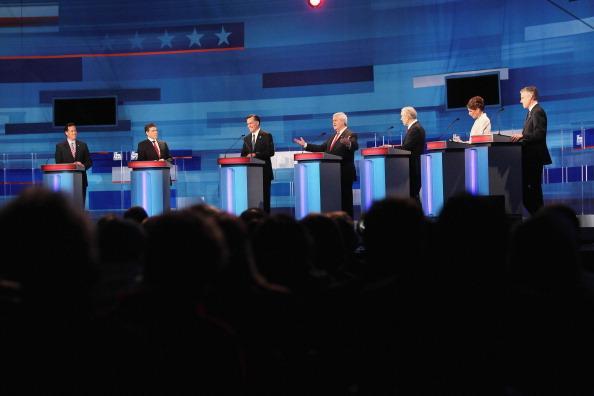
Has one of our two major parties ever had a weaker field of presidential candidates in a year when its prospects for victory seemed so great? That question was posed to me by another journalist in conversation today.
My answer, after hemming and hawing a bit, was yes: the Democratic party in 1932. Its prospects for victory were excellent by just about any measure. The gross national product had declined by 56% in four years, the unemployment rate had risen from 4% to 24% and banks were failing and wiping out depositors. We don’t know the job approval rating of the incumbent president, Republican Herbert Hoover, since the first random sample poll was not conducted until October 1935, but it surely was a lot lower than Barack Obama’s approval rating today. In the 1930 offyear elections Republicans lost 8 seats in the Senate and 53 seats in the House of Representatives; when the House convened in December (the regular schedule under the Constitution as it then existed) Democrats ended up with a majority there after a special election caused by the death of Texas Republican Henry Wurzbach resulted in the election of Democrat Richard Kleberg. (Footnotes: Kleberg was a member of the family that owned the giant King Ranch, and as his executive assistant he hired a young schoolteacher named Lyndon Johnson.)
Real journalism.Trusted by millions.
Unlimited access to in-depth reporting, expert analysis, and the stories that shape our country.
Already a member? Log in