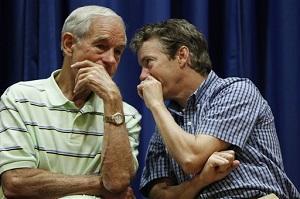
We’ve had a bit of a lively exchange this morning between two of our own — Tim Carney and Phil Klein — over Ron Paul and whether he does or should matter in this year’s election. Tim, invoking the infamous and fatal words of King Henry II, says that Paul should matter more in the GOP field because he just came within a hair’s breadth of winning the straw poll, and he has been vindicated in his lonely opposition (on the Republican side, anyway) to many policies of the Bush administration. Never mind the fact that Paul lacks message discipline and often comes across as a crank.
Phil says that Paul doesn’t and shouldn’t matter because his views are too far outside the GOP mainstream — particularly on national defense.
Recommended Stories
I have to disagree with Phil that Paul’s dovish worldview on foreign policy is too far from the mainstream. Yes, Paul takes it at times to an unpalatable limit — I don’t think most people want to hear their candidate say in a debate that it’s futile to prevent Iran from getting the bomb, whether or not it is actually true. But I believe most conservatives are prepared for a less absolutist version of his non-interventionism. Recall that in 2000, George W. Bush campaigned on a “humble foreign policy” that sounded like a (very) light version of Paul. No one panicked then. The entire country was panicking by November 2006 over his robust interventionism.
Second, on domestic policy, Paul’s time has come with the rise of the Tea Party. Those who identify with that movement are far more open Paul’s thinking on just about everything than conservatives were just nine years ago. (That includes evolving conservative attitudes toward the Iraq and Afghanistan conflicts, for example, as well as even airport screening.) I don’t think I’m going out on a limb to say that today’s Right is far more amenable to reducing the scope of our military commitments than it is toward any tax increase.
Which brings us to the third and most important reason why Ron Paul matters right now. The so-called “Super Committee” agreed to in the recent budget deal has been established in such a way that it will pit ATR against AEI, and just ahead of the Iowa Caucuses. Phil pointed this out two weeks ago, and quite correctly.
The way the Super Committee works is that its members are forced to come to consensus on a deficit reduction plan this winter, under penalty of huge across-the-board spending cuts, equally divided between defense and non-defense spending. In all likelihood, the only way to avoid massive reductions in military spending be for Republicans to agree to a tax hike. Which do you think is more likely?
In a matter of months, Paul’s worldview — the one that says we should be shutting down military bases around the globe and bringing troops home — will be pitted against a view that higher taxes might be a price worth paying in exchange for an expensive and ubiquitous military presence.
Given that Paul is a serious contender in Iowa, in a contest that will take place just as this low-taxes-versus-defense-spending battle occurs, I’d say that yes, he should be taken very seriously.
