

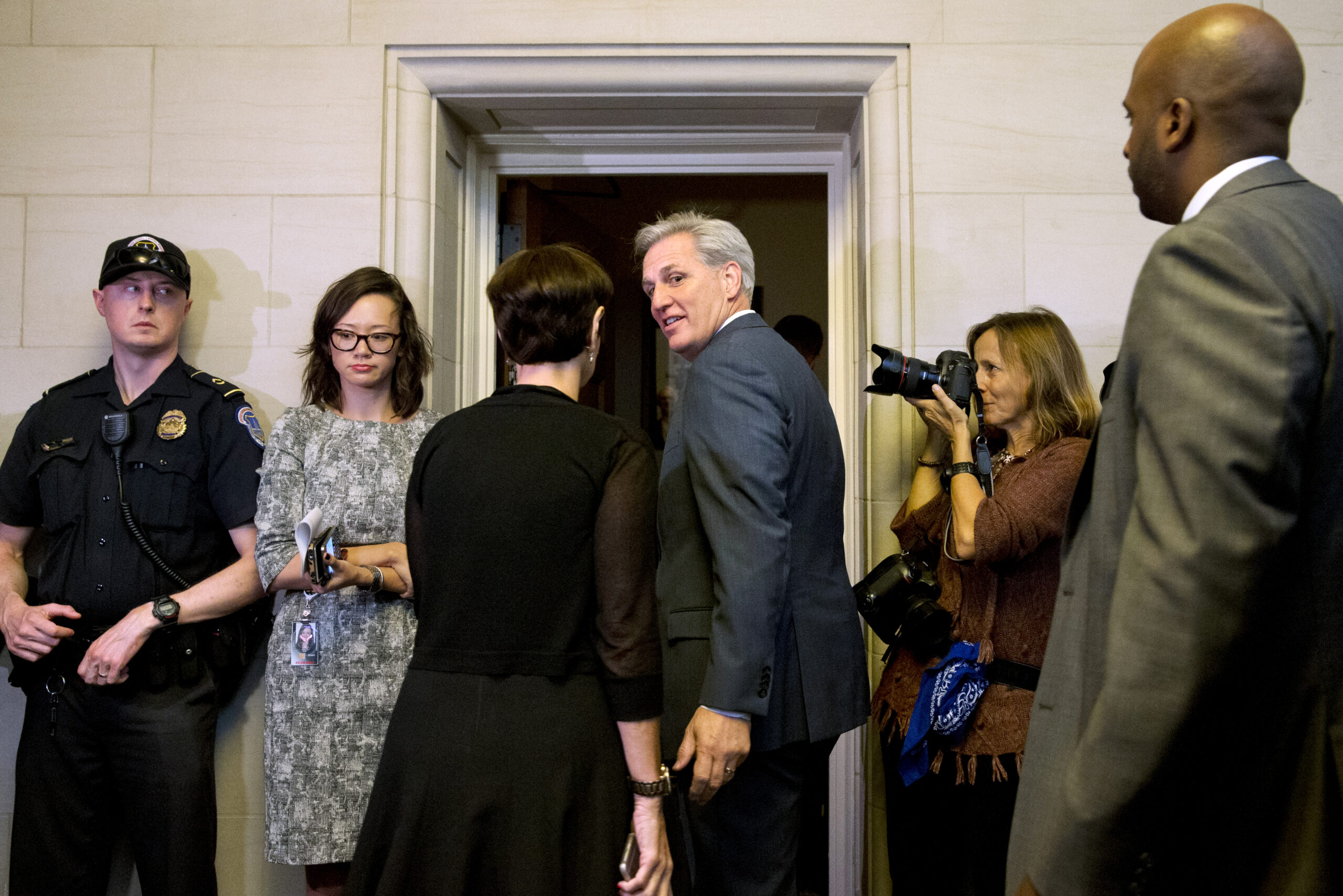
Kevin McCarthy shocked everyone paying attention, especially his fellow House Republicans, when he announced earlier today he would not run for speaker. As he suggested, Speaker John Boehner has rescheduled the Republican conference (Republicspeak for caucus) at which another Republican will be nominated for speaker. However, the possibility of the election of no speaker at all exists, if enough Republicans (30 of the 247, the highest number since the 1920s) do not vote for the nominated candidate. Theoretically, Democrats could cast a decisive number of votes and elect a speaker other than the Republican nominee; that seems unlikely and former Speaker Nancy Pelosi today said that electing a speaker is up to Republicans. If no one gets 218 votes, Boehner will presumably remain as speaker; he reiterated this afternoon that his resignation as speaker will take place only on the election of a replacement.
It is a new thing for a large bloc of the majority party to threaten not to vote for a speaker nominee. After the 1998 election, in which Republicans failed to gain seats and in fact lost just a few, several Republicans — enough to deny him 218 votes — said they would not vote for incumbent Newt Gingrich as speaker. He made the issue moot by abandoning his candidacy and resigning from the House. But that was an innovation, and the party nomination for speaker took place at the regular time, days after the congressional election; the threats of the House rebels, roughly coincident with members of the recently created Freedom Caucus, are a new thing. Of course the effect is to make the party appear in shambles and seem incapable of governing: not, you would think, a good posture in which to contest the next election.
Recommended Stories


That the rebels have been willing to make such a threat, and strongly enough that it may have persuaded Boehner to bow out, is evidence of their great frustration. This is the fifth year in which Republicans have had a House majority — indeed a larger majority than they held for all but a few months between the elections of 1994 and 2006 — and yet they feel they have accomplished little. That’s not an accurate feeling: House Republicans’ willingness to accept the sequester has resulted in federal spending remaining essentially flat for four years, something not accomplished between 1945 and 2010. But politicians tend to take their successes for granted and to dwell on their failures, particularly when a confrontation has gone on for a long time. They have had to deal with a Democratic president who lacks both the willingness and capacity to bargain and a Senate Democratic leader who is obdurate to the point of irrationality.
The irony is that this confrontation, which has gone on for almost five years now, will end in 15 months. Barack Obama will not be president after Jan. 20, 2017; Harry Reid will not be Senate Democratic leader after Jan. 3, 2017. We will have a new president, quite possibly a Republican, very possibly one who is a better faith negotiator and compromiser than Obama, and Senate Democrats will have a new leader, presumably Charles Schumer, who is oppositional but also rational enough to be (at least if you’re as smart as he is) reasonably predictable. The House rebels continue to seek confrontation and possible government shutdown, although as the poll numbers in October 2013 show that risks losing the otherwise pretty certain House majority. (If you have any doubts about this, check out Sean Trende’s Real Clear Politics analysis.) But, at least as I write, they don’t have a plausible speaker candidate. I’m sympathetic with many of the principled issue positions of Freedom Caucus members. But sometimes I think it ought to call itself the Samson Caucus.
