

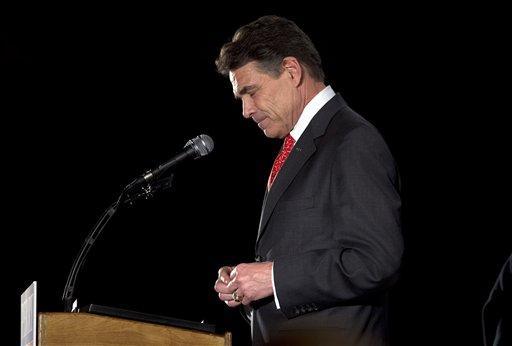
Nate Silver, whose work on his old 538.com blog and now on the New York Times website I admire greatly, has a blogpost on the question—puzzling to him and to many of us—on why Rick Perry decided the morning after his disastrous fifth-place finish in the Iowa caucuses to stay in the race, in South Carolina if not in New Hampshire, rather than bow out, as his cancellation of his travel plans to South Carolina and his return to Texas instead indicated to all of us with any history of observing these things suggested that he would.
Silver advances two scenarios for Perry’s decision. One is personal: pride demands that he keep on fighting. The other is political: his advisers, major donors, conservative leaders all demanded that he keep on.
Recommended Stories


Neither seems persuasive to me. Let me suggest a third, which I have not seen or heard anyone else advance (although I have may have missed it in the plethora of commentary). Let me call it the Tim Pawlenty scenario, after the former Minnesota governor who dropped out of the race after he lost to Michele Bachmann (and Ron Paul) in the Ames, Iowa, Republican straw poll last August 13.
Where would Pawlenty be today if he hadn’t dropped out? That’s a question Rick Perry may have thought about. As with all historical counterfactuals, we don’t know the answer, but one plausible possibility is that he may have emerged, some time between August 13 and now, as the main challenger to Mitt Romney, and he may have proved to have more staying power in that role, indeed to have overtaken Romney by many if not all metrics and not just for a month but for a much longer period of time, if he had stayed in the race. He might—might, we can’t be sure of this, but for those of us who have observed him over the years the possibility doesn’t seem nontrivial—be right now on the most plausible flight path to the Republican nomination.
What I am guessing that Rick and Anita Perry figured out on Wednesday morning, with maybe some advice from their political consultants (like my friend Mari Will) but almost certainly without any extensive conversations with Republican panjandrums across the nation, is this. If Rick Perry gets out of the race, he has zero chance of winning the Republican nomination and being elected president. If he stays in the race, his chances are not very high in percentage terms, but they are not zero. They are not zero because if Rick Santorum—the latest anti-Romney candidate to zoom upward in polls and maybe not the last one to zoom downward too—crashes and burns, then Rick Perry will be there, armed with his remaining $3 million or maybe more, to sweep up the pieces and amass a majority that can beat Mitt Romney, possibly in South Carolina, then in other Southern and maybe non-Southern states, then maybe win the nomination if Romney implodes.
Not a high probably scenario, but not a zero probability scenario either. And if you have $3 million sitting there, which you probably don’t have any other possible legal or politically defensible use for, why not use it to stay in? This is one area in which you’re better positioned than Pawlenty, who had zero cash and a lot of debt when Bachmann clocked him in the Iowa straw poll.
I am inspired to think this by a thought experiment I did after the 1992 election. As you will recall, Democrats were thought to have no chance to win in the first half of 1991 and many prominent Democrats—including Al Gore, John Kerry, Lloyd Bentsen, Bill Bradley, Dick Gephardt—decided not to run. Bill Clinton, then facing political extinction in Arkansas (both a Democratic primary opponent and a Republican general election opponent had gotten about 40% against him in 1990; it looked like his long string of Arkansas victories was about to end, with neither of the state’s two popular Democratic U.S. senators doing him the favor of retiring without winning another term) decided to run and declared in October 1991. Against weak primary opposition who were unable to beat him despite the Gennifer Flowers revelations, the draft dodging scandals and many other problems; aided by a Ross Perot whose critique of George H. W. Bush undermined him; and against a president, Bush, who at age 68 and after the 50th anniversary of his entry into public service might, absent the example of Ronald Reagan being elected president at ages 69 and 73, have chosen to retire, Clinton won.
Clinton is a brilliant politician, and he made it look easy. Nonetheless, I think after the 1992 election these other Democrats I have mentioned—Gore, Kerry, Bentsen, Bradley, Gephardt and probably others—went through the following thought exercise. They said, let me make a list of the reasons I was not elected president in 1992.
Reason one: I did not run for president in 1992.
Reason two: There is no reason two.
I think—I am guessing—that Rick Perry went through a similar thought exercise on Wednesday morning. He didn’t need prompting from Republican panjandrums; perhaps he and his wife went through the thought process together. After a few minutes, he or they got to Reason two. And, with $3 million they can’t spend (probably) in any other way, he or they said: Let’s stay in. Our chances of winning may be as low as 2%. But if we get out, they are, like Tim Pawlenty’s, zero. What have we got to lose?
There are 310 million people living in the United States. Only about 10 to 15 of the–maybe fewer–ever have been, are or will be president of the United States. If your chances of reaching that office were higher than zero–no matter how much infinitessimally higher than zero–would you want to reduce them to zero, just like that? Evidently Rick Perry didn’t.
