

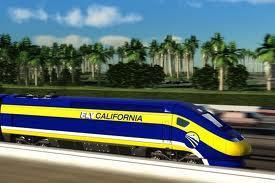
I have been inveighing against high-speed rail, one of Barack Obama’s pet projects, for some time, as faith ful readers know. Now it appears that writers on the left have problems with high-speed rail too. Kevin Drum, writing on his Mother Jones blog, weighed in on this last week. I’ve never met Drum, but from his writings he seems to be a very nice person, not given to nasty invective and willing to consider issues on their merits. Like California high-speed rail, the estimated costs of which have just been raised sharply. Drum concludes:
Recommended Stories



In response to Drum, Brad Plummer on Ezra Klein’s Washington Post blog weighs in with the weakest defense of California high-speed rail I’ve seen. He fends off concerns about one cost estimate increase by saying it “wasn’t an overrun, it was an accounting switch.” He notes that the estimate for the 100-mile segment from Borden to Corcoran (no, they’re not big towns) in the Central Valley, which the Obama administration has been eager to fund, have increased from $8 billion to $10 billion (hey, what’s $2 billion between friends?) because Chowchilla wants a bypass and Fresno wants an elevated line. Of course that’s nothing like the expense for running the line underground that residents of Atherton on the Peninsula south of San Francisco are demanding. The median house price in Atherton (next door to Menlo Park and Palo Alto) is something like $4 million, and I suspect residents of Atherton will have even more clout in getting what they want than residents of Chowchilla.
Plummer notes that the cost per kilometer in the Central Valley (the least heavily populated part of the route) is only 25% higher than the cost per kilometer of the French TGV high-speed line between Paris and Lyon. He says that California’s population will keep swelling in the years ahead, though we don’t actually know that: in 2000-10 California’s population went up by the same percentage as the national average, the first time that’s happened since it was admitted to the Union in 1850, and that increase was driven largely by immigration, which seems to be slowing down (the Mexican government estimates that net outflow from Mexico to the United States in the last year is down to zero). There has been net outmigration by Americans out of California, so it’s possible that in the next decade it will have sub-average population growth.
Plummer quotes some pro-high-speed rail source as saying that California’s putative population increase will require the building of 3,000 miles of new freeways, five airport runways and 90 departure gates. “But is that all realistic?” he asks, intelligently. “It depends on whether you believe the state’s ridership estimates for the new rail system,” he continues, “and critics have been casting plenty of doubt on those numbers of late.” At which point the blogpost ends.
If this is the best defense of California’s high-speed rail enterprise, it’s even more of a boondoggle than Kevin Drum has reluctantly concluded.
