

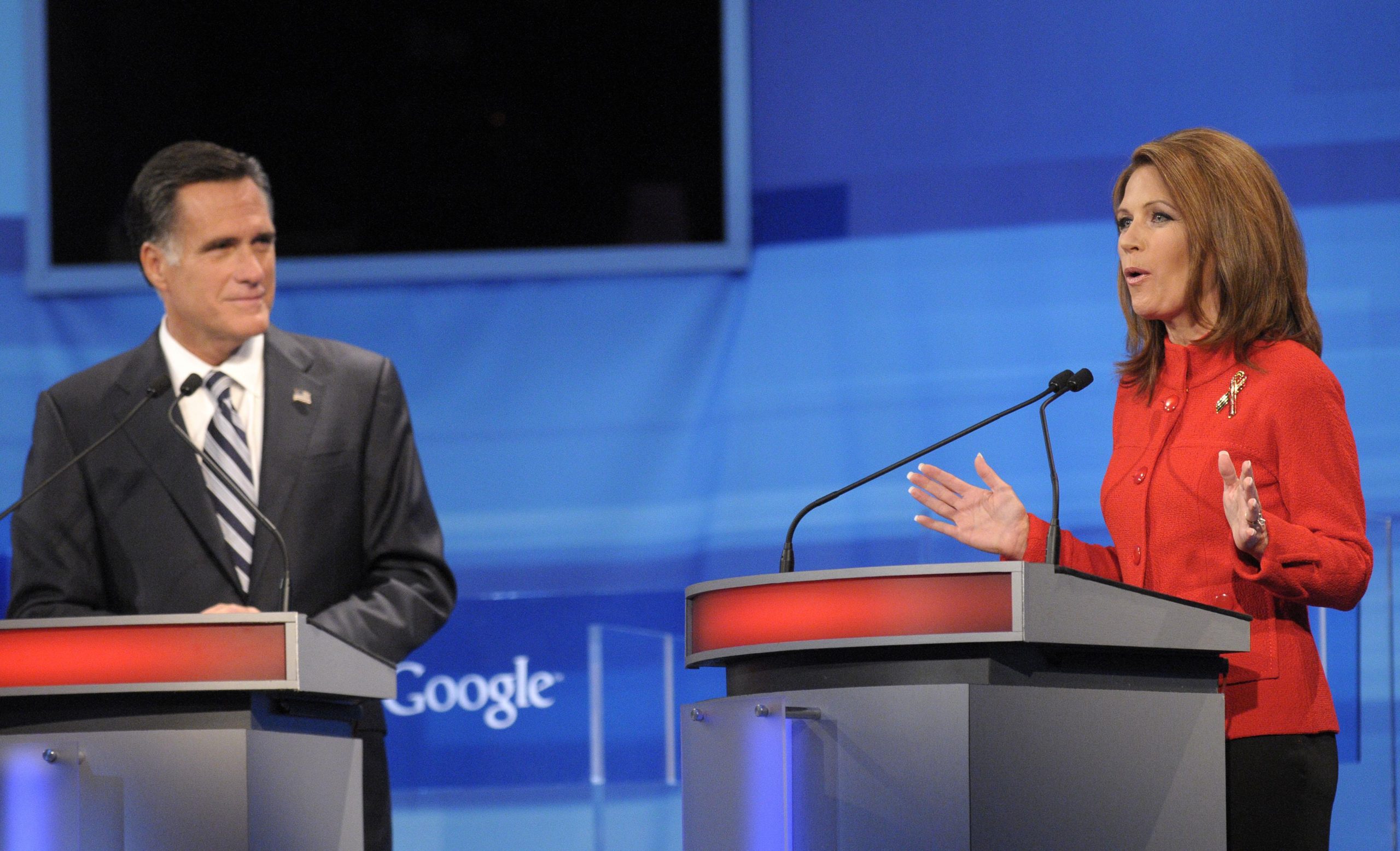
A couple of addendums to my previous blogpost on the Bloomberg/Washington Post Republican presidential debate at Dartmouth College. Here is the transcript of Romney’s response on TARP that I referred to in my blogpost:
MS. GOLDMAN: Because more than half the country believes that a financial meltdown is likely in the next several years, and the U.S. banks have at least $700 billion in exposure to Europe. So it’s a very real threat, and voters want to know what you would do differently.
Recommended Stories


MR. ROMNEY: There — it’s still a hypothetical as to what’s going to precisely happen in the future. I’m not very good at being omniscient, but I can tell you this: that I’m not going to have to call up Timothy Geithner and say how does the economy work, because I’ve spent my life in the economy. I spent my entire career working in the private sector, starting businesses, helping turn around businesses, sometimes successfully and sometimes not. And I know how to make tough decisions, and to gather the input of people from around the country to help make the important decisions that have to be made. Clearly if you think the entire financial system is going to collapse, you take action to keep that from happening. In the case of Europe right now, they’re looking at what’s happening with Greece. Are they going to default on their debt? Are they not? That’s a decision which I would like to have input on, if I were president of the United States, and try and prevent the kind of contagion that would affect the U.S. banking system and put us at risk.
But I can tell you this. I’m not interested in bailing out individual institutions that have wealthy people that want to make sure that their shares are worth something. I am interested in making sure that we preserve our financial system, our currency, the banks across the entire country, and I will always put the interest of the American people ahead of the interests of any institution.
MS. GOLDMAN: But — so would you — so would you or would you not be open to another Wall Street bailout?
MR. ROMNEY: Well, no one likes the idea of a Wall Street bailout. I certainly don’t. Asset — asset —
MS. GOLDMAN: But you said in 2008 that it prevented the collapse of the financial —
MR. ROMNEY: There’s no question but that the action that President Bush and that Secretary Paulson took was designed to keep not just a collapse of individual banking institutions but to keep the entire currency of the country worth something and to keep all the banks from closing and to make sure we didn’t all lose our jobs. My — my experience tells me that we were on the — on the precipice and we could have had a complete meltdown of our entire financial system, wiping out all the savings of the American people. So action had to be taken.
Was it perfect? No. Was it well-implemented? No, not particularly. Were there some institutions that should not have been bailed out? Absolutely. Should they have used the funds to bail out General Motors and Chrysler? No, that was the wrong source for that funding. But this — but this approach of saying, look, we’re going to have to preserve our currency and maintain America and our financial system is — is essential.
My other addendum is the interesting role that Michele Bachmann played in the debate. She started off strong by responding to one of Karen Tumulty’s question, redolent of Madame Defarge, on whether someone from Wall Street should have gone to jail and, by the way, didn’t the financial collapse result from deregulation? Bachman pointed out that it was government regulations, not deregulated markets, that were primarily responsible for the financial collapse. She was also solid in pointing out that Obamacare’s 15-member Independent Patient Advisory Board would make health care decisions for 300 million people.
At other times she seemed to be playing on Team Romney, launching tough attacks on the rivals closest to him in the polls. Bachmann was the most aggressive critic of Herman Cain’s 9-9-9 tax plan, saying it was a tax plan and not a jobs plan and that it would open up a pipeline for a revenue stream to government that could easily be increased by raising the national sales tax rate. His argument that the sales tax would never be raised because it was so transparent that Congress would never do so was not wholly persuasive, and his assurance that no increase would ever pass because he as president would veto it is unconvincing since he will not be president forever. In the ask-another-candidate-a-question period, Bachmann asked Perry about the fact that he used to be a Democrat and that Texas’s bonded debt had more than doubled during his years as governor. Perry came back with good prepared responses to both points, but she left him playing defense, not offense. Moments later, Romney reciprocated by asking Bachmann to expand on how her tax proposals would help families make ends meet: the quintessential softball.
This is not the first time Bachmann has helped Romney. Her victory in the Ames, Iowa, straw poll August 13 resulted in the elimination of Tim Pawlenty, who seemed likely to contest moderate/establishment type Republicans with Romney. And her limited experience enabled Romney, in the weeks when she seemed to be a chief rival, to have an advantage in that regard which he would not have held against some other candidates.
