

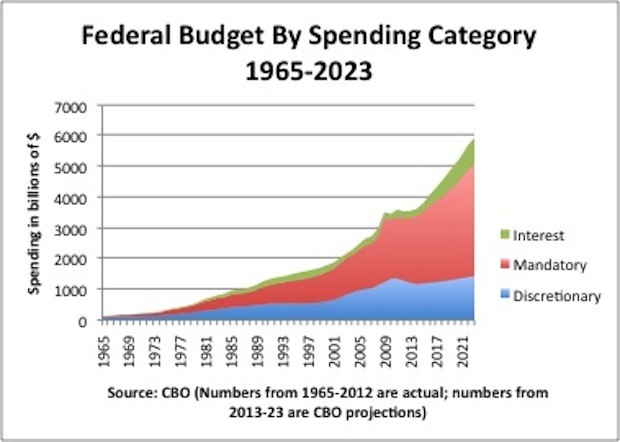
In my column this week, I outlined how the latest Congressional Budget Office report on the nation’s finances unequivocally showed that entitlements — not military spending or too low taxes — were the true driver of the nation’s long-term debt problem. Following up by taking into account CBO’s projections for the next decade as well as historical data, I put together this chart of the growth in the three main categories of spending from 1965 (the year that Medicare was created) and 2023 (the year the latest CBO projections end). What it shows is that it’s going to be increasingly difficult for future budget agreements to avoid dealing with the growth of mandatory programs.
For the unacquainted, discretionary spending is subject to the regular Congressional appropriations process that gets debated each year. It includes functions such as defense, education, transportation, foreign aid and science research. In contrast, mandatory programs such as Social Security, Medicare, Medicaid and Obamacare set benefit and eligibility requirements. Spending on these programs grows as the cost of providing those benefits and the population eligible for those benefits swells. Barring the elimination of these programs, shrinking mandatory spending requires legislation that changes the design of the programs. As the graph above illustrates, mandatory spending has grown substantially over time, from about 27 percent of the budget (including interest payments) in 1965, to a projected 62 percent of the budget in 2023. This reflects a combination of policy choices: expanding the offerings of the programs (such as President Bush’s signing of the Medicare prescription drug plan or President Obama’s increase in income eligibility of Medicaid), creating totally new programs (as with Obamacare’s subsidized insurance exchanges) as well as the growth of the aging population and rising health care costs.
Stay informed.Stay ahead.
Join Washington Examiner for unlimited access to the news, analysis, and commentary that matter most.
Already a member? Log in
