

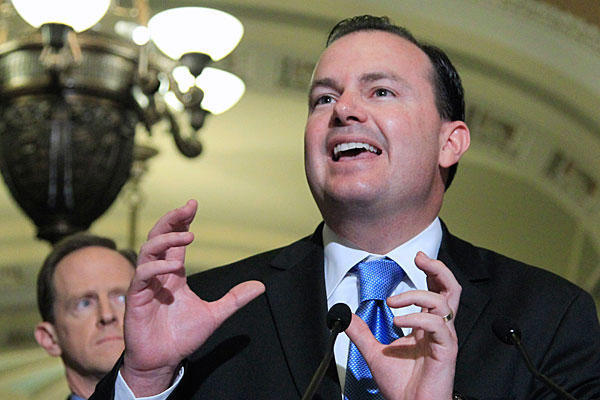
On Tuesday, Sen. Mike Lee of Utah, one of the conservative stars of the 2010 freshman class in the Senate, sat down with the Washington Examiner’s editorial board for a wide-ranging discussion. Lee, a former clerk to U.S. Supreme Court Justice Sam Alito, explained why he thinks President Obama’s national health care law will be overturned later this month. He also spoke about the types of health care reforms he’d like to see as well as earmark reform, energy subsidies, the use of the filibuster, his bill to ban late-term abortions in the District of Columbia and Romney’s Mormonism. What follows is a transcript of the discussion.
Well obviously you follow constitutional issues quite closely, and clearly later this month we have the decision coming out, the constitutionality of the health law. I guess if you can give your thoughts on where that could go and also if it does get overturned, what implications do you think that will have? Will it sort of put a check on future Congresses, do you think that they’ll consider constitutional issues more closely when drafting legislation?
Recommended Stories


Lee: Yeah, so when you say where it could go, I assume you’re asking where it will likely go?
Yeah.
Lee: So, predicting which way the Supreme Court’s going to go on any particular issue, which way it’s going to rule is of course a dangerous business, one that I try to avoid engaging in, one that I seem completely unable to avoid engaging in. Particularly in a case like this one that is so interesting, so fraught with constitutional issues. And so I have to issue that disclaimer, it is dangerous to make these predictions but I’m going to make them anyway. I’ve been attending Supreme Court arguments, been watching Supreme Court arguments since I was 10 years old, it was an odd habit I picked up as a kid, and I can tell you that I have never in my entire life seen an argument in a case that was expected to be close that was expected to be decided probably by a five to four vote, never seen a case where it was as close, as clear to me at the end of the argument as it was in this case which way they were going to rule. The clearest, most obvious vote going into the argument had to be Justice Thomas, because his writings on the commerce clause have been so clear ever since his concurring opinion in the 1995 decision of United States v. Lopez. So we knew which way he was going to go from the outset. And then I watched very closely Chief Justice Roberts, my former boss Justice Alito, Justice Scalia, and Justice Kennedy — especially Justice Kennedy at oral argument. Based on the questions they asked, their cadence and intonation, their facial expressions both while asking the questions and while listening to and responding to the answers provided them by arguing counsel, I came away with the firm and abiding conviction that the court will likely buy a vote of five to four invalidate the individual mandate of the Affordable Care Act. Now if you invalidate the individual mandate, according even to the administration’s position, you can’t invalidate the individual mandate without also taking out community rating and guaranteed issue. But if you take out that trifecta, then you, in effect, as Justice Scalia pointed out at oral argument, it’s kind taking out the heart of a statute. And under the court’s framework, analytical framework for the severability doctrine, the court has to sort of imagine what Congress might have passed had it not passed the severed provision or provisions.
But in this case if you take out heart, how can you assume that something on the periphery could have ever been passed? I think it is likely, therefore, that they invalidate the individual mandate and I tend to think they’re going to take down all of it, that they’re going to deem is non severable. That gets to the second part of your question, what then? We have to avoid, I think if we get to that point which I’m predicting, which we should get to either on Monday of next week, this coming Monday, the 18th or the following Monday, the 25th of June, if we get to that point, we have to avoid what may be an impulse to respond very quickly by passing something else just so we can say, look, we’re getting something done, we’re responding to it.
That’s part of how we got into this problem to begin with is that legislation was moved through Congress much too quickly. A 2,700-page bill should be something that’s adequately and extensively debated and discussed in committee and the floor of both houses and that didn’t really happen. In the House they were told, you’ve got to pass it to find out what’s in it, and it’s not really a good way to offer a legislative solution so I think it should be done methodically and carefully, but we shouldn’t go and try to do the same thing all over again, especially with the same speed.
But what do you think in terms of the Republicans settling on some sort of market-based health care alternative? There’s different ideas there but Republicans have failed to coalesce around a given idea and particularly if the Supreme Court rules as you think that they’re most likely to rule, a lot of focus is going to turn to Republicans and what’s their plan for doing anything.
Lee: Yep. I have a few ideas of what we could look at. I have, for a long time, wondered whether it’s a good idea to continue with the same structure that we’ve got that encourages and all but guarantees that decisions on health insurance will be made by the employer at the employer level. Made by one person on behalf of either dozens, scores, hundreds or thousands, sometimes tens of thousands, sometimes hundreds of thousands of employers depending on how big the employer is. We have over the course of decades gradually separated the patient from the provider. We did that as I understand it, at a time during World War II when there was some kind of cap placed on salaries. And employers came to Congress saying, ‘hey, you’re killing us. We’ve got to be able to compete with each other, can we at least do something, even if we can’t raise salaries’ And they said, ‘okay, well we won’t count it as a salary increase if you offer certain types of benefit plans including health insurance.’ And they said, ‘okay, great.’ And so that – it sort of evolved in a way that health care plans were not regarded as income and so this tax benefit gradually evolved that has caused most Americans to get their health insurance through their employer. I have serious doubts whether that has served us well. What I would like to see is something closer to what I proposed in connection with my the American Dream plan which is move towards a system in which individuals can make that decision on their own and offer them a tax credit, a $3,500 per family tax credit that they can use to chose their own healthcare plan. I think that’s something that really could help. I think most decisions, most of the drivers affecting healthcare costs are, and probably should be made at the state level. It’s states, after all, that license doctors and nurses and hospitals and clinics, licensed health insurance companies and regulate health insurance companies. It’s states that determine the system of laws that govern medical malpractice and liability. And so there are lots of things that – there’s some things that Congress can do.But a lot of what Congress can do is step back and allow the individual and allow the state to drive these decisions more effectively.
Your class, 2010, great class of new conservatives. (Sens. Rand) Paul, R-Ky.; (Pat) Toomey, R-Pa.; (Marco) Rubio, R-Fla.; (Ron) Johnson., R-Wis. Looking to 2012, what races are you excited about to get some reinforcements for some new conservatives in the Senate?
Lee: Ted Cruz in Texas is one of my absolute favorites. Ted may be the closest thing to my ideological twin in this upcoming class. There are certainly others that I really like. I look forward to working with Jeff Flake from Arizona. I think he will be really good. Josh Mandel in Ohio is an exciting candidate, I think that is one race that doesn’t get as much attention as it maybe should. I think he’s be great, he would be interesting to work with. I’ve enjoyed getting to know Richard Mourdock in Indiana. Deb Fischer in Nebraska is someone that I don’t know really well yet but I’ve met her a few times now and have had some great conversations with her. I think she’s one who will be great. There’s a guy in Maryland. I know, it’s Maryland. But there is an awesome candidate in Maryland named Dan Bongino. First time I met him, I didn’t even know he was running for office. He was quoting (Friedrich) Hayek and (Frederic) Bastiat and caused me to just be more interested in the conversation then I found out he was running and I found out he was a former Secret Service agent who left the Secret Service specifically to run for the senate, great guy. Anyway, there’s some very, very exciting candidates out there. (Mark) Neumann in Wisconsin is another one.
What about yourself? Ron Johnson almost got into a leadership post. Do you have any plans right now to look ahead to leadership for yourself, do you see yourself playing a role especially with (Sen. Jim) DeMint, R-S.C., still on track to leave soon?
Lee: I definitely see myself playing a role in Senate, I definitely see myself as part of this new wave of conservatives. I don’t know that that necessarily translates into the need for me to hold a formal leadership position, but that’s something that –
Is that because you’re the youngest Senator?
Lee: No, I don’t know that age necessarily has anything to do with it. I don’t think it’s age that would either keep me out or in to a leadership race, but, yeah, my focus right now is on trying to build on this coalition of conservatives that we’ve got.
There’s a date going on sort of in the background, the House Republican conference and also in the Senate conference on earmarks. Sen. (Tom) Coburn, calls them a gateway to the federal spending addiction. Sen. James Inhofe, his colleague from Oklahoma, calls them a Constitutional mandate. Where do you stand on that and where do you see that debate going?
Lee: I think the issue with earmarks has to involve the need for procedural reform, so constitutionally speaking, Congress has the right certainly to decide how money is going to be spent. The fact that Congress has that right doesn’t mean that it should exercise that right without any procedural restrictions to make sure that each spending request has at least the potential of being thoroughly vetted. I think that earmarks need to be subject to –
and by earmarks I’m referring here to legislative spending that channels money into a specific identified state, locality or to a specific recipient, a business enterprise or otherwise as opposed to a government program or for a broader objective – needs to be subject to some kind of a point order, perhaps a 60 vote point of order such that if you’ve got multiple earmarks in a single piece of legislation there needs to be a procedure whereby someone can raise the point of order which once raised, requires that particular spending request to stand on its own, to be able to withstand scrutiny and be able to be passed on the same margin as if it were a single legislative proposal.
In other words you’d have a vote on all 10,000 earmarks that were in the –
Lee: As to any one earmark as to which the point of order was raised, yes.
Do you think miscellaneous tariff bills are earmarks?
Lee: Some have argued that they are. In my mind they don’t trigger the name kind of concerns that others do. I think there is, nonetheless, a reasonable argument to be made that they fit within the technical definition and that’s why Sen. DeMint along with a few others have been working out a kind of work around strategy for that one. And I think they’re pretty close to a solution.
Have you paid attention to Raser Technologies, a green energy company in your state? This was a priority of your colleague, Sen. (Orrin) Hatch, and when they opened the plant, they called it the Hatch Plant, and now it’s bankrupt.
Lee: This is a geothermal plant?
Geothermal plant, and they have an automotive –
Lee: Right, the automotive part of it does some kind of a hybrid electric Hummer or something like that.
And it’s interesting to me, because the Republicans have been making Solyndra an issue, I mean that’s almost going to be a central issue in the presidential race. But Republicans have generally supported a lot of clean energy stuff until now, including Senator Hatch requesting earmarks for and according to policies to make it easier for Raser to get special tax credits, so I guess my question to you is, do you agree with Sen. Hatch that there should be renewable energy tax credits that are easier to get? And do you think in general Republicans are going to move away from energy subsidies as part of their attack on Solyndra, or are they just going to attack Solyndra?
Lee: I think you see Republicans moving away from subsidies in the energy area, whether it’s renewable energy or alternative energy one way or another. I think that’s the way that we’re trending and that’s the way that we should trend. That’s certainly how I feel about it. I’m uncomfortable with government deciding who’s going to succeed and who’s going to fail in business, and that’s kind of what we do when we hand out earmarks to one business over another. That’s what we did in the case of Solyndra and that’s what we do whenever we hand out an earmark of one sort or another to one business over another. And it doesn’t end well. It’s not just that there’s a risk that one company or another might not make it, and that the taxpayers might be left realizing that they have funded something that didn’t end up succeeding. It’s also just the damage that you do to the very big, very powerful government can do to the market by stepping in and putting an advantage over one company that happens to have sufficient politician prowess to be able to secure a government funding source.
That means the tax credits that favor one company over another?
Lee: Well, yeah, I mean, yes, if it’s a tax credit, and tax credits start to look an awful lot like cash, so, yeah.
Deductions? Oil depletion allowance?
Lee: Yeah. That one gets a little bit trickier, but that is one reason I favor a comprehensive tax reform package, one that just gets everybody paying a single rate. If we move the corporate income tax rate, say to 20 percent or 25 percent, everybody pays the same rate and you just don’t deviate from that at all. I think that would solve that problem. Now if you talk to the oil companies, they’ll explain why the deduction that you mentioned has been built into the equation over a long period of time and that the investment backed expectations about that credit and I understand that. But we’d all be better off if we had a lower rate and we just stuck to that.
Given the track record of some of your Republican colleagues in the Senate, should the party be successful in taking over the Senate in November, do you think a Paul Ryan budget could pass?
Lee: Yes.
And would you vote for it?
Lee: Well by a Paul Ryan budget you mean something like that? I mean, budgets don’t exist outside of time and space and so what is the Paul Ryan budget today could not mathematically be the same budget that exists in the next Congress.
Using the same principles.
Lee: The same principles meaning moving toward a premium support type reform for Medicare and so forth? Yes, absolutely. And I think something like that will happen. I am an optimist by nature and I tend to think that Republicans are going to secure a majority. It may be a modest majority, but a majority nonetheless in the Senate. And I think we will maintain, we will retain the majority in the House, we may lose some seats but not enough to lose the majority.
What’s your position on the use of surveillance drones in the United States?
Lee: It worries me. The 4th Amendment was designed to protect the reasonable expectation of privacy that individuals have in their homes and depending on how they’re used, it’s one thing, I’m not one who would say that any drone used domestically for any purposes is bad, there are lots of legitimate uses for them. I can imagine, just to cite one example, state departments of public safety using them to monitor traffic and identify traffic problems and things like that.
What about the border, patrolling the border?
Lee: Yeah, I think that’s another potentially legitimate use for drones domestically. The more of them you have and the more uses you have, the greater the likelihood that there could be some mischief with them. There’s really no one formula for it other than you’ve got to always get back to the constitutional touchstone of the 4th Amendment.
Do you think allowing state and local law enforcement to use drones would be going too far?
Lee: Well, no, because again if you’re using them to monitor traffic conditions or something like that, I don’t think there’s any real risk there or certainly the risk is manageable as it relates to privacy interests. But if, on the other hand, you’re stationing a drone over the homes of individuals that the state just wants to watch and see if they do anything illegal, to see if somebody is surreptitiously retreating to their backyard with a specific purpose of removing the “do not remove” tags from their mattresses. That causes some concern.
Just following up on health care. If people are talking about the likelihood of Supreme Court removing a mandate, there are going to be whole pieces of the health care formula that have already been moving and are already pretty well popular with people, among them elimination of lifetime caps, allowing children to stay on their parents’ health insurance until age 26, no preexisting condition exclusion for children. How are Republicans prepared or you, for instance, to deal with those kinds of things because Republicans said, we’re going to repeal the entire thing regardless of what the Supreme Court does, what’s your response going to be to the public talking about the popularity of these provisions? Are you just going to say, forget it, we’re just going to have to start over and you’re going to have to give up this stuff? Or do you see, you guys talking about some area of compromise where you can kind of preserve yourselves politically?
Lee: Yeah. First of all, I think it’s important to remember that it’s not necessarily the case that a ruling by the Supreme Court will necessarily mean that everyone’s health care options become more limited. Which insurance company was it? Yeah, it was United Healthcare, yesterday, that announced that many, if not all of the items on your list would still be honored by United Healthcare regardless of which way the Supreme Court rules. Now United Healthcare is a sophisticated business operation. They’re not going to say that unless they believe that they can make it profitable, that they can continue to operate effectively and efficiently with those reforms in place. If they do that, that’s going to put enormous pressure on their competitors to do the same. And I think a lot of them can do that and will do that.
I do think we’ve got to be careful about legislating nationally on these issues because again, the federal system was always intended to be one in which states would compete with one another. Most insurance decisions are intended for state regulation and not federal regulation. Many of the problems that we have in our health care system today are direct results of excessive federal intervention. Let me give you just one example. Insurance is essentially a contract. When you buy health insurance, you’re essentially buying a contract with somebody else who’s going to provide you with healthcare services, who’s going to provide you with health insurance. It’s not really insurance anymore, but it sort of is. Historically, almost any contract, somebody breeches that contract, your remedy is a breach of contract action arising under state law brought in state court. There are provisions of federal law, most notably provisions of ERISA, this behemoth monstrosity of a statute that is about 40 years old and has been the fodder for a lot of litigation in a lot of federal courts across the country. But there are provisions of ERISA that end up basically making it impossible for you to sue your health insurance company for breach of contract. And that erodes the transparency between you and your insurer and so anyway, my point is just where we have gotten the federal government involved, a lot of time we’ve made it worse rather than better. I want to see us avoid making the same mistakes and in my mind, most of the solutions involve less federal government involvement rather than more. So I’ll have to be talked into any expansion of the federal role and healthcare even at the margins.
So you’re saying these provisions that I was just talking about as well as many others, you still are prepared to throw out the entire health care law if the individual mandate alone is struck down regardless of the popularity of those provisions because don’t forget, the Democrats will be able to pretty handily use that against Republicans in the upcoming election that they’re going to take away the stuff that you’d like. How are you guys prepared to argue against that?
Lee: I’m prepared to argue against it by saying, I took an oath to the Constitution and I’m required to do that under Article 6 of the Constitution. My particular view of that oath is that it requires me to undertake my own constitutional analysis above and beyond whatever the Supreme Court will allow Congress to get away with. And that I can’t, consistent with my oath to the Constitution, legislate in matters that I don’t think I’m empowered to legislate, just because they may be popular. And there are a lot of these debates that can and probably should occur within the halls of our state legislatures but not on Congress.
Follow-up on a separate issue, the filibuster in the Senate. There’s all kinds of talk about getting rid of that and it seems as though the majority is edging ever more closely to move to try to eliminate the filibuster. How do you feel about that? Just with the Republicans on the verge of potentially taking the majority of the Senate, it certainly would come in handy for you if you had a point of margin that you needed to pass things but then of course there it would be whether you were with the majority or not. How do you feel about the filibuster and the 60-vote threshold?
Lee: Well when it’s used as it was, I believe, always intended to be used, I think it serves a legitimate purpose which is to allow debate to continue and ideally to allow for a relatively open amendment process, and that’s what distinguishes the Senate from other legislative bodies and certainly what is supposed to distinguish the Senate from the House. It hasn’t been operating that way in part because of the current majority leader’s practice of relying on a combination of filling the tree and rapid-fire cloture votes in order to end debate and close out amendments that he doesn’t like. So I guess part of my answer to that depends on the question, what exactly do you mean by the filibuster rule, if he’s wanted to end his current practice, great. But if he’s wanting to end the longstanding tradition of allowing for extended debate and a robust open-ended amendment process, then I’m not for that.
But if Republicans were to get majority, you’d be in favor or changing the current Senate rules?
Lee: At least changing the way that they’re administered such that you don’t have – I don’t think it serves the interest of the Senate, of individual senators, or the country as a whole to have a process that gives enormous power to the majority leader to decide in the judgment of the majority leader that we’re going to take up bill X and we’re not going to allow any amendments or we’re going to allow only those amendments that the majority leader in his infinite wisdom wants to consider and then close that debate and move immediately to a vote.
But you can image a rule set where if filling the tree was not allowed … if you were to not allow the way Senator Reid has been filling the tree, changing the filibuster would be possible?
Lee: Yeah, I mean basically what I’m saying is I’d like to see the filibuster rule serve its intended purpose as it has historically served that purpose.
Senator, is your group weighing in with Romney on a vice presidential nominee or at least naming some sort of characteristics of a vice president that you’d like to see without picking names?
Lee: My group meaning sort of the group of freshman?
Your class.
Lee: I don’t think so.
So you’re not throwing Sen. Kelly Ayotte’s hat in?
Lee: Well I have a lot of colleagues that I think would be good for our nominee to consider. And a lot of them are under consideration. Kelly Ayotte’s name has been thrown around and Marco Rubio’s name as well. Rob Portman, I also think Pat Toomey’s name.
Something about what you want out of the vice presidency or what you think Romney should be looking for something that stands out?
Lee: I just want him to win, honestly. And I think – I don’t know when the decision will be made but I suspect that whenever it is made it’ll be made on the basis of who will help maximize the chances of Mitt Romney being elected president of the United States.
And if he wins, talk about how you feel Romney will govern in the first year. Does his religion have any influence on how you think that he will be different from other presidents?
Lee: Okay, the first part of the question, I think he will hit the ground running. I think he’s going to be a very aggressive president, especially in his first term. Last time I met with him just a few weeks ago, I very much got the sense from him that he recognizes that we live in difficult times, the circumstances are pretty dire and that swift action is needed. I think he will be very aggressive, very hands on leader and I think we’ll see a lot more interaction between the president and Congress than we’ve had under this administration. I don’t know whether that answers that part of your question adequately. But as to his religion, now I happen to share his religion, I’m a member of the same church that he belongs to.
I suppose it’s kind of hard for me to separate myself from that and speak objectively on that. I don’t think there’s anything about his religion that will cause him to govern differently than any other president has governed. Yes, I don’t know how else to answer that one.
Kind of his Utah-ishness?
Lee: His Utah-ishness? (Laughter.) I’m not sure what that means.
Well, he goes skiing more than golfing, I guess.
Lee: Mormons – who was it? Oh, Bill Maher. He was recently mocking Mormons apparently on the webcast version of his TV show last night. He was mocking Mormons saying, it’s the dumbest religion ever and he was mocking them for saying, America is the best. He was also mocking American exceptionalism saying one of the reasons he thinks that Mormonism is such a dumb religion, I don’t know how gets away with saying this, by the way… Mormons are – sort of have an extra chromosome when it comes to American exceptionalism. And I think on that point, he raises – on that point there’s some good insight. Mormons do have an added dose of belief in American exceptionalism.
Why is that?
We believe that this is a choice land, it’s a great place to be. We believe that the founding of America was something that was brought about with a degree of divine intervention and certainly inspiration.
So do Southern Baptists.
Lee: Exactly, hence my point. I don’t know that he will govern any different than other presidents have. I think most of the men who have occupied the White House, the overwhelming majority of them, have shared on a religious level, a firm and abiding belief in American exceptionalism. Mitt Romney has that, he has that in spades, but so have most other presidents. And so that’s why I say, at the end of the day I’m not sure his Mormonism, necessarily will make him govern any differently than most of the other presidents we’ve had.
I wanted to ask you about, you introduced a bill in February to outlaw in the District of Columbia all abortions – about all abortions – after 20 weeks. Why is that a logical place to draw the line either from a pro-life perspective or political perspective? Why there?
Lee : Well first of all, there’s a new body of research showing that the fetus experiences a significant amount of pain particularly after the 20th week of pregnancy. As to why we drew the line in the District of Columbia, that of course relates to our power under clause 17 of Article I, section 8 – our plenary legislative power, the same kind of power that a state legislature has within the District of Columbia so that’s why we drew it there. But it’s a valid point. I think it’s a discussion that needs to occur. Several state legislatures have passed similar legislation. I thought it would be appropriate that we pass legislation like that through Congress for the District of Columbia.
Do you think you would save any babies? I mean DC is so small, you could go to Maryland, which is pretty liberal. Would you actually be preventing abortions by passing this law or is there some other purpose?
Lee: Well the fact that somebody might go to another state to acquire a particular good or service has never been regarded as a reason why another state shouldn’t enact a law. The fact that somebody else is going to allow it anyway doesn’t make it right. We have laws to protect members of society that are vulnerable in one way or another, in one way or another we’re all vulnerable, but I think we’ve got a particular obligation to protect those that are most vulnerable and our obligation is probably at its highest when what we’re talking about is protecting them from pain, violence and threats to their life, so that’s what this is about.
On health care, you mentioned United Health, that insurance company you brought up, they are going to cover most of the provisions providing, for Obamacare, but not preexisting conditions. So if the Supreme Court were to strike down the individual mandate, as you seem pretty certain they will, but leave the rest of the law, as it could happen, intact, is there a danger that that becomes a kind of Pyrrhic victory if you leave these insurance companies under the burden of all these mandates including all the preexisting conditions and whatever else? There’s a natural path it seems to crowding out insurance companies under those circumstances and anything with a public option for short order. What do republicans – first of all, is that a valid concern and what do Republicans need to do to avert that?
Lee: I don’t think anyone thinks that the rest of the law, that if you take out the individual mandate and the Court finds it severable from the rest of the statute, I don’t’ think that anyone thinks the rest of the law can remain intact as it is and that nothing else is going to change. It’s just not politically tenable, it’s not economically tenable either, so as to what would happen with that particular provision, that’s hard to predict. We probably ought to talk about that in a couple of weeks after the court has ruled and after we’ve seen the initial reaction. But here again, this is a question that ought to be debated within each state legislature. What we’re talking about is, we are determining in advance the terms of a contractual relationship between one party and another party. Legislation like that, particularly in the field of insurance has historically been the domain of states, not the federal government. And I think it’s entirely appropriate for states to decide who may be excluded and under what circumstances and who may not. It is not appropriate for Congress to be doing that. So one way or another I’m not going to be in favor of either leaving intact or inserting after the fact, federal legislation that would deal with that, I think that’s a state law creature.
Just to sort of bring everything together with Mitt Romney and Utah and health care, recently news that Governor Romney had chosen your former governor (Mike) Leavitt to run his transition team and help sort of plan out the early stage of his presidency, caused quite a stir among conservatives, because among a number of other issues, Leavitt runs a consulting practice that has been profiting from consulting with states to implement health care exchanges under Obamacare and he’s been an advocate of these exchanges. (This is) on top of the context that Mitt Romney’s law in Massachusetts was built around exchanges. This raised a lot of eyebrows and concerns among conservatives. Would you respond to that, whether you think there’s reason to be concerned or reason not to be concerned? Or any insight you have being from Utah and having more experience with former Gov. Leavitt?
Lee: Mike Leavitt is a statesman and he is a statesman of highest order and he’s an outstanding manager. He’s got unparalleled skills in terms of his interpersonal relations and things like that. The fact that he has run a business and run it effectively and figured out a way to make a profit from, in one thing or another shouldn’t be something that causes anyone, especially conservatives, to criticize him for doing. We need to avoid falling into that trap that sometimes the left falls into of saying, ‘oh, profit seeker, must be evil.’ So he is a very effective administrator and I can understand why Gov. Romney would place confidence in him. I certainly don’t think it is cause – I don’t think it ought to be cause for concern among conservatives.
But isn’t there a different between being a profit seeker in a free market and being a profit seeker as a result of big government? Isn’t that a fair distinction that conservatives can make?
Lee: Well, sure, it’s a distinction people can make, but if the rule were, you cannot be considered a conservative or even palatable to any conservatives under any circumstances, if you have operated in or especially made a profit in any area that isn’t 100 percent governed by the free market, no one would qualify. The truth is, there are so many things, especially in the post-Obamacare world where the market isn’t really free.
But isn’t there a distinction between profiting off of government role in the economy and working in a way that you are building a greater government role, and I think that’s an ambiguous question when it comes to exchanges, but there’s some people lobbying for Obamacare and that’s how they’re getting rich.
Lee: He didn’t lobby for Obamacare, by the way.
I know, but he’s implementing it. He’s building it in states, he’s putting it into effect so that’s different from just getting rich off of Obamacare, it’s helping to implement it and that’s how he’s making money.
Lee: Yeah, well –
What does that say about Gov. Romney’s intentions are president on the healthcare issue?
Lee: I don’t think it says anything about that. I think it says that he recognizes in Mike Leavitt an extraordinarily gifted administrator, one who possesses sound judgment in a number of areas and that he can trust Mike Leavitt to get a difficult job done in a compressed period of time, which is what this particular role requires.
Gov. Romney has been widely criticized for what he did with the health care situation in Massachusetts when he was governor. There is an important distinction that often gets left out of the discussion which is, he did it as the governor of an state and he has been one of the first people to acknowledge time and time again, there are things that states can do that the federal government can’t do and shouldn’t do and there are things that he did at governor of Massachusetts that he would never dream of doing as the president, because there’s a very different role there within the federal government. If you were to ask Mike Leavitt, I don’t speak for Mike Leavitt, so don’t take me as his spokesman, but I would strongly suspect if you were to ask him, what should the role of the federal government be when it comes to healthcare? I strongly suspect that would you would hear from him would be sentiments not unlike those you’ve heard from me today which are most of these issues ought to be decided within the halls of state legislators and by governors and not by Congress.
Before you go, we can’t let you go without asking about your colleague Sen. Hatch. He seems to be doing a lot better than he appeared to be doing in February. Do you have any plans to endorse him, to join Sarah Palin?
Lee: I plan to endorse the Republican candidate as soon as we have a Republican candidate in that race or whether that’s Sen. Hatch or whether that’s Dan Liljenquist, either way I’ll be endorsing that person. It does appear that Sen. Hatch is ahead in the polls from everything I hear he has a significant lead. These things are difficult to predict, but based on the data that I’ve become aware of it seems like the winds are blowing in his favor.
On sequestration, a lot of the major defense companies in the area, Lockheed and Northrop-Grumman are already planning major layoffs, should that go into effect in January which is just a few months to go. What do you think the chances are that that will be dealt with by Congress in a presidential election year?
Lee: The chances that Congress will deal with that between now and the end of the year are pretty high. It doesn’t make a lot of sense to put as much of a cutting burden on the military as we did with the sequestration. I say we, even though I voted against it for a whole host of reasons including that one. I heard a lot of people in Congress were concerned about that and I think a lot of people will be pushing for it, so – it’s difficult to predict but I suspect that will be one of the things that gets done. I wish it would get done sooner rather than later because it causes a lot of uncertainty between now and then.
When do you think they’ll take that up?
Lee: I think we should take that up this summer, but I don’t think we will, because for whatever reason, the majority party seems intent on taking as few controversial votes between now and the elections as possible. So I think most would say even though we should be dealing with that much sooner, it’s probably not likely that we deal with it until the lame duck session.
Do you think that Congress and the executive branch has gotten too big for Congressional oversight?
Lee: Yes, I think the entire federal government has gotten way too big and of course most of that means the executive branch, and I think that’s one of the reasons the founding fathers wisely placed limitations on federal power, putting the Congress, putting the federal government on just a few basic things like national defense, weights and measures, trademarks and patents, granting letters of marque and reprisal and a few others (and) leaving everything else to the states. They intuitively understood that whether we remained as 13 states or whether were grew as most of them predicted we would to include a much larger group that it would become much, much more difficult to oversee a general purpose national legislature unless you kept the limitations intact. We ignored those limitations over the last few decades. We’ve done it with somewhat gradually and with the approval of the Supreme Court, but that is one of the problems we face. It is simply so big that no one person can wrap his or her head around the whole thing and that makes it very, very difficult.
