

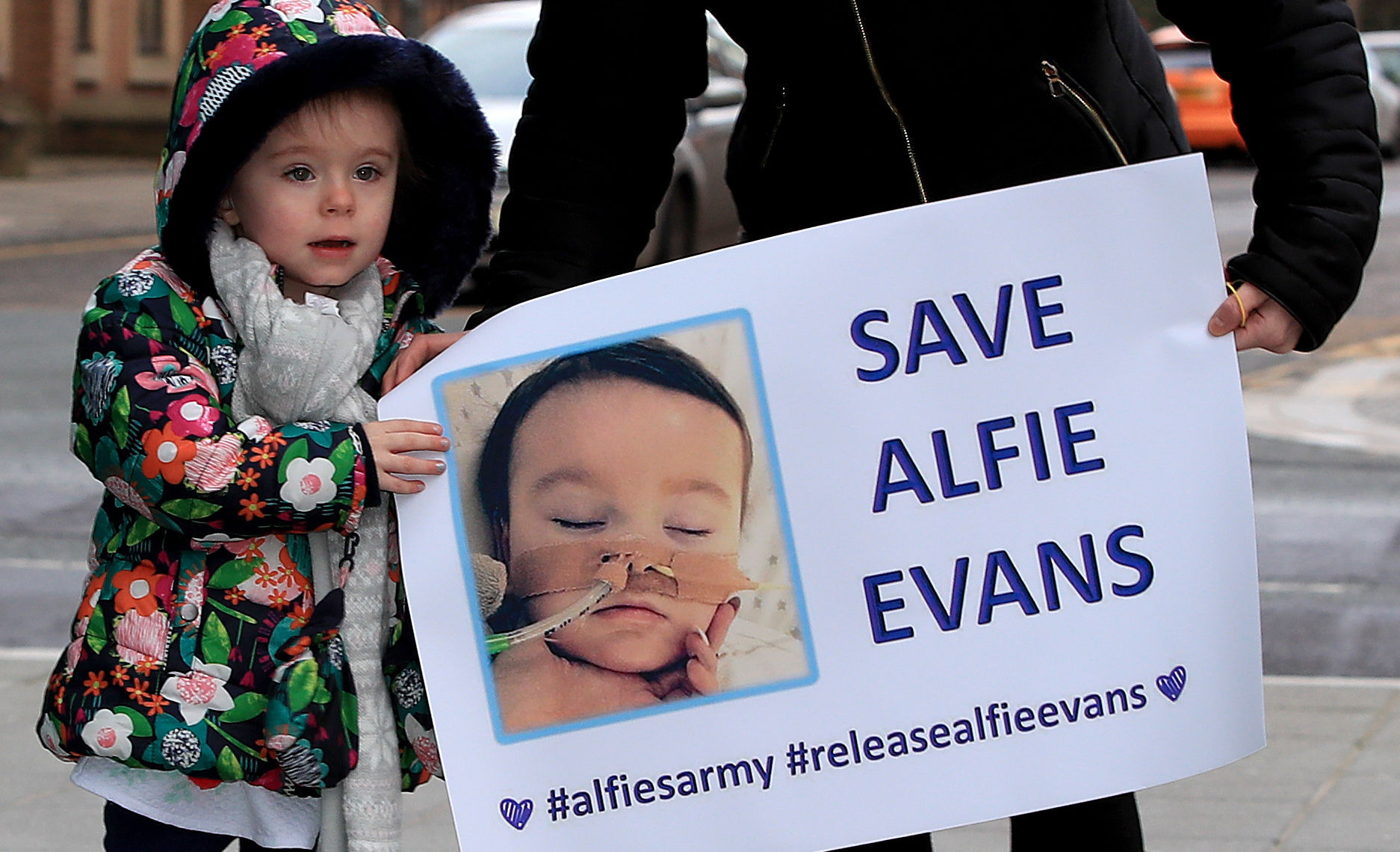
Alfie Evans, the toddler from Liverpool whose parents want to take him to Italy for further treatment, isn’t dead yet. The English courts have all but deemed him dead, but he still breathes.
The boy first fell ill in December of 2016. He was determined to be the victim of an undiagnosed neurological disease. Some time in late 2017 his doctors at the Alder Hey Children’s Hospital in Liverpool concluded that his brain was no longer functioning and that he should be given palliative care but not otherwise kept alive. The boy’s parents, Tom Evans, 21, and Kate James, 20, rejected this advice and sought to have Alfie removed to the Bambino Gesù Hospital in Rome, which had agreed to receive him as a patient and administer further treatments.
Recommended Stories


A court case ensued, involving the Supreme Court of the United Kingdom and the European Court of Human Rights, and at every stage Alfie’s parents were rebuffed. On Monday the Italian Ministry of Foreign Affairs announced that Alfie had been granted Italian citizenship and that Italy hoped he would be transferred to the Bambino Gesù as soon as possible.
Also on Monday, medical professionals at the Alder Hey Children’s Hospital withheld life support. Alfie was expected to die soon thereafter. Protests erupted outside the hospital; protesters urged officials to allow Alfie’s parents to take him to Rome, but so far to no avail.
At this writing, as far as we’re aware, Alfie Evans still lives. The legal intricacies aren’t easy to untangle, but it appears that the court system, in consultation with the medical professionals who’ve attended to Alfie, are legally entitled to make the final decision on the boy’s welfare.
Alfie is said by professionals to have suffered from a neurological disease resulting in his brain’s near-total incapacity. We respect their judgement and have no reason to doubt it. Yet it does not follow from their assessment that Alfie should not be cared for in the manner deemed right by the man and woman who brought him into the world. Well-trained and scientifically informed physicians, however accomplished in their fields, are not equipped to decide what a human life needs or deserves. Alfie’s parents, so far as we’re aware, do not object to their medical opinions on the state of their boy’s brain and his chances of recovery. Yet they believe he ought to be given continued medical care and parental love and affection. Their judgement should obtain.
Alfie’s case is not unlike that of Jahi McMath, the 13-year-old girl who in 2013 suffered a massive loss of blood and cardiac arrest. Her doctors determined that she was what American professionals term brain dead, and there is no cause to doubt either their medical assessment or the category of brain death. Yet Jahi’s family, in a similarly complicated legal battle, removed her from the care of Children’s Hospital of Oakland and brought her to a hospital in New Jersey. At this date Jahi is still alive in a New Jersey apartment. And although she is severely mentally disabled, she is also, as Wesley J. Smith has reported from personal interactions, capable of responsive behavior. Her mother cares for her and will not hear of doing otherwise.
Alfie’s parents appear equally determined. The medical and scientific elite may not believe there is anything worthwhile or beautiful in a young couple sacrificing their lives to care for a child who will never exhibit anything close to ordinary human responsiveness. But that is not their call to make. The world would be a poorer and drearier place without parents who live only to care for their incapacitated little ones.
