

In his concurring opinion regarding Espinoza v. Montana Department of Revenue, Justice Samuel Alito gave a history lesson about a trend long forgotten from an era that seldom gets much attention from the popular imagination. The virulent anti-Catholicism of the late 19th century seems obscure today, but it was an omnipresent and ugly fact of life at that time.
Such bigotry is believed to have turned the course of the 1884 presidential election. That was when a Presbyterian minister denounced the Democratic Party as the party of “rum, Romanism, and rebellion” at a New York City event for the Republican candidate, James Blaine. The comment, in a heavily Catholic city, was amplified all over the nation by Democratic newspapers. It backfired spectacularly in the last days before the election, and Grover Cleveland won a surprise victory.
Blaine’s name was pulled back out of history’s dustbin for this Supreme Court case. The decision revolved around a tuition scholarship program in Montana. The program provided a tax credit to donors to private scholarship programs that helped children attend private schools. The litigation was triggered when some of the recipients attempted to use their scholarships at religious private schools.
The program was struck down by Montana’s Supreme Court because the state has a so-called Blaine Amendment in its Constitution, a nativist, anti-Catholic legal provision, versions of which several states adopted during that era of panic over Catholics’ supposed dual loyalties to Washington and the Vatican.
As Alito put it:
Alito even included with his concurrence a famous cartoon depicting Catholic bishops as alligators rising up out of the “American River Ganges” (i.e., the Potomac) to devour a class of virtuous Protestant schoolchildren and their teacher.
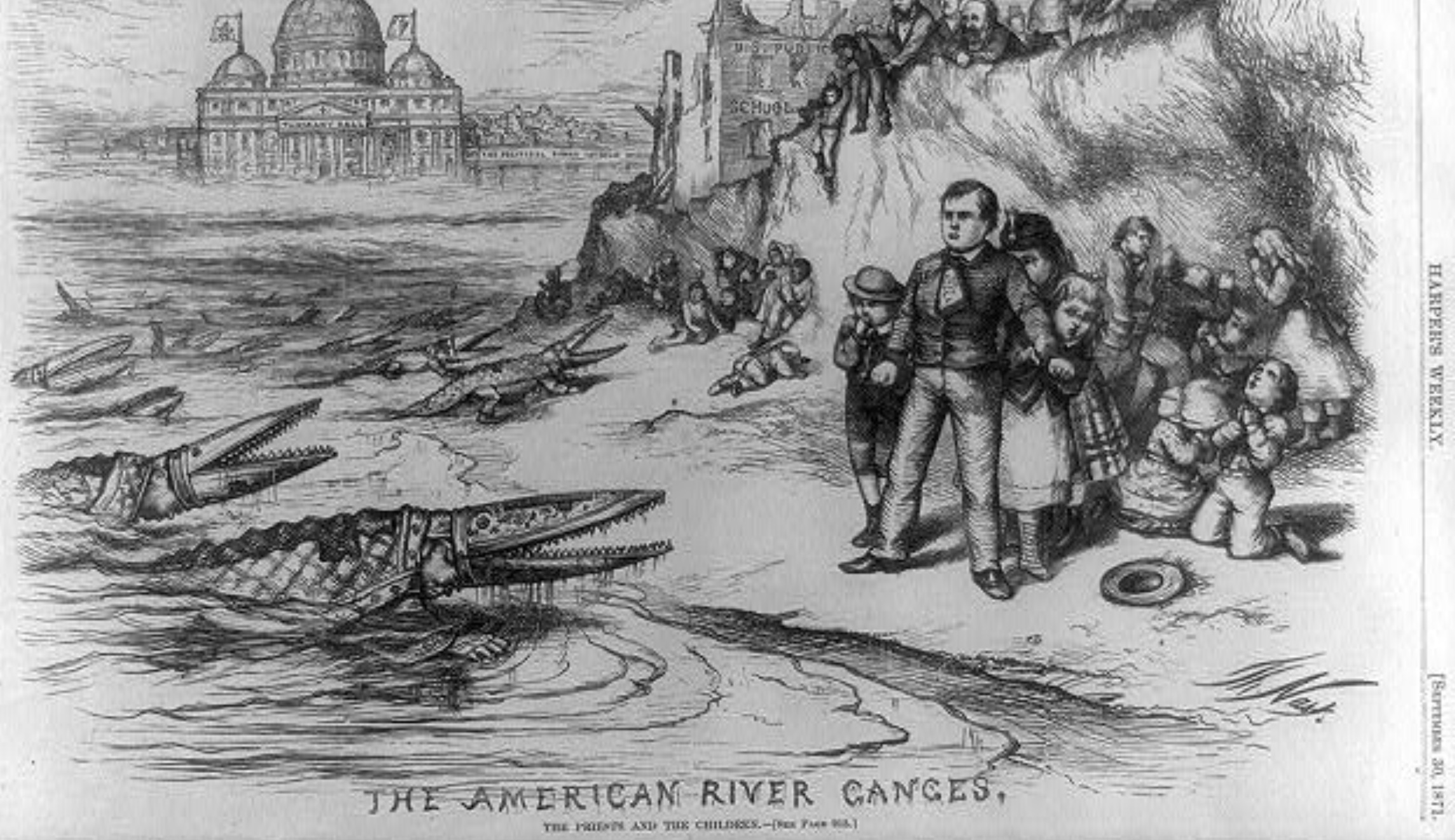
This is where state Blaine Amendments (38 states adopted such amendments) came in, as well as the attempt to pass a federal Blaine Amendment. They were designed to suppress Catholic influence by preventing public money from making its way, by whatever path, to the enemy. The goal was to protect the overtly Protestant character of public schools. There was always a danger that Catholic schools could get help as well, as in Canada, given that they were providing a public service by educating children and feeding and sheltering orphans and the poor. Blaine laws would be there to nip such arguments in the bud.
It is fitting that a law spawned in rank bigotry and anti-immigrant sentiment should receive its comeuppance now, in an epoch anxious about discrimination. So you might be surprised to see Justices Elena Kagan and Ruth Bader Ginsburg dissenting and trying to justify such discrimination.
“The Montana court,” Ginsburg wrote, “remedied the state constitutional violation by striking the scholarship program in its entirety. Under that decree, secular and sectarian schools alike are ineligible for benefits, so the decision cannot be said to entail differential treatment based on petitioners’ religion.”
The sophistry of this argument is puzzling. Suddenly, this case is no longer about the constitutionality of Montana’s discriminatory Blaine Amendment, as everyone thought it was. Rather, it is about the Montana Supreme Court’s one-time action of striking down an entire program that appeared to run afoul of it. Two Harvard-trained legal minds suddenly found themselves incapable of tracing the path between a state constitution’s provision and its obviously discriminatory consequences.
In other words, it doesn’t matter whether Montana’s court used a potentially discriminatory rationale to strike down a duly enacted law. After all, the program is no more, so there’s no discrimination going on — so what’s the problem?
It is heartening to see the Roberts court, after so many deep disappointments this term, strike a blow for freedom and government neutrality in matters of religion. It is sad, however, that only five justices out of nine could be convinced.
