

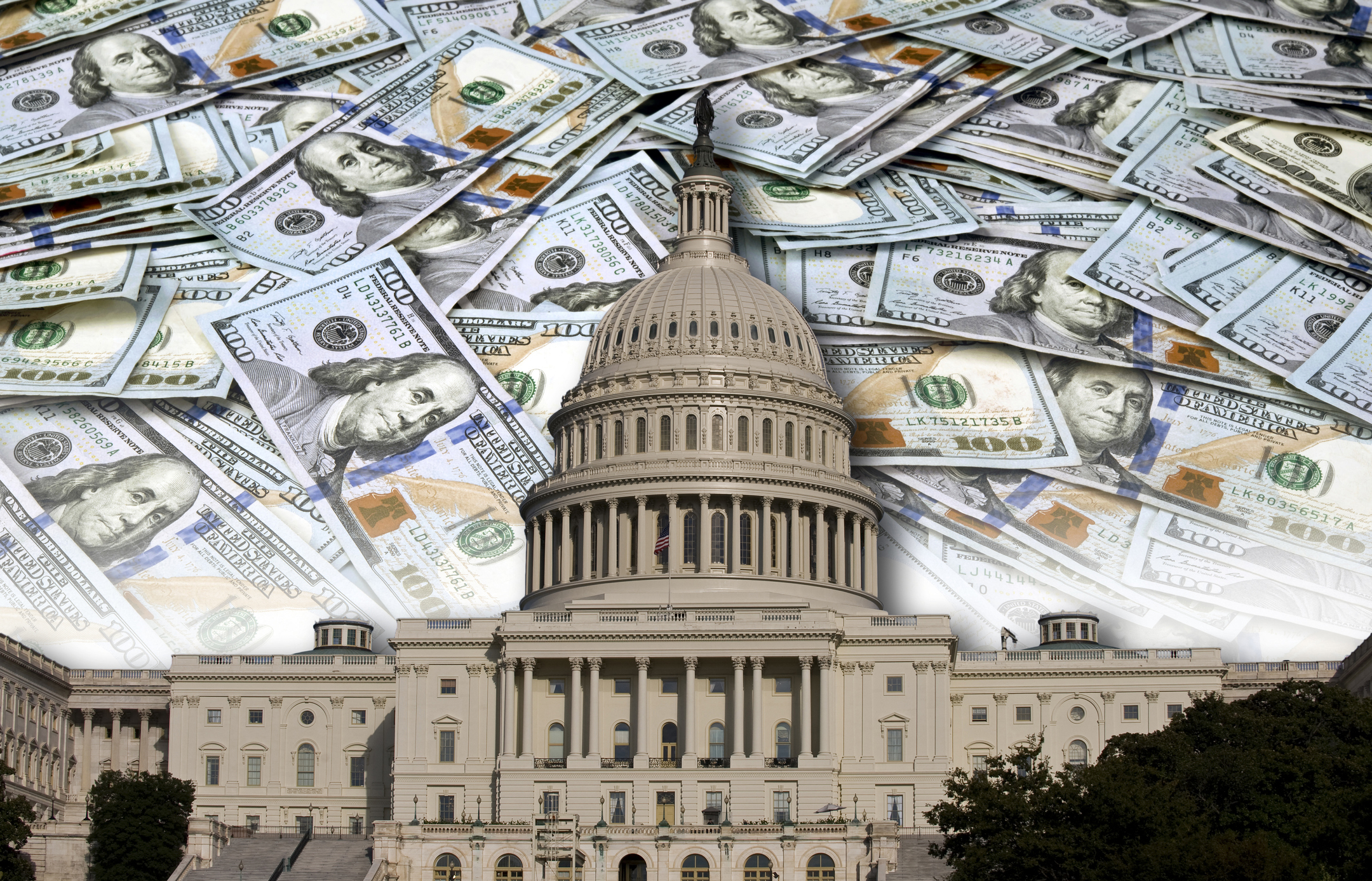
This week, the nonpartisan Congressional Budget Office delivered the sort of bad news that Washingtonians routinely shrug off, even though it should make them feel like their hair is on fire.
In less than 10 years, the agency projects that Uncle Sam will run annual deficits closer to $2 trillion than the current $1 trillion per year, and that’s assuming that all of the temporary tax cuts in the 2017 tax reform law are allowed to expire.
Recommended Stories


There are many reasons why leaders and bureaucrats fail to take this seriously year after year. For one thing, people tend to tune out when warnings are too frequent. For another, there’s just the perception that it’s other people’s money.
But, in this case, the problem is far worse than that. Some problems become so big and so intractable that people just normalize them. People learn to live with such problems, convincing themselves that the consequences are too far off to matter.
What seemed like what might become a manageable problem 20 years ago — recall that George W. Bush ran for president promising to use the budget surplus to start paying off the national debt — is now one of these big and intractable problems. It’s not just that the debt and the deficits are too big; it’s also that Congress is never forced to face their cause. Entitlements, unfortunately, play no role in Congress’s annual appropriations process, and what Congress is not forced to face, it will not face voluntarily.
It’s useless to blame either the recent tax cuts (revenues have actually increased in the time since) or the government’s garden-variety wasteful spending. The increase in the deficit and all of the nation’s future fiscal woes are tied to Congress’s inability to tackle entitlement reform.
As the Manhattan Institute’s Brian Riedl pointed out, the annual shortfall in Medicare and Social Security costs, currently at $440 billion, will rise to $1.9 trillion by 2030. Between now and 2049, these two programs combined are projected to pay out $63 trillion more than they will take in.
Neither party and neither party’s leaders want to grapple with this problem. As deep as President Trump’s denial on this issue has been since 2015, that of the Democrats is even worse. Trump has been unwilling to reform entitlements, but most of the Democrats’ leading presidential candidates actually want to expand Medicare, the program for which the fiscal prognosis is far more dire, and some of them even want to expand Social Security. This is madness.
Liberals are quick to propose a simplistic tax increase as the solution to everything, but there is no reasonable source of tax revenue great enough to save both of these programs. That would require huge benefit cuts and tax increases that fall on everyone right down to the poorest. Only dramatic reforms can solve this problem, and the longer Congress waits to act, the worse the crunch will be when the time comes.
In truth, the Left should be more concerned about this than the Right. Politicians who hold forth sanguine hopes of forgiving student debt or changing the weather with $93 trillion Green New Deals must understand at some point that their priorities will lose when the nation’s entire tax revenue, no matter how high taxes go on the wealthy, is exhausted just in cutting checks for the elderly and their healthcare providers. Once the nation reaches the point where tax increases are needed just to keep entitlements funded, there won’t be anyone left to raise taxes on to pay for new programs.
But for now, the Left is in denial. So is the Right, which has long claimed that the economy can grow itself out of this problem. Ideally, Social Security would be changed to guarantee a certain level of retirement income but to let people save and invest some or most of the money that currently goes to payroll taxes and see if they can do better. By letting markets do the lifting instead of taxpayers, the government would allow even a modest monthly investment, between ages 18 and 67, to grow to help support a more comfortable retirement.
Absent action, lawmakers will be forced to adopt a toxic combination of severe and sudden benefits cuts and draconian middle-class tax increases. Today’s workers can only hope they will not be around when it happens.
