

When historians 30 or 50 years from now look back on 2018, what will they find most noteworthy? It won’t be three government shutdowns, Michael Wolff’s Fire and Fury, or the end of the illustrious Senate career of Joe Donnelly.
We can rarely ever be sure, from the too-close perspective of the present, what events will prove most important decades from now. But we can guess. And we believe that the most significant events in the realm of politics and government this past year were those involving federal courts and freedom of conscience.
Recommended Stories


Governments around the U.S. tried to compel individuals to act and speak against their conscience. In three key cases, the Supreme Court checked state power and upheld the conscience rights of the dissenters. This was an important stand for conscience amid a furious onslaught of the Left’s culture warriors.
Illinois tried to compel state worker Mark Janus to fund the liberal and politically active public employee union to which he didn’t even belong. The Supreme Court stood up for Janus. The First Amendment “includes both the right to speak freely and the right to refrain from speaking at all,” Justice Samuel Alito wrote.
California tried to force the National Institute of Family and Life Advocates, a pro-life clinic for pregnant women, to advertise abortion. The Supreme Court blocked California, upholding not only the Constitution, but also the enlightenment principle that it is tyranny to force someone to speak what they believe to be evil.
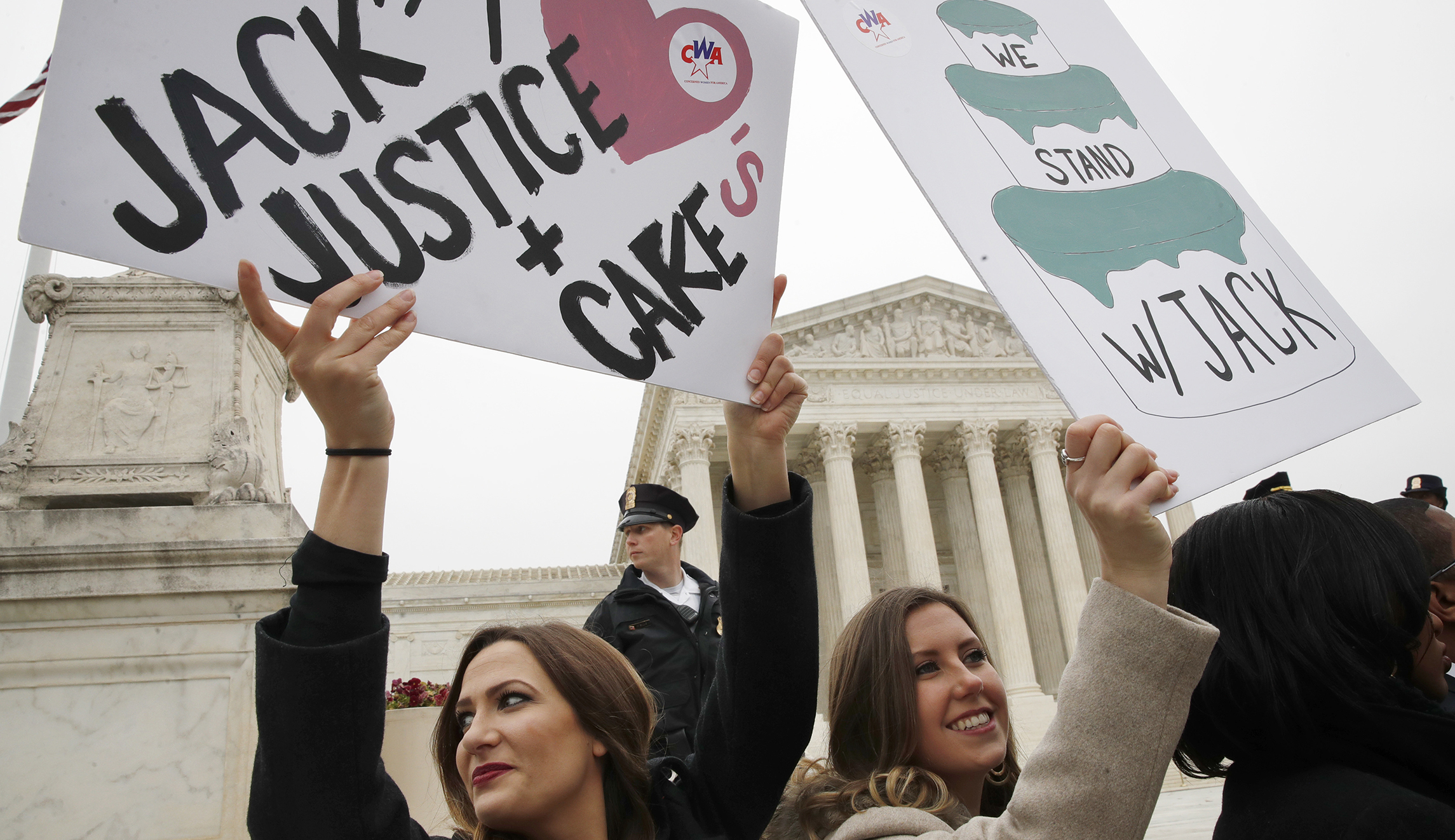
Colorado tried to force Jack Phillips to create a cake celebrating a gay wedding. The Supreme Court ruled in his favor. The 7-2 majority found that Colorado’s Human Rights Commission held an explicit disdain for religious viewpoints.
That governments may not act on anti-religious animus may sound pretty fundamental, but it is something of a reactionary view these days. It’s certainly not in keeping with the “social justice” movements of the day or the mainstream of the Democratic Party who argue that one must set aside his own moral views the moment he enters into the public square if those moral views are rooted in religion. “I do my religion on Sundays,” was how Rep. Nancy Pelosi, D-Calif., put it when asked to square her Catholicism with her aversion to freedom of conscience for other religious people.
But the 7-2 ruling for Jack Phillips in the Masterpiece Cake Shop case was far too modest in its reach. The two liberal justices joining Anthony Kennedy and the four conservatives didn’t want to go as far as the Constitution does and say that religious conscience deserves special protection.
That’s why the other major victory for conscience this year was the replacement of Anthony Kennedy (who was fine on conscience issues) with Brett Kavanaugh, who should be excellent on these issues.
Other lower-court appointments this year and late last year will build a stronger bulwark for conscience. Kyle Duncan was confirmed in the 5th Circuit (tellingly, Sen. Kamala Harris, D-Calif., opposed him for defending the conscience rights of Hobby Lobby’s owners), and in late 2017, Amy Coney Barrett won a seat on the 7th Circuit (while being attacked for her adherence to Catholic dogma).
The likes of Sen. Dianne Feinstein, D-Calif., Harris, and Pelosi aren’t shy about their attacks on the free exercise of religion and the freedom of conscience. They have the elite media on their side.
For that reason, we don’t know how the 2018 victories will look a generation from now. Will they represent the turning of a tide, the building of a bulwark that protects at least the innermost sphere of religious liberty from the stampeding culture warriors? Or will be it be a last stand, or even a spark that motivates totalitarian minds to finally eradicate dissent?
Whichever way the battle goes next year, at least it didn’t end this past year. 2018 was, as Justice Clarence Thomas wrote in Masterpiece, the year religious liberty lived “to fight another day.”
