

Two of the largest offshore wind developers in the world are once again challenging President Donald Trump’s crackdown on the industry, taking legal action against the administration’s lease suspension of its $5 billion wind farm off the coast of Rhode Island.
Danish developer Ørsted announced on Friday that the renewables firm, alongside its project partner Skyborn Renewables, filed a complaint against the administration in the U.S. District Court for the District of Columbia regarding its Revolution Wind project.
The project, which is estimated to be more than 80% complete, was scheduled to come online this year, though the administration has repeatedly attempted to thwart that timeline.
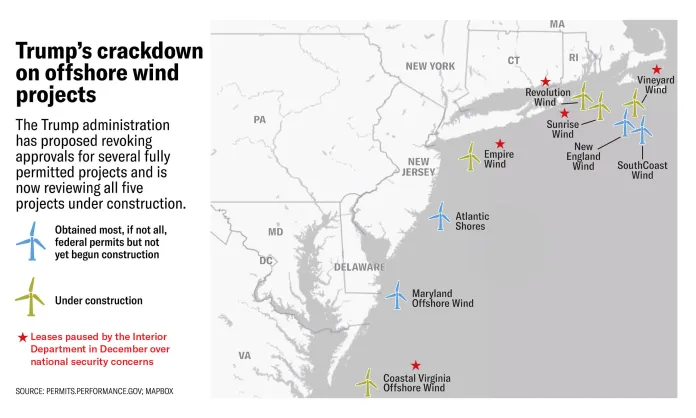
Norwegian offshore wind developer Equinor also announced Friday that it filed a civil suit in the U.S. District Court of the District of Columbia challenging the administration over its Empire Wind project in New York.
Just days before Christmas, the Interior Department paused leases for five under-construction offshore wind projects, including Revolution Wind, citing national security concerns.
All five projects have obtained all federal permits and are at various stages of construction.
The Trump administration claims that the projects pose national security risks related to the movement of massive turbine blades and highly reflective towers, which the administration claims create radar interference called “clutter.” In December, the Interior Department said this “clutter” can obscure legitimate targets and generate false targets in their vicinity.
The move is the latest attempt from the administration to block the development of offshore wind, while circumventing past legal challenges and court losses already faced in Trump’s crackdown.
Trump has targeted the offshore wind industry since his first day in office, launching a government-wide policy assault on new and existing development. In the last year, the administration has increased regulatory hurdles for new projects, canceled more than $679 million in funding for offshore wind-related projects, and attempted to strip permits for under-construction wind farms — including Empire Wind and Revolution Wind.
The stop-work order imposed on the Empire Wind project was lifted in May after the administration said it had made a deal with Gov. Kathy Hochul (D-NY) to approve two gas pipelines.
Equinor is seeking a preliminary injunction to allow the project to continue construction while litigation proceeds. The Norwegian company has said the wind farm is more than 60% complete.
“While Empire continues to work closely with Bureau of Ocean Energy Management (BOEM) and the other relevant authorities to find a prompt resolution to the matter, the order is in Equinor’s view unlawful and threatens the progress of ongoing work with significant implications for the project,” Equinor said in a release.
“The preliminary injunction filing is necessary to allow the project to continue as planned during this critical period of execution and avoid additional commercial and financing impacts that are likely to occur should the order remain effective,” Equinor said.
The Interior Department first attempted to block Revolution Wind with a stop-work order in August 2025, accusing project developers of rushing through the permitting process and failing to reach an agreement with the War Department via executive order over national security concerns.
Ørsted pushed back against the order, accusing it of being unlawful and claiming that the company was losing more than $2 million per day over the pause.
A federal judge ruled in favor of the company in September, calling the administration’s stop-work order the “height of arbitrary and capricious actions.”
“If Revolution Wind cannot meet benchmark deadlines, the entire project could collapse,” the judge said. “There is no doubt in my mind of irreparable harm to the plaintiffs.”
Ørsted is now looking for a similar win, saying that it believes the lease suspension for the project violates the law.
The renewables giant insists that Revolution Wind acquired all federal and state permits in 2023, following a review process that started over nine years ago.
The company said Friday that the project underwent a “years-long consultation” with the Department of War’s Military Aviation and Installation Assurance Siting Clearinghouse regarding any possible national security and defense effects.
“Revolution Wind has spent and committed billions of dollars in reliance upon, and has met the requests of, a thorough review process,” Ørsted said. “Additional federal reviews and approvals included the U.S. Coast Guard, U.S. Army Corps of Engineers, National Marine Fisheries Service, and many other agencies.”
TRUMP HALTS FIVE UNDER-CONSTRUCTION OFFSHORE WIND PROJECTS, CITING NATIONAL SECURITY
The company noted that the project is on track to deliver enough energy to power more than 350,000 homes this year, as 58 out of 65 wind turbines are installed. As of December, it was expected to start generating power as soon as this month.
If the lease suspension is not lifted, Ørsted said the project faces “substantial harm.”
