

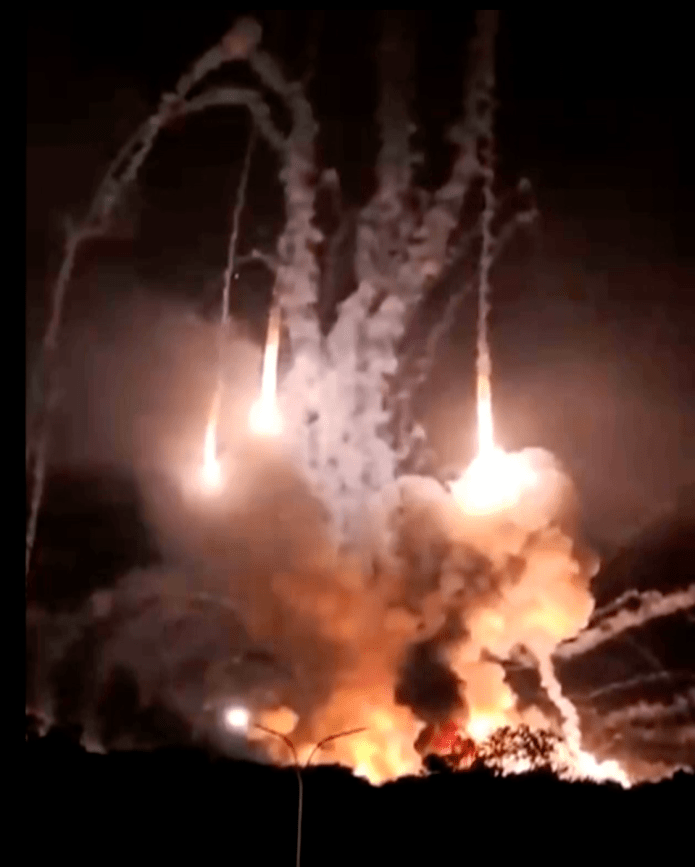
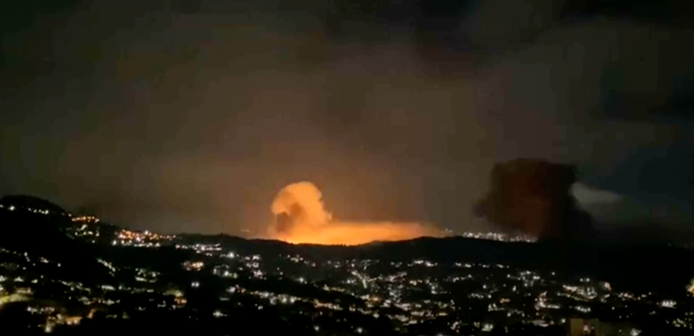
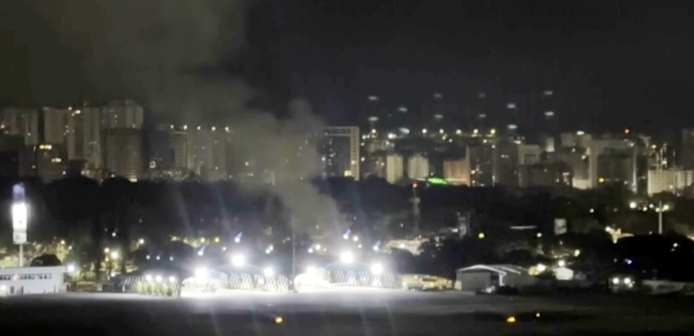
The United States carried out an extraordinary military operation aimed at toppling Venezuelan President Nicolas Maduro’s regime overnight, President Donald Trump announced early Saturday morning.
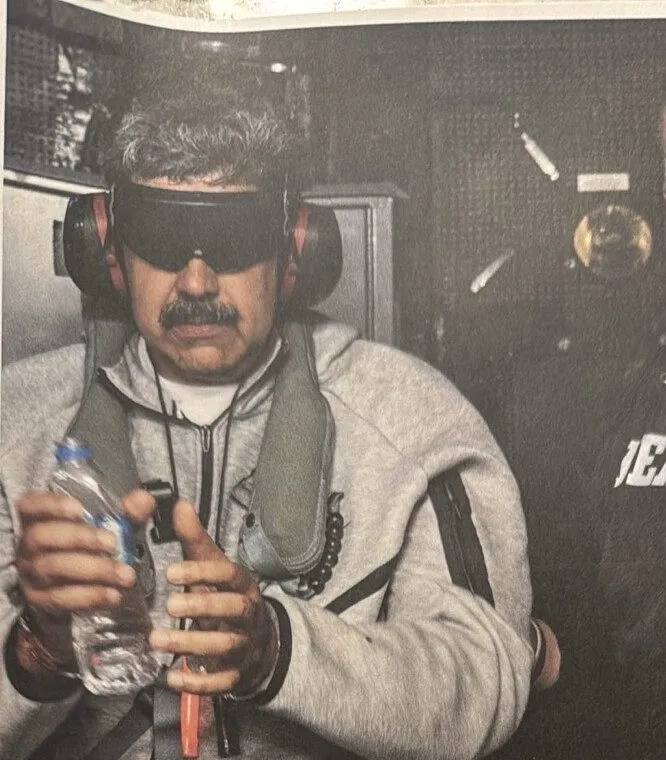
The U.S. captured Maduro and his wife and flew them out of the country after carrying out strikes on Caracas, Venezuela’s capital city, according to Trump. Venezuelan Vice President Delcy Rodríguez said the government is unaware of the whereabouts of Maduro and first lady Cilia Flores after the attack, which entailed at least seven blasts and lasted less than 30 minutes.
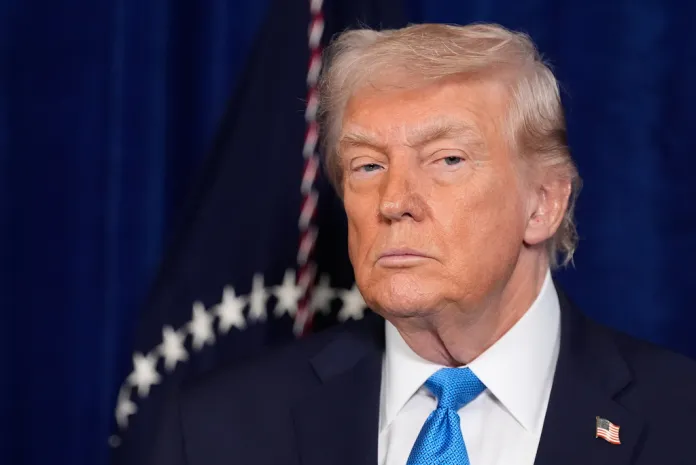
President Donald Trump listens as Defense Secretary Pete Hegseth speaks at Mar-a-Lago club, Saturday, Jan. 3, 2026, in Palm Beach, Fla. (AP Photo/Alex Brandon) 
Venezuelans celebrate in Madrid after U.S. President Donald Trump announced that Venezuelan President Nicolás Maduro had been captured and flown out of the country on Saturday, Jan. 3, 2026. (AP Photo/Bernat Armangue) 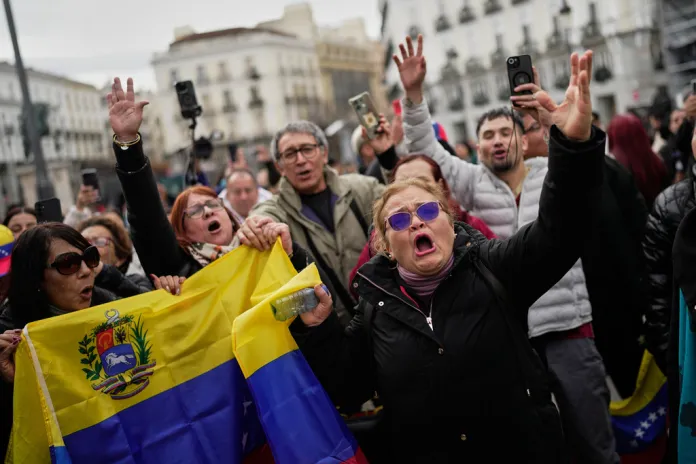
Venezuelans celebrate in Madrid after U.S. President Donald Trump announced that Venezuelan President Nicolás Maduro had been captured and flown out of the country on Saturday, Jan. 3, 2026. (AP Photo/Bernat Armangue)
MADURO ‘CAPTURED’ AND TAKEN OUT OF VENEZUELA AFTER US MILITARY OPERATION IN CARACAS: TRUMP
What comes next?
Trump is holding a press conference at 11 a.m. Saturday, when he promised to reveal more details about the strikes. The president said he would “discuss” whether he sought congressional authority before the U.S. military engaged in a large-scale strike on Venezuela, in comments to the New York Times. House Minority Leader Hakeem Jeffries reportedly did not receive notice of the strikes.
Trump said that the U.S. would be “making the decision” about who should lead the country next, during his first television interview on the strikes Saturday morning.
“We’ll be involved in it very much. And we want to do liberty for the people. We want to, you know, have a great relationship. I think the people of Venezuela are very, very happy because they love the United States. You know, they were run by essentially a dictatorship,” Trump said during his appearance on Fox News’s Fox & Friends.
Maduro faces a new indictment from the Justice Department on narco-terrorism charges that appear to be similar to a separate 2020 indictment of Maduro and others in the Southern District of New York. The charges also include possession of machine guns, promising strong prison sentences.
Maduro will stand trial on criminal charges in the U.S., according to Sen. Mike Lee (R-UT), citing a phone call with Secretary of State Marco Rubio. Rubio told him he anticipates “no further action in Venezuela” now that Maduro is in U.S. custody, Lee added.
REPUBLICANS RALLY AROUND TRUMP AFTER MADURO CAPTURE AS DEMOCRATS CRY FOUL OVER ITS LEGALITY
Attorney General Pam Bondi said Maduro and his wife would “soon face the full wrath of American justice on American soil in American courts.” He will likely make an initial appearance in federal court in Manhattan as soon as Monday, according to Fox News.
The timing could change at this stage, but his appearance will happen “likely Monday,” the outlet learned.
“Nicolás Maduro and his wife, Cilia Flores, have been indicted in the Southern District of New York. Nicolás Maduro has been charged with Narco-Terrorism Conspiracy, Cocaine Importation Conspiracy, Possession of Machineguns and Destructive Devices, and Conspiracy to Possess Machineguns and Destructive Devices against the United States,” Bondi wrote on X. “On behalf of the entire U.S. DOJ, I would like to thank President Trump for having the courage to demand accountability on behalf of the American People.”
Why did the U.S. carry out the attack?
Rubio said the U.S. conducted the stunning special forces military attack because Maduro’s regime is illegitimate, which has long been the viewpoint of the U.S. and allies. The Trump administration is seeking to use Article II of the Constitution to justify the attack, as it states the president is the commander-in-chief of the U.S. military.
The Trump administration also defended the attack on the basis of accusations that Maduro is funneling drugs and members for the notorious Tren de Aragua gang into the U.S., with the defense coming after the Pentagon had carried out over two dozen lethal attacks on suspected “narco-terrorist” boats coming from the Venezuela region. Throughout 2025, the U.S. invoked the Alien Enemies Act to target TDA gang members, citing their connection to Maduro’s government.
“Maduro is NOT the president of Venezuela and his regime is NOT the legitimate government,” the secretary said in a statement to X after the strikes were revealed.
“Maduro is the head of the Cartel de Los Soles, a narco-terror organization which has taken possession of a country. And he is under indictment for pushing drugs into the U.S.,” Rubio continued.
TRUMP WARNS IRAN THAT US IS ‘LOCKED AND LOADED’ TO ‘RESCUE’ ANY ‘PEACEFUL PROTESTERS’ HARMED
Thousands of Venezuelans were arrested following protests in the wake of the July 2024 presidential elections, which opposition leader María Corina Machado, the U.S., and other democracies said were stolen in favor of Maduro. Machado was awarded the Nobel Peace Prize in October 2025 for her “courageous struggle for democracy, human rights, and non-violent political reform in Venezuela.”
Venezuela’s vast oil deposits are also seen as a major factor in Washington’s interest in the country.
Trump promised the U.S. will get “very strongly involved” in the future of Venezuela’s oil industry now that Maduro is no longer in control of it.
“We have the greatest oil companies in the world, the biggest, the greatest, and we’re going to be very much involved in it,” he said on Fox News.
Vice President JD Vance echoed the emphasis on oil in a statement to X.
“The president offered multiple off ramps, but was very clear throughout this process: the drug trafficking must stop, and the stolen oil must be returned to the United States,” he said.
REPUBLICANS RALLY AROUND TRUMP AFTER MADURO CAPTURE AS DEMOCRATS CRY FOUL OVER ITS LEGALITY
What happened during the operation?
The U.S. Army’s elite Delta Force carried out the operation, which resulted in several injuries but no U.S. fatalities, alongside FBI agents. It bears a strong resemblance to a special operation that took place exactly three decades ago, when U.S. forces toppled Panamanian General Manuel Noriega from power on Jan. 3, 1990.
Maduro and his wife were asleep at their home inside the heavily guarded residence when the special forces dragged them out of their beds and captured the couple during the overnight raid, according to CNN. The pair were taken to the U.S.S. Iwo Jima, one of the American warships that had been prowling the Caribbean, after their capture, Trump revealed during his first television interview on the strikes Saturday morning.
The president said he watched “every aspect” of the “extremely complex” special operation from Florida. He added that U.S. forces practiced the operation by building an “identical” replica of the house where Maduro and his wife were captured, similar to how the U.S. military built life-size replicas of Osama bin Laden’s Abbottabad compound to train Navy SEALs for the raid that killed him in 2011.
“No death on our side is really amazing,” he said during the Fox and Friends appearance. “The whole maneuver, the landings, the number of aircraft, which were a massive number, the number of helicopters and just fighter jets who had a fighter jet for every possible situation and reasons for they broke into places that were not really able to be broke into, you know, steel doors that was were put there for just this reason, and they got taken out in a matter of seconds. I’ve never seen anything like it.”
What has been the reaction?
Footage circulating on social media on Saturday showed thousands of Venezuelans in the capital of Caracas jubilantly celebrating Maduro’s capture. Maduro supporters are displaying posters of the fallen president in the wake of the attack, while others are praising Trump’s action in the streets.
International reaction was mixed.
Countries ranging from Russia to Mexico condemned the strikes, as well as key allies to the U.S., such as Great Britain, which framed the strikes as a “flagrant violation of international law.”
However, Argentine President Javier Milei, who has emerged as a critical supporter of Trump in South America, praised the action.
“FREEDOM MOVES FORWARD. LONG LIVE FREEDOM DAMMIT,” he said.
In the U.S., Miami’s Venezuelan community was pictured celebrating after Trump announced the capture of Maduro.
In Doral, home to the largest Venezuelan community in the United States, people held outside a South American eatery, praising the president’s announcement, and chanting “Liberty! Liberty! Liberty!”
Congressional lawmakers also offered mixed reactions in the immediate aftermath of the strikes.
Rep. Carlos Gimenez (R-FL) praised the operation and compared Trump’s actions to the fall of the Berlin Wall, calling it “a big day in Florida, where the majority of Venezuelan, Cuban, & Nicaraguan exiles reside.
Others, such as Sen. Andy Kim (D-NJ) said the administration had lied to them about not seeking to oust Maduro.
House Permanent Select Committee on Intelligence Ranking Member Jim Himes (D-CT) called Maduro “an illegitimate ruler” but said he had “seen no evidence that his presidency poses a threat that would justify military action without Congressional authorization, nor have I heard a strategy for the day after and how we will prevent Venezuela from descending into chaos.”
“The Administration must immediately brief Congress on its plan to ensure stability in the region and its legal justification for this decision,” Himes said.
Senate Majority Leader John Thune (R-SD) described Maduro’s capture as “an important first step to bring him to justice for the drug crimes for which he has been indicted in the United States.” He said he spoke to Rubio on Saturday morning and was looking forward to further briefings when the Senate returns next week.
What is the context?
Speculation has grown for months that the U.S. might seek to topple Maduro’s regime.
NDAA REQUIRE HEGSETH TO SUBMIT ‘UNEDITED VIDEO’ OF BOAT STRIKES OR FACE TRAVEL BUDGET CUTS
Throughout 2025, the Pentagon ratcheted up military might in the South American region to historic levels as the White House launched a pressure campaign on Maduro that appeared to be centered around accusations he was allowing, if not pushing, drugs into the U.S.
Trump authorized over a dozen controversial strikes on vessels in the region’s water suspected of carrying South American drugs and “narco-terrorists,” and repeatedly tentatively endorsed regime change in Venezuela, fueling rumors he would authorize land strikes against the country.
