

The seizure of a Venezuelan-linked oil tanker earlier this week represents a new pressure point the United States is applying to Nicolas Maduro, the widely considered illegitimate leader of the oil-rich country.
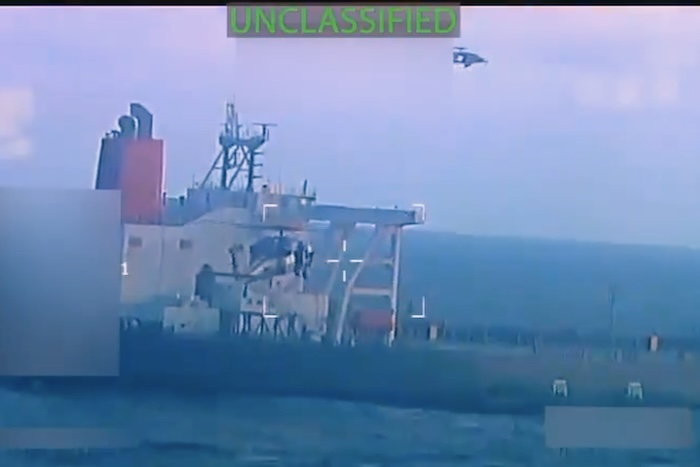
U.S. forces boarded the Skipper, a vessel that the Treasury Department sanctioned in 2022 when it was under a different name, on Wednesday morning in the first such mission since the U.S. began its large-scale military buildup in the Western Hemisphere over the summer.
“We’re not going to stand by and watch sanctioned vessels sail the seas with black market oil, the proceeds of which will fuel narco-terrorism of rogue and illegitimate regimes around the world,” White House spokeswoman Karoline Leavitt said during a press briefing on Thursday, indicating more missions like this seizure could come later.
When asked whether the president views the seizure as an escalation toward Venezuela, she told reporters on Thursday, “I think the president considers the seizure of the oil tanker as effectuating the administration’s sanction policies.”
Venezuela primarily sells oil to China, and targeting vessels heading to or from Venezuela could dissuade Chinese companies or other buyers from continuing to purchase their oil if there’s concern that it could be seized by the U.S.
“I think that the significance of the move for Venezuela is enormous, because they are dependent on this revenue from these oil sales,” Clayton Seigle, a senior fellow in the Energy Security and Climate Change Program at the Center for Strategic and International Studies, told the Washington Examiner. “So if this becomes the first of many, then that could throttle a lot of, most of, thankfully, even all of Venezuela’s oil exports and the associated revenues.”
Countries including Russia, Iran, and Venezuela operate what is called the “shadow fleet,” which is the term given to their strategy of using outdated oil tankers to export oil in violation of Western sanctions that are directed at them. There are hundreds of these tankers operating at any given time, owned and operated by shady businesses as they try to obfuscate their true intentions.
The Skipper was flying under a Guyanese flag and had been spoofing its location to indicate it was off the Guyanese coast instead of its actual location at Venezuela’s Jose terminal.
A 2022 Treasury Department sanctions announcement named Viktor Artemov the owner of the vessel, then named the Adisa, and said he oversaw a vast complex network of front companies used to facilitate illegal oil shipments exporting Iranian oil in support of Hezbollah and Iran’s Islamic Revolutionary Guard Corps.
“Bad guys find workarounds and loopholes and ways around following the rules, and one of them is to transport oil on ships that are not part of the sanctioned fleet,” Seigle said. “So basically, what they do is they get ships that are really past their useful and safe life expectancy, and instead of sending them to get scrapped in the junkyard, they give them a life extension to run fraudulent and illegal oil.”
The Trump administration is carrying out a concerted whole-of-government approach to apply pressure on Maduro.
Treasury Department officials announced Thursday that they applied sanctions to three nephews of Maduro’s wife, Cilia Flores; a businessman affiliated with Maduro; six shipping companies; and associated vessels “that have engaged in deceptive and unsafe shipping practices.”
Trump said earlier this week that Maduro’s “days are numbered” and has publicly discussed carrying out strikes on targets in Venezuela, though none have happened so far, and he has not ruled out deploying U.S. forces to Venezuela.
The Trump administration’s recently released National Security Strategy provided new insight into the administration’s foreign policy aspirations for the Western Hemisphere, which it has now made the top priority. The administration wants “a Hemisphere whose governments cooperate with us against narco-terrorists, cartels, and other transnational criminal organizations,” according to the NSS.
The U.S. military has carried out lethal strikes against more than 20 suspected drug smuggling boats since the beginning of September, killing roughly 85 people to date. These strikes are a stark change from the decades of prior practice of the Coast Guard interdicting vessels, seizing them and any drugs on board, and arresting the people aboard.
The first strike, which occurred on Sept. 2, has come under significant congressional scrutiny following media reports that the senior military officer ordered subsequent strikes to kill two people on the vessel that had survived the initial strike.
That officer, Adm. Mitch Bradley, has briefed lawmakers behind closed doors on the details of the strike. War Secretary Pete Hegseth said he did not know about the subsequent strikes until after Bradley had ordered them and they had been carried out.
The administration released a short video of the Sept. 2 strike, as it has with many of the strikes the military has conducted. Lawmakers have called for the military to release the full video, which the president initially said he was OK with but then backed off that support. The department has not released it yet.
The Democratic members of the Gang of Eight — Sen. Mark Warner (D-VA), the vice chairman of the Senate Select Committee on Intelligence; Senate Democratic Leader Chuck Schumer (D-NY); House Democratic Leader Hakeem Jeffries (D-NY); and Rep. Jim Himes (D-CT), ranking member of the House Permanent Select Committee on Intelligence — sent a letter to Hegseth on Friday urging him to release the full unedited video of the strikes in question.
US SEIZED OIL TANKER OFF VENEZUELAN COAST: TRUMP
“We also urge you to expedite the public release of the video, taking into account appropriate precautions to protect sources and methods, so that the American people can judge for themselves the legality and necessity of their government engaging in such activities that potentially put our men and women in uniform at risk,” they wrote.
Warner, who spoke to reporters at a Defense Writers Group event on Friday morning, said he does not “see any reason why this video can’t be released,” arguing that Pentagon officials can “do the same kind of edits that they’ve done on all the other videos that they have released.”
