

The capture and arrest of former Venezuelan dictator Nicolas Maduro has created uncertainty for its longtime ally, Cuba.
The two governments are so close that Maduro’s security forces were often from Cuba, which explains why officials in Havana said 32 Cubans were killed in the daring U.S. operation to arrest Maduro and his wife, Cilia Flores, last weekend.
Cuban officials said they were killed “after fierce resistance in direct combat against the attackers, or as a result of the bombing of the facilities,” and lowered flags to mourn the losses. The one-sided loss of life during the mission also exposed a vulnerability to Cuba’s intelligence apparatus.
Secretary of State Marco Rubio said over the weekend that Caracas’s internal security force was “entirely controlled by Cubans,” and that they “are the ones that were propping up Maduro.”
Where did the Cuba-Venezuela relationship originate?
For years, first Hugo Chavez and then Maduro sent billions of dollars’ worth of oil to prop up the Cuban government, led initially by Fidel Castro, in exchange for Cuban intelligence, advisers, and healthcare professionals.
Cuba, which came under the Castro brothers’ rule in 1959, became close with Chavez, who became president of Venezuela in 1999. Their relationship was a mentor-pupil relationship in which Chavez looked up to Fidel and Raúl Castro, which evolved into deep economic and military ties between their respective countries.
During a 2000 trip that Castro took to Venezuela, he and Chavez signed their first oil deal, agreeing to provide Havana with 53,000 barrels of oil a day in exchange for about 40,000 doctors, dentists and other experts, according to the Wall Street Journal.
“The relationship between the two countries has been very, very close since the arrival of Chavez in the year 1999. Chávez was a big admirer and a follower of Fidel Castro. There was a very quick relationship established between the two governments,” Arcos added. “It essentially saved Cuba out of the terrible economic crisis after the collapse of the Soviet Union, and in many ways, it replaced the Soviet Union as the patron for the Cuban government, sending mostly oil in exchange for Cuban advisors, and that included, of course, doctors, but also military and intelligence advisors.”
When Chavez was briefly forced out of power in a 2002 coup, Castro helped him regain control of the country only days later.
The relationship continued after Chavez got sick, for which he received treatment in Cuba, and Maduro rose to power in Caracas.
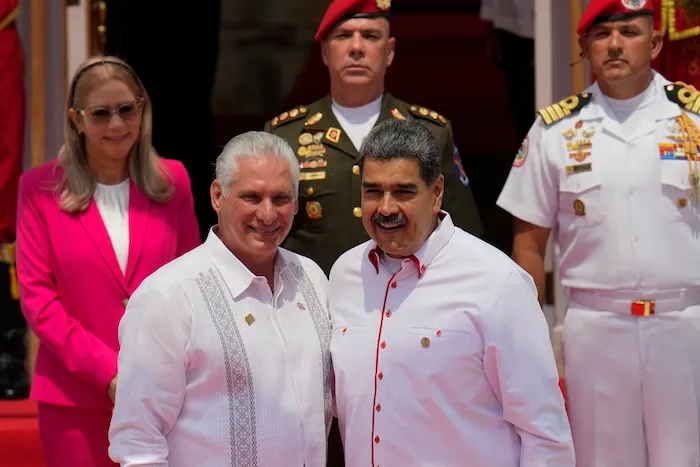
“In many ways, Cuba, the little country, the poor, much smaller than Venezuela, became Venezuela’s patron, and Venezuela became Cuba’s colony. It’s a very interesting phenomenon because Venezuela is much, much bigger, much richer, and as the provider of oil to Cuba, it could have set the conditions for the relationship,” Sebastián Arcos, the interim director of the Cuban Research Institute at Florida International University, told the Washington Examiner. “But the way it happened was the other way around. It was Cuba dictating and Venezuela following.”
While Venezuela is a much larger country with a larger population and oil reserves, the country has relied on Cuba for support over multiple decades. As a result, Havana could now face trouble if it cannot continue to rely on oil from Caracas.
Without Maduro, Cuba faces an energy crisis
Venezuela is not Cuba’s only oil provider, but it is the country’s largest.
Cuba requires about 100,000 barrels of oil a day to function, but only produces about 40% of that domestically, Jorge Piñon, a researcher at the University of Texas Energy Institute, told Bloomberg News. Ten years ago, Caracas was sending enough oil to fully meet Cuba’s needs, but that has been reduced to roughly 35,000 barrels a day, he added.
The U.S. blockade on Venezuela will almost inevitably lead to a further reduction. However, it’s unclear how far it will drop, which has already led to frequent blackouts and a diminishment of their agricultural production.
They also obtain oil from countries such as Mexico and Russia, although in much smaller quantities, and Havana has a limited oil stockpile. Venezuela also has Russian military equipment, like air defense systems, though they were not able to stop the U.S. forces from capturing Maduro and Flores.
“Cuba looks like it is ready to fall,” President Donald Trump said. “I don’t know if they’re going to hold out, but Cuba now has no income. They got all their income from Venezuela, from the Venezuelan oil.”
Without Venezuelan support, the already brutal conditions in Cuba — accumulated waste, blackouts, and an energy crisis — will likely only worsen. The country’s economy declined by 1.1% in 2024, according to the government, and inflation remains above double figures, according to CNN.
It remains unclear whether Delcy Rodríguez — Maduro’s vice president, who has since been sworn in as his successor — will collaborate with the United States to implement the changes the administration seeks or continue to operate as the government did under Maduro. U.S. officials have indicated they will try to use an oil blockade on Venezuela as leverage to get the remaining Maduro government to cooperate with U.S. interests.
Maduro operation shows weaknesses of Cuba’s security apparatus
Both Maduro and Chávez relied on the Cubans for national security purposes, utilizing more experienced allied personnel to root out possible dissent within their ranks. The consecutive Venezuelan leaders relied on Cuban personnel in part due to their admiration and partnership with Castro, the long-time Cuban dictator.
During President Donald Trump’s first administration, his then national security adviser John Bolton said in a 2019 speech that there were 20,000 Cuban “thugs,” if not more, adding, “These Cubans are not there to help Venezuelans, as he claims, but to support Maduro and his repressive security services.”
Cuba’s foreign minister, Bruno Rodríguez, who was in office then and still is, denied it at the time and called Bolton a “pathological liar.”
More than half of the total number of people who were killed in the U.S. operation were Cuban, demonstrating how interwoven they were to Maduro’s personal security. However, it was not enough to repel the U.S. special operators.
Now, though, the new president, Delcy Rodríguez’s decision on what to do with the other thousands of Cuban intelligence and security assets will be an indication of how cooperative she intends to be with the United States. If they kick out the Cuban security apparatus out of Venezuela, Arcos noted, it would be a sign that she is serious in her efforts to meet the Trump administration’s demands.
Following the Maduro operation, President Donald Trump warned that similar missions could follow in Venezuela and other countries in the Western Hemisphere, like Cuba, as a part of the administration’s efforts to get all of Central and South America to cooperate with them on various subjects such as migration, counter-narcotics, and more.
MADURO CAPTURE LEAVES MANY ‘NEXT-DAY’ QUESTIONS UNANSWERED BY TRUMP ADMINISTRATION
The Cuban government “is a huge problem,” Rubio noted, adding that, “they’re in a lot of trouble,” but he declined to provide specific future steps.
Trump and Colombian President Gustavo Petro have exchanged insults in recent weeks, predating the Maduro operation, and the U.S. president has warned that an operation targeting his Colombian counterpart “sounds good to me.”
