

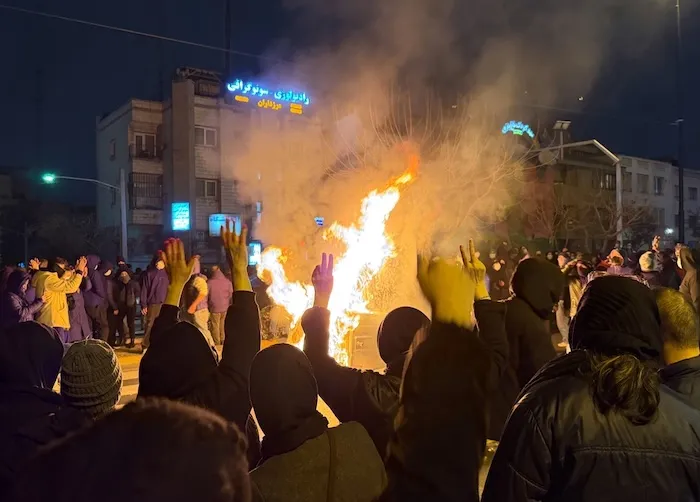
President Donald Trump has threatened to intervene militarily if Iran continues its deadly crackdown on protests inside the country, though it’s unclear whether he will ultimately give an order and what it would entail.
Through the first couple of weeks of this iteration of protests in Iran, the country’s security forces are believed to have killed roughly 2,000 people. The government has also tried to blackout the internet so people within the country cannot communicate with one another or the outside world, which makes knowing and confirming the death toll challenging.
“These are violent, if you call them leaders, I don’t know if they’re leaders or just they rule through violence. But we’re looking at it very seriously,” Trump said on Air Force One Sunday night. “The military’s looking at it. And we’re looking at some very strong options.”
He has several options he could choose between, ranging from doing very little aside from publicly praising the protesters to attempting kinetic military operations designed to bring down the regime that’s been in power in Tehran since 1979, as well as several plausible choices in between.
Military options:
If the president opts for military operations, it could be a lightning-quick one-off operation like the bombing of three of their nuclear facilities, which occurred over several hours in one night in June. Specific targets could include senior political officials such as Supreme Leader Ali Khamenei, senior military leaders, or Iranian security forces that are carrying out the crackdown on protesters.
“I think it’s a really extraordinary time, and this feels a little bit different. Having watched several of these, it just feels more serious. And I think the impression we’re getting, at least from what I’m reading, is that the regime appreciates the seriousness of this,” retired Gen. Joseph Votel, who was commander of U.S. Central Command from 2016 to 2019, told the Washington Examiner.
The U.S. may need additional manpower and resources in the region before such an attack, and would need to be prepared for possible Iranian retaliation targeting U.S. troops or bases nearby. The Iranians carried out a perfunctory retaliatory operation after the U.S. targeted three of its nuclear facilities in June with a telegraphed mission targeting the largest U.S. base in the region, at Al-Udeid Air Base in Qatar.
“We have kinetic or military tools and those that could target the Iranian regime suppressive apparatus that is a multi-layered system of different institutions, which comprise the suppression response to whenever protests take place,” Jason Brodsky, the policy director of United Against Nuclear Iran, told the Washington Examiner.
In addition to the various forces that Iran has, both to quell protests and its military, the U.S. could look at hitting headquarters, command and control centers, and even its weapons production and storage facilities.
It’s unclear, however, what the intended effects of one-off strikes would be for the protesters, given how large Iran’s security forces are believed to be.
“I’m unsure that one-off strikes here and there, frankly, would be sufficient, which is not to say that I would recommend something more extensive, but I’m just reflecting that it’s an extraordinary undertaking, in my judgment, to disrupt the security forces in some dramatic way, while also still keeping the protesters animated,” Nicholas Carl, the assistant director for Critical Threats at the American Enterprise Institute, told the Washington Examiner.
Nonmilitary options:
Short of direct military intervention, the U.S. could try to bring the internet back to the people of Iran, after the government widely blocked its use in response to the protests.
White House spokeswoman Karoline Leavitt said on Monday that Trump has spoken with Elon Musk about Starlink, a satellite internet constellation that can provide internet to underserved rural or remote areas, including in war zones.
The day before, Trump said, “We may get the internet going, if that’s possible,” adding, “We may speak to Elon, ‘cause as you know, he’s very good at that kind of thing, he’s got a very good company. So, we may speak to Elon Musk. And in fact, I’m going to call him as soon as I’m finished with you.”
Musk previously said he directed Starlink to provide Iranians with internet in June after the regime turned off access following strikes from Israel.
Trump, as is becoming a pattern, is willing to negotiate but does not want to be strung along.
The president had expressed an openness to meeting with Iran to discuss an off-ramp until he said on Tuesday he “cancelled all meetings with Iranian Officials until the senseless killing of protesters STOPS.”
The president also announced a 25% tariff on any country that trades with Iran and the U.S. It could further hamper its already struggling economy, which has long faced Western restrictions.
“It appears as though Tehran wants to resume diplomatic engagements with the United States, likely trying to persuade the Trump administration to hold off on any kind of major military action against the Iranian state,” Carl added. “I haven’t seen any indications yet that Iranian leaders are prepared to revise their hard-line negotiations and make concessions that they haven’t been willing to make previously, but nevertheless, by resuming negotiations, their calculation may be that they can, in some ways, hold off U.S. action just long enough for them to gain further control over their population.”
Trump could also seek to apply additional sanctions on Iranian leaders or launch cyberattacks, and there had been talks of possible negotiations.
Lasting influence of Operation Midnight Hammer
The U.S. military carried out Operation Midnight Hammer, targeting three of Iran’s nuclear facilities in June during the 12-day Israel-Iran war. The unprecedented operation was the first time in history that the U.S. military used the massive ordnance penetrator bombs, which are the largest non-nuclear bombs in the U.S. arsenal.
There are several perceptions from the attack that likely remain relevant in the current climate amid the protests.
“I think clearly our ability to reach out, deploy from the United States, and do something very precise and effective like we did, has got to be informing the calculus of the regime that we don’t have to have. We don’t have to go through a whole big staging of forces in the region,” Votel added. “We can reach out and do things right from the United States.”
Trump’s willingness to authorize the June operation — the first major U.S. attack on Iran’s nuclear facilities — makes his current threat of a new kinetic military mission more plausible this time around, while the success of U.S. forces had also proved definitively that Iran’s defenses were no match for the power of the U.S. military, weakening the facade of Iran’s air defense.
The U.S. military’s mission to capture and arrest former Venezuelan dictator Nicolas Maduro also demonstrated its capabilities. And in both situations, those missions came after public warnings from the president, who is now issuing similar comments about the regime in Tehran, issuing them again this week.
IRAN ‘PREPARED FOR WAR’ BUT HOPING FOR NEGOTIATIONS
“Well, I think in Tehran, the credible threat of U.S. military force has just gotten more real, because President Trump has a demonstrated track record of using American military power for targeted surgical strikes, and he has in the past when he has given many warnings to the Iranian regime. He then acted on those warnings after they defied him,” Brodsky added. “I think we’re seeing the same pattern now.”
In both instances, as appears to be the case now, Tehran has the opportunity to meet Trump’s demands to head off his possible authorization of military action.
