

MASSACHUSETTS — The Coast Guard is attempting to rectify years of chronic underfunding that has led to a degradation of facilities, effects on readiness, and the men, women, and families of those in the service.
About six months ago, the Coast Guard launched Operation Restore Habitability, a long-term project to update and improve damaged or outdated infrastructure at stations and facilities all over the country and in U.S. territories.
In the final 39 days of fiscal 2025, the Coast Guard allocated more than $26 million for contracts, completing 626 improvements at 236 facilities. That’s just the first phase of the project, which will likely go on for years.
Some of these improvements range from ensuring air conditioning systems work in warmer climates, heat in the colder climates, fixing plumbing troubles, and many more routine maintenance issues that for years would go unfixed until the local coast guard personnel affected by those problems figured out how to do it themselves.
Master Chief Petty Officer of the Coast Guard Phil Waldron is overseeing the initiative, and he sat down with the Washington Examiner earlier this month to discuss its progress.
Do It Yourself Projects
In the past, some of these more maintenance-related problems could take “years” to be addressed while other cases “could almost be filed away as indefinite,” he said.
“Oftentimes, though, what would happen was the crew on board that unit would just undertake the project themselves,” Waldron said. “And the frustrating part behind that, there is, you have folks who are paid to be boat drivers, boat mechanics, law enforcement officers, and now in their spare time, when they’re not out doing the job, they’re back hanging drywall and fixing toilets and trying to do work that they’ve never been trained to do. Quite frankly, a lot of times you have folks performing maintenance on their buildings by watching YouTube videos to learn how to do it.”
Brian Martin, the command master chief for Coast Guard Sector Southeastern New England, described the previous strategy for repairing older infrastructure as do-it-yourself projects.
“I think we’ve done the best we could with what we’ve had,” Waldron said, acknowledging however, that, “significant underfunding is really the root cause of how we got into this situation.”
The mission is personal to Waldron, who remembers early in his career being stationed at a small boat station in Detroit where they “spent a substantial amount of our time just fixing the building,” and “having to worry about leaky pipes and having to worry about plumbing issues,” he said.
Like Waldron, Martin also had to participate in DIY renovations earlier in his career.
“A while back, I was the officer in charge at Station Milford Haven,” Martin said. “We did basically room renovations. We took some time during the winter months, when it’s a little bit slower, and we would basically shut down a room, try and pull everything out, go in, remove the carpet, try and paint it, and put new carpet in ourselves and try to update the fixtures and stuff like that.”
Their personal experience with run-down facilities also demonstrates that it has long been a problem for the service, where aging and unreliable equipment and quarters force the personnel who use it to figure out how to fix it the best they can because there were higher priorities for senior leaders.
But the creation of Operation Restore Habitability is intended to rectify those issues and stop the degradation in its tracks.
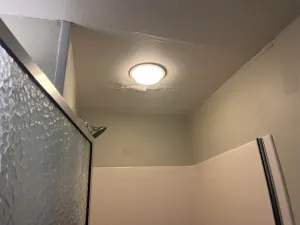
“The primary driver behind the entire thing is habitability. But really, it all speaks right into readiness,” Waldron said. “Not to oversimplify, but even thinking about Maslow’s hierarchy of needs here, just setting that ground-floor baseline expectations of safety and security and all of that there. We have to have that in place, and then from there, we can build on it.”
A 2025 report from the Government Accountability Office found that as of June 2024, the Coast Guard faced a backlog of shore infrastructure projects that will cost at least $7 billion to fix. The report said that total had more than doubled since 2019, when the backlog was $2.6 billion.
Failing to address these problems can also make the problem worse.
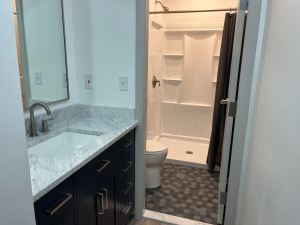
“How I think that number exponentially grows is probably due to a trickle-down effect here,” Waldron said. “Let’s take a heating, ventilation, and air conditioning issue here — what that leads to, oftentimes, is sweating pipes and condensation. What that leads into could potentially be mildew and mold. And so one is just the cause of another is the cause of another.“
Congress included nearly $25 billion for the Coast Guard in the One Big Beautiful Bill Act, which is funding these improvements.
Now, the Coast Guard is relying on their newly created “rapid infrastructure project implementation team,” nicknamed RIPIT, to go to facilities and figure out how to “get them fixed in a lot more rapid fashion than we ever have in the past,” he said.
USCG Stations Provincetown and Cape Cod Canal
The Washington Examiner traveled to Coast Guard Stations Provincetown and Cape Cod Canal to see some of the improvements firsthand.
Within the first several weeks of Operation Restore Habitability, Coast Guard Station Provincetown had its exterior repainted, multiple bathrooms and showers renovated, while the remaining bathrooms are set to undergo a similar redo. They also had a half-court basketball court installed that they already use for multiple purposes, which has already improved morale and built excitement among those guardsmen who live there.
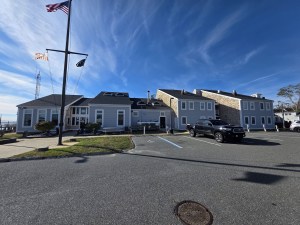
Martin told the Washington Examiner that the paint job took about a week, but needing to find the requisite tools and equipment, it could have taken the station three to six months for the guardsmen to do it themselves in their downtime outside of their normal duties.
“I think when you do things like that, upgrade things, it shows the people that are here that we’re investing in where they live, and investing in them as people,” he said.
The building itself at Coast Guard Station Provincetown is roughly 40 years old, and is one of the newer facilities in the northeast for the service, while the building housing Coast Guard Station Cape Cod Canal is about 100 years old. With older buildings, problems naturally arise, and it used to force guardsmen to improvise, learn new trades, and figure out how to make the best out of it.
At Coast Guard Station Cape Cod Canal, interior heating was a problem in the winter, so RIPIT came in and replaced the windows, while they are in the process of redoing the living quarters for the service members who live on-site. They also installed a half-court basketball court.
“I’ve been in the Coast Guard for almost 27 years, and I’ve never seen anything like this in the Coast Guard,” Martin said.
Between the two facilities, they have each already received two or three times the amount of money for these types of projects through Operation Restore Habitability compared to the funding they each received in the previous four years combined.
At Provincetown, RIPIT has invested $397,022, and they have received $184,418 over the last four years for major infrastructure investments, while Cape Cod Canal RIPIT investment projects totaled $615,257 and they had received $208,816 in the prior four years.
Both stations have additional upgrades they want to make in Phase II of the project.
