

Millions of Ukrainians are currently suffering through “absolutely impossible” winter conditions with near-daily Russian attacks on the war-torn country’s energy infrastructure, as they near the four-year anniversary of the beginning of the full-scale invasion.
Suffering civilians both near and far from the front lines desperately hope for a breakthrough in the United States’ diplomatic efforts for an end to a war of aggression that Russian President Vladimir Putin could have chosen to end every single day since he ordered its commencement on February 24, 2022.
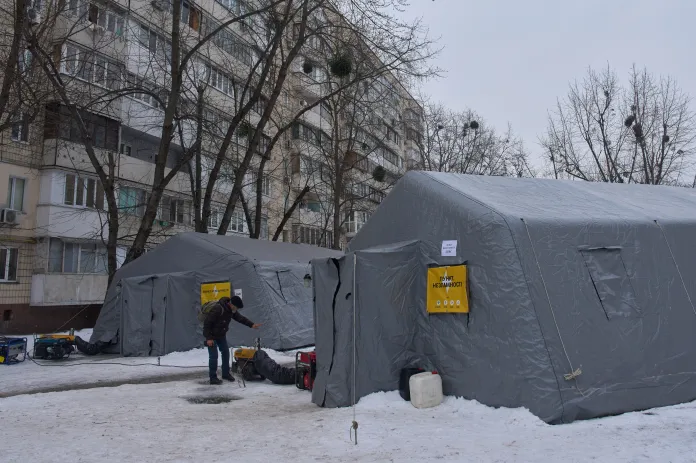
“It’s absolutely impossible conditions, and I think the sense of urgency is of the highest possible way,” Ukrainian Ambassador to the U.S. Olga Stefanishyna told the Washington Examiner in an interview at the embassy in Washington, D.C., earlier this month. “There are no such measures invented by humanity which could secure people from these attacks. So basically, people are freezing in their homes, and there’s no way for them to get access to more electricity and more heating, because Russia attacks, by missiles, the energy facility.”
TRUMP GIVES RUSSIA AND UKRAINE JUNE DEADLINE TO END WAR: ZELENSKY
She described it as a “major humanitarian catastrophe and disaster,” as well as a “genocidal effort targeted to attack as many Ukrainian people as it is possible … and to destroy as much in Ukraine as it is possible, to make sure that we are not able to function as a state.”
Last month, the mayor of Kyiv, Vitali Klitschko, told Reuters that heating was out for about half of the city’s three million people. He also said that the current crisis is the most difficult to handle since the start of the war.
In December, U.N. officer-in-charge for Europe, Central Asia, and the Americas Kayoko Gotoh said 2025 was one of the deadliest years for civilians since the war began, noting that civilian casualties from January 2025 through November 2025 were about 24% higher than during the same time period the year before.
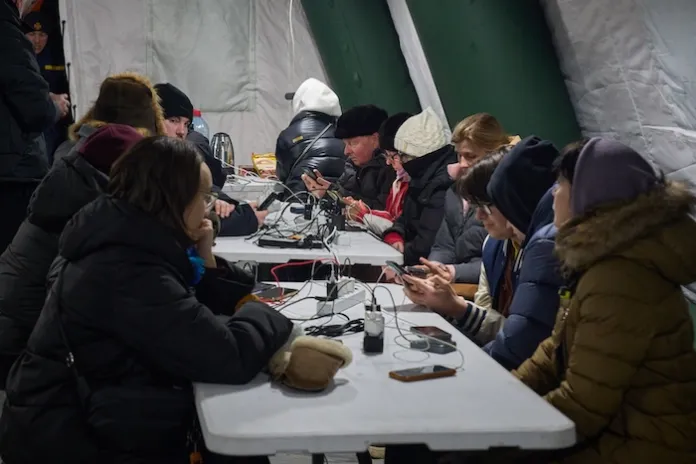
A young family living in Kyiv, Nastia and Illia, whom the Washington Examiner was able to connect with through the U.S.-based Hope for Ukraine non-profit, said, “When attacks are systematic and specifically target energy infrastructure, it becomes especially exhausting psychologically. You are not only afraid of the explosions. You understand that after them, there may be days of cold and darkness.”
The couple was forced to leave their home in Melitopol in 2022 and resettled in the capital.
“We plan our work, household chores, cooking, laundry — even taking a shower — around the hours when we have power. If we know we will have electricity for just 2–4 hours, we try to do everything at once: charge phones and power banks, run the washing machine, cook meals for the next day or two.”
“When the power goes out, life feels like it pauses,” they said about their routine. “The pace slows down. You start conserving everything — battery, warmth, energy. The war has turned our lives into constant adaptation. There is no stability. Things that once felt ordinary — electricity, heating, internet — now feel like privileges rather than basic necessities.”
HUGO GURDON: AMERICAN DECLINE, OR A REBOUND?
President Donald Trump, acknowledging the brutal winter conditions, said in late January that he asked and Putin agreed to a weeklong energy infrastructure ceasefire, though Ukraine accused Russia of both violating the agreement and of carrying out large-scale attacks in the days after its expected expiration.
Tuesday will mark four years since Russia began its full-scale invasion. Despite the expectations of a quick decapitation operation to depose Ukrainian President Volodymyr Zelensky and his government, Russia only holds about one-fifth of Ukraine’s territory currently, and its military has suffered more than 1 million casualties since the war began. But they have not shown any inclination that either will stop them from continuing the war for minimal gains on the battlefield.
Beginning of negotiations
The Trump administration’s effort this past year to pursue diplomatic negotiations to end the conflict, a mission Trump has spearheaded, was a marked change for the United States, which had, under former President Joe Biden, prioritized supporting Ukraine’s defense.
“This is a big transformation,” Stefanishyna said. “But unfortunately, although we have progress and secured a process on a diplomatic level, it has no major effect on the battlefield, but also it scaled up the military terror against all the population. So basically, speaking about where we stand in terms of reaching the fourth year since the beginning of the war, this winter is marked by unprecedented terror against the population.”
WHAT REPUBLICANS DO, AND DON’T, WANT TO HEAR FROM TRUMP AT STATE OF THE UNION
Negotiations have continued this week, though Russia has refused to budge on its demands that Ukraine make significant sacrifices to end the war that would more closely resemble a surrender. Russian leaders have demanded Ukraine give up the territory Russia occupies, as well as some Russian forces have been unable to conquer militarily, and have demanded there be limits put in place for how large Ukraine’s military can be. They also refuse to allow Ukraine’s allies in Europe to station troops in Ukraine as a post-war security guarantee.
“Vladimir Putin has not yet negotiated in good faith, never once,” Sen. Roger Wicker (R-MS) said at the Munich Security Conference earlier this month. “He will begin to negotiate in good faith only when he is hurting enough, and that’s what these all sanctions may do. That’s what more serious, more decisive and skillful weaponry may do. But he will not negotiate in good faith, and has not yet said one word about actually ending this war in a meaningful way.”
Russia has made a major part of its war aims the seizure of the entire Donbas region, which consists of the Donetsk and Luhansk oblasts in the eastern part of Ukraine, and it borders Russia. There’s a heavy Russian population in the area, and fighting in the region predates the larger war. Russian forces currently hold almost the entirety of Luhansk, while the Ukrainian military has managed to retain control over approximately 20% of the territory in Donetsk.
Russia has demanded Ukraine give up the portion of Donetsk it still holds in any negotiated settlement, though Ukraine spent years fortifying the city in the event of such an invasion and has largely rebuffed public calls for land concessions.
The U.S., under Trump, no longer prioritizes helping Ukraine above all else; rather, the administration’s top priority is working through a negotiated end to the war.
“Zelensky is gonna have to get moving. Russia wants to make a deal, and Zelensky is gonna have to get moving, otherwise he’ll miss a great opportunity,” Trump, who reportedly wants to see an agreement come together in a matter of months, said earlier this month.
The president’s comments demonstrate his willingness to criticize the leaders of both Russia and Ukraine for not getting to a breakthrough, though only one side is the aggressor in the conflict and they have not shown a willingness to concede in negotiations.
FOREIGN AGENTS PUMP LARGE AMOUNTS OF CASH INTO CAMPAIGNS AHEAD OF 2026 ELECTIONS
“The question is, what are Russians are ready to do? We don’t hear compromises from the Russian side,” Zelensky said at the Munich Security Conference. “We want to hear from them, something.”
While leaders speak positively about apparent progress, it’s not felt by Ukrainians whose lives have been upended and are facing the brutal winter without essential resources to stay alive.
“The first years we were trying to fight back and waiting until the war will be over. But at this point, we’re trying to live as a country, knowing that the aggressor would not go anywhere,” the ambassador, Stefanishyna, said. “Russia will not disappear, so it will always be a neighbor of Ukraine. And we should start understanding, how do we live with this?”
For Ukraine, any deal needs to address its major concern of how to ensure Russia doesn’t restart the conflict at the time and place of their choosing, knowing Russia’s long history of aggression toward its neighbors. They are trying to learn the lessons of previous instances of Russian aggression, ensuring that they are ready if they need to be in the future. Russia invaded Crimea in 2014 and the world watched as it happened.
Many Eastern European countries have boosted their defense spending in recent years after watching what became the largest land war on the European continent since World War II, over concerns that they could be a future victim of Russian aggression.
DEMOCRATS TEST ‘EPSTEIN CLASS’ ATTACK LINE AGAINST TRUMP’S ORBIT
Ukrainian children
A major part of Russia’s war aims includes the targeting of Ukrainian children to erase their Ukrainian identities.
The Ukrainian government has registered more than 25,000 Ukrainian children who were abducted by Russian forces and brought back to either the occupied territory in Ukraine or to Russia, according to Stefanishyna. Many of these children were orphaned in the war, and upon being taken are given Russian passports and told they’re now Russian citizens. Some received military training from Russia.
“The nature of this crime speaks about the very nature of the Russian aggression. Russia knows the only way to conquer Ukraine is to deprive Ukraine of its future, and Ukrainian children are the future generations of Ukrainians,” Stefanishyna said.
The International Criminal Court announced arrest warrants in March 2023 for Putin and Alekseyevna Lvova-Belova, the Commissioner for Children’s Rights in the Office of the President of the Russian Federation, whom they said shared responsibility for these child deportations.
The thousands of kidnapped Ukrainian children were sent to more than 200 different facilities stretching far across Russia, according to a September report from the Yale University Humanitarian Research Lab, which has tracked the deportations since the early parts of the conflict.
Children at more than half of those facilities were subjected to re-education, while those at slightly fewer than a fifth of the facilities underwent militarization training.
WHAT IS THE FCC EQUAL TIME RULE AT CENTER OF COLBERT-TALARICO INTERVIEW CONTROVERSY?
In Dec. 2025, members of the Senate Subcommittee on State, Foreign Operations, and Related Programs held a hearing about the issue, and many declared that the return of Ukrainian children should be a non-negotiable part of any diplomatic agreement to end the war.
Fewer than 2,000 Ukrainian children have been returned to their families, according to the Kyiv Independent. First lady Melania Trump has also worked on securing the release of abducted Ukrainian children, and has announced three separate instances of getting them returned.
