

Soldiers from across the country descended on Huntsville, Alabama, this week to demonstrate their ability to operate drones and the innovations they have developed based on their needs and experiences.
The Army’s first annual Best Drone Warfighter Competition, sponsored by the Army Aviation Association of America, featured three distinct competitions in which soldiers competed for the titles of Best Operator, Best Hunter-Killer Team, and Best Innovation.
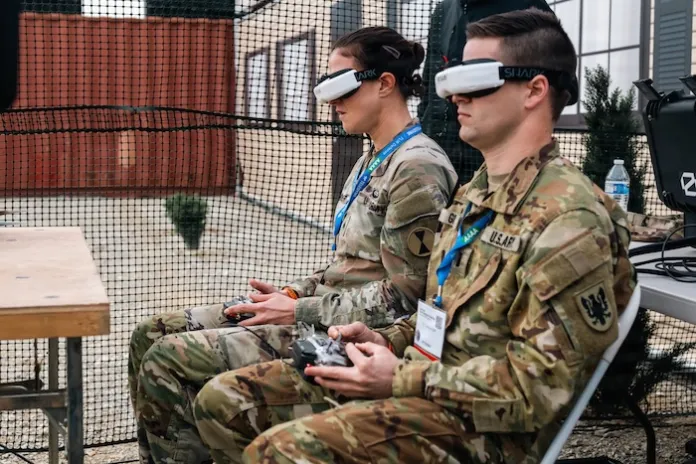
For the best operator competition, two soldiers at a time raced first-person-view drones through an obstacle course. Not only did they have to make it through the course, but they also had to do it faster than their competitor to advance to the next round.
Sgt. Javon Purchner, 1st Cavalry Division Artillery, won the tournament in a thrilling best-of-three match that included two nixed launches due to drone error. Several competitors crashed their drones on the two-lap track, forcing operators to navigate multiple obstacles of varying heights and types.
Soldiers participating in the Best Hunter-Killer Team had to complete a series of tiring exercises before even starting the drone portion of the competition, simulating what they are likely to experience on a battlefield.
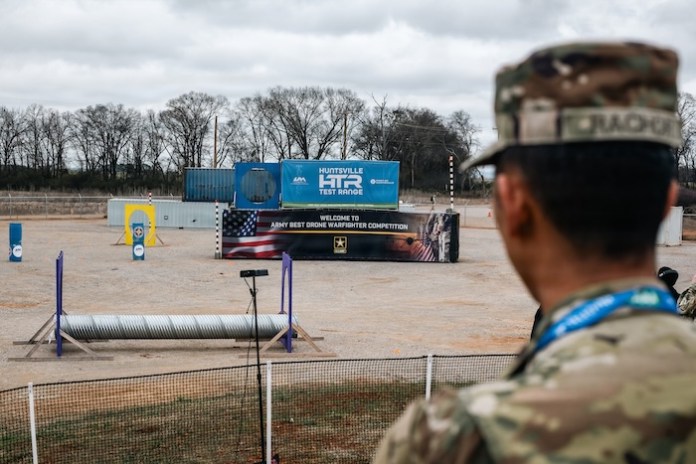
Specifically, they had to first camouflage themselves within ten minutes, run a series of tiring maneuvers involving dragging a sled with a 145 lb body dummy and do an overhead water-can press as many times as they could within five minutes before they then had to trek 1,000 meters as quickly as possible before launching their hunter and killer drones to identify and take out simulated targets.
Staff Sgt. Angel Caliz and Spc. Jonah Burks from the 2nd Cavalry Regiment, V Corps, won the hunter-killer event.
Multiple teams were not able to complete the final leg of the race before time ran out. Some teams struggled to make the trek with their gear fast enough to leave time for the drone component.
SFC Jose Morua, one of the soldiers overseeing this competition, told the Washington Examiner that the best teams not only reached the final stage quickly to give them time for the final leg but also were “communicating very, very well,” with one soldier operating the hunter drone and the other manning the killer drones.
The third lane of competition was about what innovations individual units have made for themselves, and there was a panel of five judges who graded the entries in a Shark Tank-like setup.
Dr. John Hrynuk of the DEVCOM Army Research Lab, who was one of the judges, told the Washington Examiner they saw “a really wide range and a lot of interpretations on what innovation in drones means, from payloads and sensors to the specific integration and how the drone is used.”
“What we’ve seen in the innovation tent over here is a lot of different mission-specific, unit-specific challenges. So they all came, and they brought different technology, because they all have different jobs, and we’ve seen things percolating up from below. I have this challenge, this is how I want to solve it, using drones. And that’s been really valuable to see as a scientist as well,” he added.
1st Lt. Ryan Giallonardo, Chief Warrant Officer 3 Robert Reed, Chief Warrant Officer 2 Nathan Shea, and Sgt. 1st Class Brent Wehr from the 28th Infantry Division won the competition with their project, dubbed Project R.E.D. (Recovery Exploitation Drone).
The drone they use works with AI-enabled object recognition software to identify downed drones, and with its robotic 3D-printed carbon fiber arm and claw, can pick them up instead of putting soldiers at risk to do the same thing.
Army Secretary Dan Driscoll attended the final day of the competitions on February 19 and presented the winners with plaques.
“We’re better than we were. We’re not where we need to be. But the one thing I know is that all of those soldiers out there, you are the most innovative, talented people that I have ever, and I mean this very sincerely, ever gotten to work with. But what we need is, is not going to be the bullshit conversations that I have in the Pentagon that will solve this for us,” he said during the ceremony. “It is going to be what you did today, putting on camo, getting out in the mud… telling us what works and what doesn’t work.”
US-IRAN CONFLICT: ALL SIDES BRACE FOR WAR AS ‘NOTHING BURGER’ NUCLEAR NEGOTIATIONS PROVE FRUITLESS
The winning teams also received an Army Research Lab drone prototype and a one-year research-and-development agreement to assist the lab with design improvements.
“At the end of the day, it’s not about receiving trophies or awards—it is about ‘what lessons can we take from this to find out who the best operator is and how they became the best operator? What skills and resources, and training allowed them to become the best operator?’” Col. Nicholas Ryan, who leads the unmanned aerial systems team for the Aviation Transformation Integration Directorate at Fort Rucker, Alabama, told reporters. “And who’s doing some amazing innovation out there across the Army…that we can then take and scale across the entire Army?”
