

President Donald Trump made the most consequential decision of his second term last Friday at 3:38 p.m.
“Operation Epic Fury is approved. No aborts. Good luck,” Trump said, instructing the Department of War to move ahead with a decapitation operation against Iran that was many years in the making, according to his top military adviser, Gen. Dan Caine.
The message from the president, coincidentally, came as he was aboard Air Force One, nearing his arrival in Corpus Christi, Texas, where he touted his economy and energy policy agendas.
After the president’s authorization, U.S. troops began making their final preparations, checking and rechecking their systems. Pilots and crews did one last rehearsal for their strike packages and air crews began loading their final weapons aboard aircraft. The first U.S. attacks were conducted by CYBERCOM and SPACECOM to disrupt their communications and ability to respond and defend against the incoming attacks.
At 9:45 a.m. local time Saturday morning, or 1:15 a.m. in Washington, D.C., more than 100 U.S. aircraft took off in a single synchronized wave that included tankers, airborne early warning, electronic attack bombers, drones, and more.
The strikes were closely coordinated with the Israelis, who are actively participating in attacks.
“The first shooters at sea were tomahawks unleashed by the United States Navy, closed in on Iranian naval forces and began to conduct strikes across the southern flank in Iran on the ground, forces fired precision standoff weapons, measured, deliberate, precise and lethal,” Caine said.
The U.S. deployed B-2 stealth bombers; F-18, F-16, and F-22 fighter jets, A-10 attack jets and F-35 stealth fighters; and one-way attack drones.
The one-way attack drones, coincidentally, were “modeled” after Iran’s highly effective Shahed-drones — which they have given to Russia for their war in Ukraine — and it was the first time the U.S. used these in combat.
U.S. forces ultimately struck more than a thousand targets over the first 24 hours of the conflict, which is now in its third day.
In the opening salvo, the Israelis said they killed Supreme Leader Ali Khamenei and several other top leaders, including Islamic Revolutionary Guard Corps Cmdr. Mohammad Pakpour, Defense Minister Aziz Nasirzadeh, two Khamenei advisers, a current and former chairman of Iran’s nuclear program, and a chief intelligence official in Iran’s military emergency headquarters.
Iran, for its part, has launched countless missiles and drones at U.S. bases in several countries in the region and at Israel. They have targeted U.S. assets in the United Arab Emirates, Qatar, Kuwait, Bahrain, Oman, Jordan, Iraq, and Saudi Arabia.
In the fog of battle, Kuwaiti air defenses accidentally shot down three American F-15E Strike Eagles aircraft, but all six pilots ejected, were found, and are in stable condition. An investigation into the incident is underway.
Four American service members were killed in an Iranian attack, though the Pentagon has not said where in the region they were. Secretary of War Pete Hegseth said they were in a fortified tactical operation center when it was hit by an Iranian projectile. Leaders have warned that the U.S. will likely have more casualties as Iran continues to retaliate against the ongoing U.S. operations.
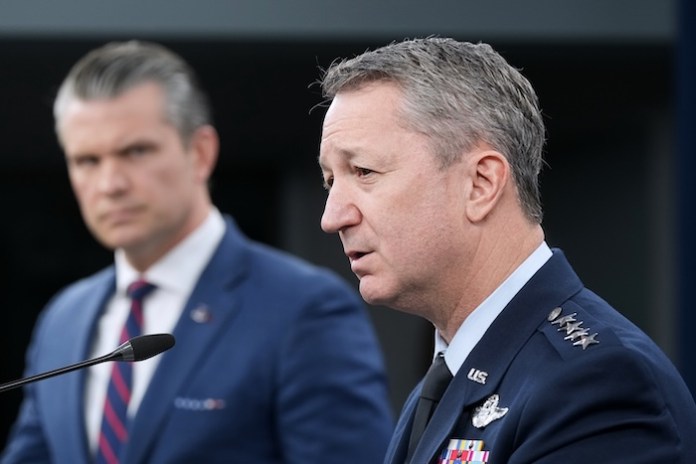
“We expect to take additional losses, and as always, we will work to minimize U.S. losses,” Caine told reporters at the Pentagon Monday. “But, as the secretary said, this is major combat operations.”
There are concerns that Iran’s proxy forces in the region could enter the fray, which would further strain U.S. and Israeli defenses. Hezbollah, Iran’s proxy in Lebanon, and Israel have already attacked one another but it has remained relatively contained for now.
Leading up to Trump’s approval of the mission, the Department of War spent the last couple of weeks bolstering its assets in the Middle East. They deployed thousands of service members from all branches of the military, hundreds of fourth- and fifth-generation fighter aircraft, dozens of refueling tankers, and two carrier strike groups and their embarked air wings.
Caine acknowledged that more U.S. military assets are currently heading to the region. He didn’t want to provide specifics for operational security, but said, “We have more tactical aviation flowing into theater just based on the time it took to get it out there.”
Both Caine and Trump have warned that this mission, unlike last year’s Operation Midnight Hammer, will be a sustained campaign that will likely last weeks.
DAN CAINE SAYS ADDITIONAL FIREPOWER HEADED TO MIDDLE EAST AND HEDGES OPERATION TIMELINE
“This is not a single overnight operation,” the chairman said. “The military objectives that CENTCOM and the Joint Forces have been tasked with will take some time to achieve, and in some cases, will be difficult and gritty work.”
Trump said the conflict could take four weeks, while Hegseth acknowledged they will operate until they accomplish their goals.
