

The U.S. intelligence community has “high confidence” it knows where Iran’s enriched uranium is located, Director of National Intelligence Tulsi Gabbard told lawmakers on Thursday.
The whereabouts of Iran’s enriched uranium is a major factor in the U.S.’s war, a goal of which is to ensure Tehran can never obtain a nuclear weapon, though it’s unclear what President Donald Trump will authorize the military to do regarding the goal.
The head of the International Atomic Energy Agency, Rafael Grossi, said there are lingering questions about whether Iran had moved their enriched uranium prior to last year’s 12-day war between Israel, the United States, and Iran.
“There are many questions that we will only elucidate when we are able to go back,” Grossi said on Wednesday, though he also noted, “The impression we have, and I think that is a widespread impression in others who are also observing, is that it hasn’t been moved.”
COULD THE US INSTITUTE A DRAFT FOR THE IRAN WAR?
CIA Director John Ratcliffe told lawmakers Iran “currently possess[es] at least 440 kilograms,” which is roughly 972 pounds, “of highly enriched uranium at 60% weapons grade that would be capable of putting together 10 nuclear weapons.”
Israeli Prime Minister Benjamin Netanyahu said on Thursday, “Iran no longer has the capacity to enrich uranium and manufacture ballistic missiles.”
Last week, Secretary of War Pete Hegseth told reporters that the department has a “range of options” for what to do with Iran’s enriched uranium.
“We have a range of options, up to and including Iran deciding that they will give those up, which of course we would welcome,” he said. “They weren’t willing to do in negotiations.”
Trump on Thursday downplayed the possibility he could deploy ground troops or special operators to Iran, though extracting or destroying the enriched uranium would require some physical presence.
“No, I’m not putting troops anywhere,” he said at the White House. “If I were, I certainly wouldn’t tell you. But I’m not putting troops.”
Secretary of State Marco Rubio told lawmakers recently, “People are going to have to go and get it,” when asked whether Iran’s enriched uranium would be secured.
Any such mission would come with great risk, in part because whoever is on the ground would need to first find the enriched uranium, then verify it, and either extract or destroy it. It’s also unclear whether any of the canisters it’s in have been punctured since the bombings, and the risks associated with setting them off.
Grossi said his organization could never participate “in any military operation of any kind,” though the idea would be that they could verify the enriched uranium. He added, “We are an international inspectorate and an agency for cooperation in the peaceful uses of nuclear energy, so that would not be conceivable.”
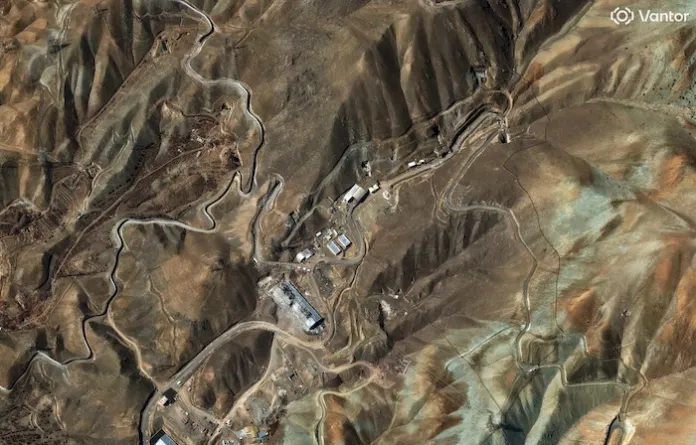
The IAEA chief indicated the enriched uranium is believed to be beneath the rubble at Iran’s Isfahan facility with smaller amounts likely at the Natanz and Fordow facilities that were destroyed in last year’s Operation Midnight Hammer.
US LOOKS TO LESSONS FROM UKRAINE IN HOW TO FIGHT IRANIAN DRONES
Leaving the enriched uranium behind, however, also poses risks, especially if the regime can survive the current war. The health of new Ayatollah Mojtaba Khamenei remains an unknown, though he is viewed as a hard-liner who would carry on the regime’s reign. If the regime can make it through the war, it could seek to acquire a nuclear weapon.
U.S. military leaders have put an emphasis on Iran’s ballistic missile program during this war, which is nearly three weeks old.
“Our objectives unchanged, on target and on plan, destroy missiles launchers and Iran’s defense industrial base so they cannot rebuild, destroy their navy, and Iran never gets a nuclear weapon,” Hegseth said on Thursday. “Iran’s air defenses flattened Iran’s defense industrial base, the factories, the production lines that feed their missile and drone programs, being overwhelmingly destroyed. We’ve hit hundreds of their defense industrial bases directly, their ability to manufacture new ballistic missiles has probably taken the hardest hit of all.”
MISSILE THREAT TO GROW EXPONENTIALLY OVER THE NEXT DECADE: INTELLIGENCE COMMUNITY
He said the Iranians built up their conventional weapon stockpiles as a way of establishing their own deterrence so they could develop their nuclear program.
“It’s the conventional umbrella that was growing and growing and growing that was meant to protect that nuclear capability,” Hegseth said.
