

A month of sustained U.S. and Israeli airstrikes on Iran has systematically targeted and, in several cases, reportedly destroyed key components of Iran’s nuclear program, military infrastructure, leadership facilities, and elements of its energy sector, according to information released by government bodies and multiple outlets’ reporting.
At the highest level, several of Iran’s most sensitive and hardened assets are now assessed to be destroyed or rendered inoperable, while cumulatively, U.S. Central Command says 11,000 targets have been hit since the beginning of the war.
Among the most consequential losses is a hardened underground command site tied to late Supreme Leader Ayatollah Ali Khamenei, described in multiple reports as a primary wartime coordination bunker.
BYRON YORK: TRUMP NEEDS A SHORT WAR
U.S. and Israeli officials have said the facility was struck directly in the opening phase of the campaign, with follow-up assessments indicating it was destroyed, disrupting senior-level command and control. Satellite imagery reviewed and verified by the New York Times shows the site effectively leveled.
Iran’s nuclear infrastructure has also taken some of the most severe damage. At the Natanz enrichment complex, strikes knocked out power systems and destroyed above-ground facilities critical to centrifuge operations.
Additionally, sections of the underground enrichment halls collapsed or became inoperable after power loss and secondary damage, effectively halting production at Iran’s primary enrichment site.
Strikes on supporting nuclear infrastructure, including access points and auxiliary buildings tied to underground facilities, have further limited Iran’s ability to resume uranium enrichment operations.
Israeli Prime Minister Benjamin Netanyahu has claimed that “Iran today has no ability to enrich uranium.”
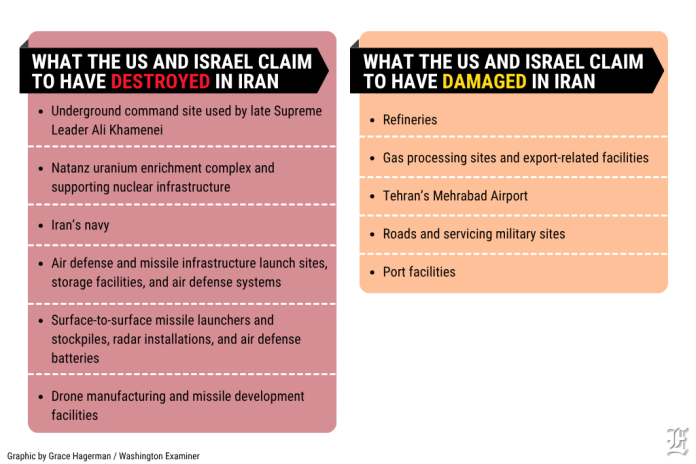
Military and naval assets have also been destroyed in significant numbers. U.S. Central Command said that coordinated strikes eliminated 60 Iranian naval vessels, including fast-attack craft operated by the Islamic Revolutionary Guard Corps, in the Persian Gulf and along Iran’s most southern coast.
President Donald Trump has claimed on several occasions that Iran’s navy is essentially destroyed and that the country closed the Strait of Hormuz, a vital oil shipping lane.
Satellite imagery, reviewed by the New York Times, from the first weeks of the war, shows one larger moored ship sunk at port, alongside Iranian missile base buildings with gaping holes in the roofs from airstrikes.
Air and missile capabilities have been degraded through the destruction of launch sites, storage facilities, and air defense systems. Israeli officials have said multiple surface-to-surface missile launchers and stockpiles were destroyed in targeted strikes, while radar installations and air defense batteries were hit to open corridors for continued operations.
HOW IRAN TRANSFORMED FROM AN ISLAMIC REPUBLIC TO A MILITARY DICTATORSHIP
Reuters reported that the U.S. only has verification of a third of Iran’s missile arsenal being destroyed. The exact state of Iran’s missile defenses is unclear, as several different figures have been reported throughout the war.
According to figures released by the Israeli Defense Force, around 75% of Iran’s missile launchers have been wiped out. Trump, on the other hand, said 99% of Iranian missiles have been destroyed, with CENTCOM bringing the number closer to 66%.
Strikes have also hit key defense industry sites involved in weapons production. Facilities tied to drone manufacturing and missile development have been destroyed or rendered unusable, according to U.S. and Israeli officials, part of a broader effort to limit Iran’s ability to replenish its arsenal during the conflict.
Energy infrastructure, while not uniformly destroyed, has sustained significant damage in targeted strikes on refineries, gas processing sites, and export-related facilities. Some installations have been described by officials as “taken offline” after sustaining direct hits that damaged critical processing units and storage capacity.
At the lower end of the damage spectrum are sites that have been struck but not completely destroyed, leaving them degraded or only partially operational. Tehran’s Mehrabad Airport and aviation infrastructure have been hit in multiple rounds of strikes, damaging runways, hangars, and support facilities without fully shutting down operations nationwide.
Similarly, some oil and gas facilities, including portions of larger fields and processing hubs, have been damaged but remain capable of limited output.
TRUMP’S IRAN DEAL MUST BE NOTHING LIKE OBAMA’S
Transportation and logistics infrastructure, including roads and servicing military sites and port facilities, has also been disrupted by repeated strikes, complicating Iran’s ability to move equipment and personnel.
Taken together, the strikes since Feb. 28 point to a campaign focused on eliminating Iran’s most critical strategic capabilities while degrading infrastructure tied to energy production and force mobility.
