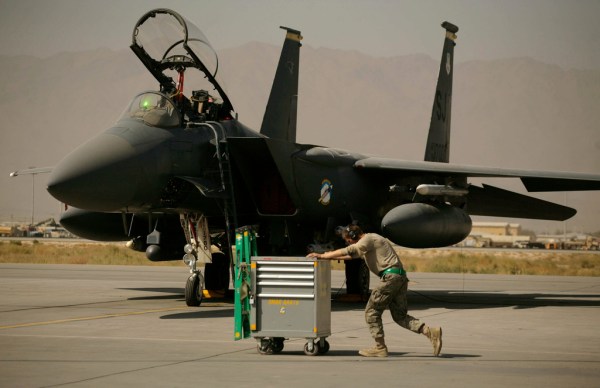
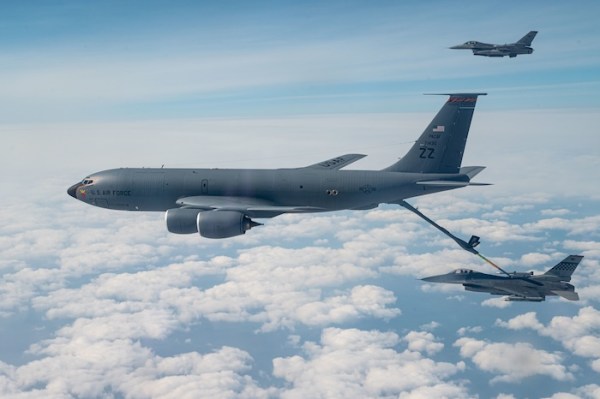
The search and rescue mission this week to locate and save the missing weapons systems officer shot down in Iran was akin to “hunting for a single grain of sand in the middle of a desert,” CIA Director John Ratcliffe said on Monday.
The two American airmen aboard the F-15 ejected themselves from their aircraft on Friday, seconds after it was hit by incoming Iranian fire. Both landed deep within Iranian territory. The pilot was found and rescued within about six hours, but the other officer was on his own, injured, for nearly 48 hours in a foreign country with hostile forces racing to capture him as a prisoner of war.
President Donald Trump indicated on Monday that an Iranian shoulder-fired “heat-seeking missile” downed the U.S. Air Force F-15 jet days earlier, though the Pentagon has not confirmed what type of projectile hit the aircraft.
“The second rescue mission involved 155 aircraft, including four bombers, 64 fighters, 48 refueling tankers, 13 rescue aircraft, and more,” Trump said during a briefing, noting that some of them intentionally flew to various locations not believed to be where the missing American airman was hiding to confuse the Iranians.
To aid in that misdirection effort, the CIA executed a deception campaign to confuse the Iranians hunting for the airmen.
“We deployed both human assets and exquisite technologies that no other intelligence service in the world possesses to a daunting challenge comparable to hunting for a single grain of sand in the middle of a desert,” Ratcliffe explained. “This was also a race against the clock, as it was critical that we locate the downed aviator as quickly as possible, while at the same time keeping our enemies misdirected.”
The president said the CIA had a “camera” focused on what it believed to be the injured and hidden American airman for “45 minutes,” before getting confirmation that the figure was the injured American, though it’s unclear if Trump was referring to drone or satellite capabilities.
He also acknowledged that there were some advisers who were not in favor of carrying out a rescue mission because doing so put “hundreds of people” in harm’s way.

The rescue operations did not go perfectly — Iran damaged an A-10 Warthog aircraft. The pilot, upon realizing he wouldn’t be able to safely land the aircraft, crossed into friendly territory and ejected. This pilot was safely recovered not long after.
Both Trump and War Secretary Pete Hegseth praised the extraordinary recovery effort but spent little time discussing the capabilities Iran maintains that allowed it to shoot down two U.S. aircraft in a matter of hours.
“The HH60, Jolly Green fight was engaged by every single person in Iran who had a small arms weapon, and one of the aircraft, the trailing aircraft, took several hits. The crew sustained minor injury, and they are going to be fine,” Gen. Dan Caine, the chairman of the Joint Chiefs of Staff, said during Monday’s press briefing.
Two H-6 helicopters took small-arms fire from the ground, wounding the crews in both aircraft and requiring them to land safely in Kuwait, while two MC-130Js became inoperable when their nose wheels sank into the wet, sandy terrain, the Wall Street Journal reported.
Trump said their contingency plan, which they relied on, was to have lighter and faster aircraft come in for their rescue, and that they “blew up” the old planes “to smithereens.”
LINGERING QUESTIONS FROM THE F-15 CRASH AND DRAMATIC RESCUE OPERATION
“We control the sky,” Hegseth said. “Do you see we flew for seven hours in daylight over Iran to get the first pilot, and we flew seven hours in the middle of the night to get the second, and Iran did nothing about it.”
The president has given Iran until Tuesday night Eastern time to make a deal to either end or pause the war or risk U.S. escalation. If a deal fails to materialize, Trump has threatened to bomb civilian infrastructure in Iran, such as power plants and bridges, though Iran, too, could match that U.S. escalation with its own, which could likely target Gulf countries.