

Russian forces have bombarded Ukraine with massive numbers of drones and missiles just days after the end of the three-day ceasefire, which both sides accused the other of breaking.
Since the early hours on Wednesday, Russia launched more than 1,500 drones and over 50 missiles of various types, Ukrainian President Volodymyr Zelensky said, adding that the Ukrainian military intercepted 94% of the incoming drones and 73% of the incoming missiles.
Stay informed.Stay ahead.
Join Washington Examiner for unlimited access to the news, analysis, and commentary that matter most.
Already a member? Log in
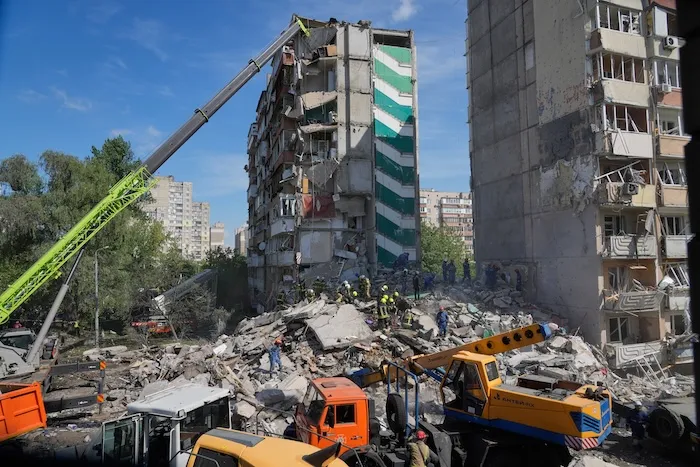
A Kh-101 missile hit a residential apartment building in Kyiv, the capital of Ukraine, which is hundreds of miles from the frontlines, and it collapsed several floors. The current death toll from the apartment building strike is nine, and roughly 20 people are believed to be missing following the strike. Dozens were injured as well.
The intense, dayslong Russian attack came just days after the completion of a three-day ceasefire and prisoner exchange that was brokered by President Donald Trump.
Russia pursued a short-term ceasefire so it could safely hold its Victory Day parade, which is held every year on May 9 to commemorate the Soviet Union’s victory over Nazi Germany in World War II. The parade, long been known for displays of military hardware and equipment, was scaled down this year in comparison to past years.
“With the lack of battlefield advances, high casualties, and mounting economic costs that are already causing growing dissatisfaction in Russia, Putin has tailored his Victory Day address as a message first and foremost for domestic consumption,” Royal United Services Institute associate fellow Natia Seskuria told the Washington Examiner.
“The subdued parade and scaled‑back displays of military hardware indicate increasing vulnerability, even as the Kremlin insists the war is ‘coming to an end.’ Putin seeks to reassure the public that Russia is still winning a war that is losing popularity, and to justify the ongoing sacrifices as part of an existential struggle against NATO and the West,” she continued.
Despite the ceasefire, both sides accused the other of breaching the agreement.
George Barros, an expert with the Institute for the Study of War, told the Washington Examiner that Zelensky “played a very smart political game here” because “Vladimir Putin is not able to secure his airspace,” so there was a “truncated parade.”
Outside the frontlines
Ukraine, in recent months, has begun targeting Russia’s logistics supply lines beyond the frontlines, which is not something it had been doing this time last year.
However, instead of relying on expensive long-range weapons systems provided by Western allies to hit deep inside Russian territory, Ukraine is using drones to target Russia’s supply lines in the middle range beyond the frontlines.
“The number of middle strikes has also grown significantly. There are now twice as many strikes at distances of 20+ kilometers compared with March, and four times as many compared with February. And there will be even more. This is a priority area,” Zelensky said on May 5.
Ukrainian troops last week used drones to hit a truck driving along a highway in Mariupol, which is Russian-occupied Ukrainian territory approximately 60 miles from the frontlines.
“If that intensifies in the direction in which it appears to be, then the Russians are going to struggle with being able to mask the forces that they need to be able to make these sorts of gains,” Barros explained. “The Russians don’t have a good answer. They don’t have an operational concept. They don’t have tactics that are a silver bullet.”
This matured Ukrainian capability will force the Russians to defend their logistics much further away from the frontlines than they had been. If the threat makes it harder for Russia to get materials and troops to the frontlines, it could slow their advance.
Russian forces have only been able to gain roughly 107 square miles of territory since the start of 2026, ISW told the Washington Examiner.
On Monday, prior to Russia’s overwhelming assault, Zelensky warned, “Distance is already becoming less and less important — we have demonstrated that through our long-range capabilities.”
Russian ‘recruits’
Russia has tried to lure young adults — both domestically and internationally — into joining the military with the promise of high salaries, free college tuition, and even Russian citizenship to overcome its manpower issues.
Several African countries have warned that countless young men have been tricked into traveling to Russia under the guise of better opportunities, only to be thrown into the military and risk ending up on the frontlines.
More than 1,000 Kenyans have traveled to Russia to fight in the war, though not all of them left from Kenya (some were living in the diaspora), and only 30 of them have returned to the country, the Kenyan government said in February.
The authorities stepped up their efforts to intercept these recruits and stop them from going. As a result, the handlers involved have evolved their tactics, including changing the route of getting them from Kenya to Russia.
In addition to Kenya, Tanzania, Zambia, South Africa, Nigeria, Ghana, Togo, Botswana, and Mali have all acknowledged men getting falsely recruited into the Russian army, according to the New York Times.
Closer to home, Russian officials are looking for university students domestically to fill its new drone forces, which were formed last November as a new branch of the country’s army, according to NBC News.
Earlier this week, Russian media reported on the killing of Valery Averin, 23, a student at the Buryat Republican College of Construction and Industrial Technologies who is believed to be the first confirmed case of a student killed in the war after getting recruited by the Defense Ministry.
He completed his training as a drone operator on March 24, last spoke with his foster mother, Oksana Afanasyeva, on April 2, and was killed on April 8.
“He really wanted to serve, but the army wouldn’t take him — said he was mentally unstable or something. He lied to me, said he was going to work at Wildberries. And when I found out he’d signed a contract, I nearly lost my mind. I said, ‘What have you done? Where did you go?’ He said, ‘Nothing’s going to happen to me, everything will be fine, don’t worry,’” Afanasyeva told BBC Russia.
RUSSIA ENDS CEASEFIRE, LAUNCHING ‘200 ATTACK DRONES’ AT UKRAINE
Attempting to find new recruits is meant to avoid the need for a mobilization effort.
Putin ordered a partial mobilization of reservist troops in late 2022, a widely unpopular move that led to a large exodus of eligible men who feared getting drafted into the conflict. Since then, the Russian leader has sought to avoid a repeat of that.
