

A George Soros-backed boycott against companies supposedly “colluding with the Trump administration” apparently failed to see success on Black Friday and throughout the holiday weekend, which drew a record-breaking number of shoppers.
The failed effort was spearheaded by the Indivisible Project, an activist group responsible for organizing a bulk of the on-the-ground “resistance” against President Donald Trump. Indivisible has received more than $7.6 million in funding from Open Society Foundations, the hub of liberal financier George Soros’s grant-giving network.
Their latest anti-Trump campaign, called “We Ain’t Buying It,” targeted three major retailers, Target, Home Depot, and Amazon, accusing them of “capitulating to the Trump administration and going along with their harmful, authoritarian policies.”
Indivisible claimed that Target “caved to Trump” by rolling back its diversity, equity, and inclusion practices, Home Depot has “done nothing” to protect illegal immigrants from deportation raids on store property, and Amazon awarded the Trump administration a discounted service agreement, “all in exchange for massive corporate tax breaks.”
“But we can make it clear that there is a price to pay for enabling authoritarianism,” Indivisible told its army of activists ahead of the holiday shopping season, instructing them not to buy from businesses that are “undermining our democracy,” as part of the coalition’s full blackout from Thanksgiving Day to Cyber Monday.
No Kings, another anti-Trump activist movement, joined the We Ain’t Buying It alliance alongside the American Federation of Teachers, the largest teachers’ union in the United States, and a vocal opponent of Trump’s policies.
Millions of Americans were supposed to withhold their purchasing power for those five days in protest. However, the “coordinated weekend of economic noncooperation” ended up gaining little traction, it seems.
Despite protesters picketing outside Target stores nationwide, chanting “No DEI? No dollars,” Target and Amazon advertised steep discounts on the shopping holidays that appear to have attracted droves of shoppers across the country, Reuters reported.
Statistics from the market intelligence firm Sensor Tower show that Amazon’s A.I. chatbot, Rufus, also drove sales. Rufus, an artificial intelligence shopping assistant, helps Amazon users find gifts, receive personalized recommendations, and compare products. In the United States, Rufus consultations that resulted in a purchase surged 100% on Black Friday, compared to the past 30 days, while Amazon shopping sessions that did not involve Rufus increased by only 20%.
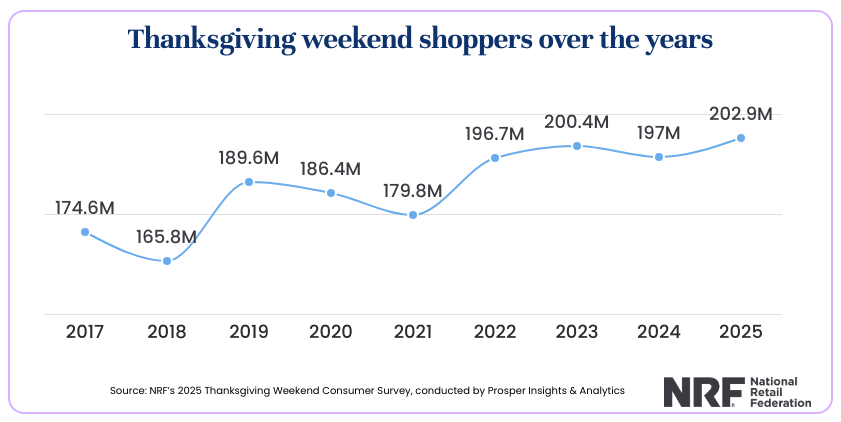
Overall, according to data released on Tuesday from the National Retail Federation, a record 202.9 million consumers shopped between Thanksgiving Day and Cyber Monday, up from 197 million shoppers during the same five-day period last year.
That figure surpassed a previous record of 200.4 million shoppers set in 2023, according to the NRF’s annual consumer survey, and exceeded the original estimate of 186.9 million shoppers.
“This year’s record turnout reflects a highly engaged consumer who is focused on value, responds to compelling promotions, and seizes upon the opportunity to make the winter holidays special and meaningful,” NRF President and CEO Matthew Shay said in a press statement.
Customers turned out in both in-store and online settings. The top shopping destinations during Thanksgiving weekend were supermarkets, with a 47% share of the sales. Other popular shopping spots included department stores at 40% and clothing outlets at 37%.
The NRF has forecasted that holiday spending between Nov. 1 and Dec. 31 will break $1 trillion for the first time in 2025.
OPINION: CONSUMERS LOVE TRUMP’S ECONOMY AS HOLIDAY SPENDING SOARS TO RECORD HIGHS
“American consumers may be cautious in sentiment, yet remain fundamentally strong and continue to drive U.S. economic activity,” Shay said. The NRF’s chief economist and executive director of research, Mark Mathews, agreed, noting that “the economy has continued to show surprising resilience in a year marked by trade uncertainty and persistent inflation.”
The Washington Examiner contacted Indivisible and the We Ain’t Buying It press teams for comment.
